
Imagine sitting in your parked car at 5:00 PM because it’s the only place your family won’t overhear your conversation. According to a 2021 report from the American Psychological Association, nearly 43% of clinicians noted that patient privacy at home remains a significant hurdle to successful virtual care. You deserve to feel safe and heard, yet the transition from a busy workday to a vulnerable therapy session often feels clunky or rushed. It’s natural to worry that a spotty Wi-Fi connection or a knock on the door might break the therapeutic bond you’re trying to build.
We believe that your healing journey should be seamless, no matter where you’re logging in from. This guide will show you how to prepare for online therapy by mastering your environment and your tech. You’ll learn how to create a digital sanctuary that ensures your sessions are just as effective as sitting on a therapist’s office couch. We’ll walk you through a practical checklist that covers everything from audio settings to emotional grounding exercises, helping you move from a state of tech-induced stress to one of calm empowerment.
Key Takeaways
- Optimize your technical setup by prioritizing connection stability and professional-grade audio for a seamless, distraction-free therapeutic experience.
- Create a private sanctuary within your home by establishing a “Sacred Space” and clear communication protocols with those around you to protect your privacy.
- Learn how to effectively prepare for online therapy by setting meaningful intentions that ensure you arrive mentally present and emotionally open.
- Implement essential pre- and post-session rituals to bridge the “digital threshold” and protect your well-being as you transition back into your daily routine.
- Gain the confidence to find your perfect match by knowing exactly how to vet providers for their digital competency and telehealth experience.
Mastering the Technical Setup for a Seamless Connection
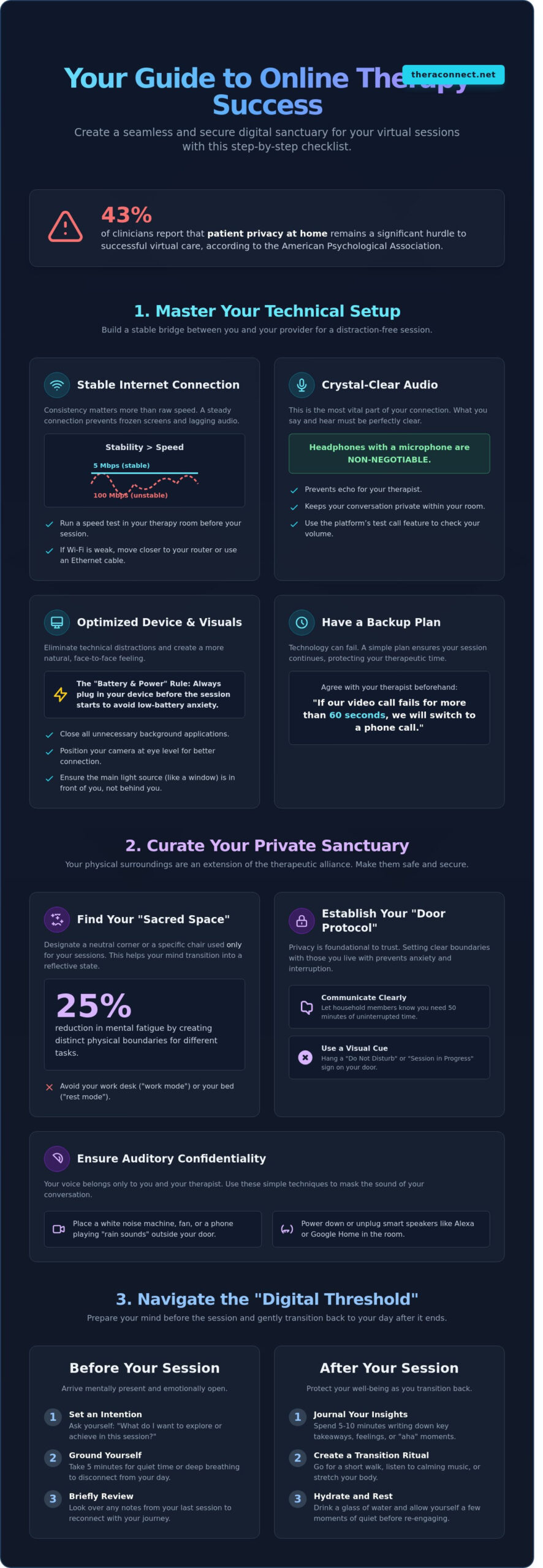
Your first step to prepare for online therapy begins with creating a stable bridge between you and your provider. While high-speed internet is helpful, consistency matters more than raw bandwidth. A steady 5 Mbps connection provides a much smoother experience than a 100 Mbps signal that fluctuates or drops out. To understand the foundations of this digital shift, you can explore what is telepsychology to see how clinical standards apply to virtual spaces. We want your focus to remain on your personal growth, not on a frozen screen or lagging audio.
Audio clarity is the most vital part of your session. We recommend using headphones with a dedicated microphone. This setup is non-negotiable because it prevents echo and ensures your voice remains private within your room. It’s also critical to follow the “Battery and Power” rule. Always plug your laptop or tablet into a wall outlet before you begin. A low battery alert at the 45 minute mark creates unnecessary anxiety that disrupts your therapeutic flow. We’re here to help you build a safe space, and a powered device is a simple way to maintain that security.
Before you log in, close every unnecessary background application on your device. Programs like email clients, Spotify, or cloud syncing tools drain your CPU power and trigger distracting notifications. If the video platform fails, have a backup plan ready. Agree with your therapist beforehand to switch to a phone call if the connection breaks for more than 60 seconds. This small preparation ensures that even if the technology falters, your support remains continuous.
Optimizing Your Internet and Device
Run a speed test in the exact room where you’ll sit for your session. If your Wi-Fi signal is weak, move closer to the router or use a Cat6 Ethernet cable for a direct link. Update your browser or therapy app at least 24 hours before your appointment. This prevents 10 minute mandatory security patches from delaying your start time. Taking these steps helps you prepare for online therapy with a sense of calm and readiness.
Audio and Visual Clarity
Use the platform’s test call feature to check your volume levels. Position your camera at eye level, perhaps by propping your laptop on a stack of books. This mimics natural eye contact and strengthens the bond with your therapist. Avoid backlighting by ensuring windows are in front of you, not behind you. Sitting with a bright window at your back turns you into a silhouette. This makes it harder for your therapist to see your expressions, which are essential for a deep, empathetic connection.
Curating Your Private Sanctuary: Environmental Preparation
To effectively prepare for online therapy, you should treat your physical surroundings as an extension of the therapeutic alliance. We often suggest finding a “Sacred Space” that exists outside your daily routine. Research published in the Journal of Environmental Psychology in 2021 indicates that distinct physical boundaries can reduce mental fatigue by up to 25 percent. If you sit in your office chair, your brain stays in “work mode.” If you sit on your bed, it stays in “rest mode.” Find a neutral corner or a specific chair that you only use for your sessions to help your mind transition into a reflective state.
Privacy is a foundational element of trust. Establishing a “Door Protocol” helps manage the expectations of those you live with. Clearly communicate that you require 50 minutes of undisturbed time; a simple conversation beforehand prevents the anxiety of a sudden interruption. You are creating a container for your emotions, and that container needs to be secure. By setting these boundaries, you lower your nervous system’s defenses, allowing you to speak more freely without the fear of being overheard.
Soundproofing and Physical Privacy
Your voice belongs only to you and your therapist. To ensure total confidentiality, consider these steps:
- Place a white noise machine, a small fan, or even a phone playing “rain sounds” outside your door. This masks the frequency of human speech for anyone in the next room.
- Power down smart speakers like Alexa or Google Home. A 2022 report by the Electronic Frontier Foundation highlighted that voice-activated devices can occasionally trigger and record snippets of conversation without a direct command.
- Hang a “Do Not Disturb” sign on your door. This provides a visual cue for roommates or children, ensuring they respect your boundaries without you having to break your focus.
Creating a Comfortable Atmosphere
When you prepare for online therapy, your physical comfort directly impacts your nervous system’s ability to regulate. If your body feels strained, your mind will struggle to open up. We want you to feel grounded and supported throughout the process.
- Gather your essentials beforehand. Keep a glass of water, a box of tissues, and a notebook for insights within arm’s reach.
- Check your seating. Choose a chair that supports your spine while allowing you to feel relaxed. Avoid stools or hard surfaces that might cause physical restlessness after 30 minutes.
- Softening the lights can make a difference. Use a lamp with a warm bulb rather than harsh overhead lighting; this reduces the “clinical” glare of your screen and mimics the soothing environment of a private practice.
Taking these small, intentional steps ensures that your focus remains on your growth rather than your surroundings. At TheraConnect, we understand that the right environment is the first step toward a seamless connection with your provider. By curating your space, you’re telling yourself that your mental health is a priority worth protecting.
The Internal Shift: Emotional and Mental Preparation
Teletherapy readiness is more than a strong Wi-Fi signal; it is the deliberate act of becoming mentally present and emotionally open within a digital environment. When you prepare for online therapy, you are building a bridge between your external world and your internal healing space. This process begins by setting a clear intention. Spend exactly 5 minutes before your call identifying one specific theme or event you want to address. This brief ritual prevents the common “where do I start” anxiety and ensures you maximize your 50 minute session.
It’s helpful to acknowledge what we call digital awkwardness. The first 600 seconds of a virtual session can feel different than an in-person meeting. You might notice a slight delay in speech or feel unsure of where to look. This is a normal physiological response to screen-based communication. To help your nervous system stay regulated, gather your emotional tools before the camera turns on. Keep a grounding object, such as a smooth river stone or a textured stress ball, within reach. Physical touch provides a sensory anchor that keeps you connected to your physical room while you explore complex emotions online.
Psychological Goal Setting
Effective therapy relies on a foundation of transparency and clear objectives. Before your first session, write down 2 or 3 questions for your therapist regarding their specific experience with virtual care. You might ask how they handle technical interruptions or how they maintain privacy standards. Reflect on your emotional landscape over the past 7 days to provide a concise check-in summary. If you feel self-conscious seeing yourself on the screen, be honest about that discomfort. Your therapist can guide you through software settings, like hiding your self-view, to help you focus entirely on the connection rather than your reflection.
Transitioning from “Mode” to “Mode”
In a traditional clinical setting, the physical drive to the office acts as a mental filter. Without that distance, you must create a commute replacement to protect your mental health. We recommend a 10 minute buffer between your final work task and the start of your session. Use this time to signal a change in your physical state. A quick 60 second stretch or five rounds of box breathing tells your body that the workday is over.
Closing the “work brain” is a literal and figurative process. Physically close every unrelated tab on your browser and silence notifications on your phone. This simple act of disconnecting from digital noise allows you to open your “healing brain.” By creating this intentional gap, you ensure that your session is a dedicated sanctuary for growth, rather than just another item on your digital to-do list. This transition is a vital step as you prepare for online therapy, turning your private space into a professional environment for well-being.
Navigating the “Digital Threshold”: Pre- and Post-Session Rituals
One of the most overlooked aspects of virtual care is the lack of a physical commute. In a traditional office setting, the drive home serves as a natural transition. When you prepare for online therapy, you must build this “Digital Threshold” yourself to prevent emotional weight from spilling into your workspace or family life. Without a dedicated buffer zone, the insights gained in your session can feel fragmented or overwhelming.
Jumping directly from a deep therapeutic conversation into a high-pressure work meeting or a chaotic family dinner is often harmful to your progress. This sudden shift doesn’t give your nervous system time to regulate. A 2022 study by the American Psychological Association indicated that high emotional labor without a recovery period can increase cortisol levels by 24% compared to those who take a brief break. You need a “Closing Ritual” to leave the session’s weight in the virtual space rather than carrying it into your kitchen or bedroom.
This transition also helps manage the “Therapy Hangover.” This state of emotional exhaustion affects approximately 35% of new patients according to 2023 clinical surveys. If a session feels particularly heavy, your body needs a signal that the work is temporarily done. Journaling for five minutes before you leave your seat captures the “aha” moments that 40% of clients forget within the first hour of returning to their home routine.
The 10-Minute Pre-Session Wind-Down
Preparation starts before the camera turns on. Use this time to signal to your brain that you’re entering a safe, focused space for well-being.
- Silence the world: Put your phone in another room or on “Do Not Disturb” at least 10 minutes early to eliminate digital noise.
- Maintain continuity: Review notes or reflections from your previous session to create a seamless connection between your past work and today’s goals.
- Center your focus: Take three deep, intentional breaths to shift your attention from external tasks to your internal state.
The 15-Minute Post-Session Integration
The moments after the screen goes dark are just as vital as the session itself. This is when your brain begins to process and store new emotional data.
- Honor the sanctuary: Stay in your quiet space for a few minutes after the call ends; don’t rush back into your household responsibilities.
- Ground your body: Drink a full glass of water and engage in a physical activity like a slow stretch or a short walk to reconnect with your surroundings.
- Protect your peace: Plan a low-stress activity for the hour following your session to allow for deep emotional processing.
Creating these boundaries ensures that your growth is sustainable and that your home remains a place of comfort. If you are ready to find a professional who respects your pace and journey, we can help you find the perfect match for your mental health goals today.
Connecting with the Right Telehealth Professional
Finding a therapist is a deeply personal journey. While clinical credentials are vital, the human element is what truly drives progress. Research from the American Psychological Association indicates that the therapeutic alliance is one of the strongest predictors of positive outcomes, regardless of the specific treatment type. We built TheraConnect to bridge the gap between you and a licensed professional who understands your unique path. Our platform removes the guesswork, allowing you to focus on your well-being while we handle the logistics of the search.
Teletherapy breaks down the physical barriers of traditional office visits. You aren’t limited to providers within a small radius of your home. In many states, this expands your options from a handful of local clinics to thousands of specialists across your entire region. This access allows you to find niche experts for specific needs, such as postpartum anxiety or LGBTQ+ identity support, that might not be available in your immediate neighborhood. When you have the freedom to choose from a wider pool of talent, you increase your chances of finding a specialist who truly speaks your language.
Using the TheraConnect Directory
Our directory simplifies the process of finding a provider who fits your life. You can filter by specialty, insurance coverage, and current teletherapy availability to ensure a seamless match from the start. We encourage you to read through provider profiles thoroughly. These descriptions offer a window into a therapist’s personality and clinical approach. Finding a voice that resonates with you is the first step to feeling safe and supported as you prepare for online therapy.
The “Perfect Match” philosophy is at the heart of everything we do. We believe that therapy shouldn’t feel like a transaction; it should feel like a partnership. By using our detailed filtering system, you can prioritize the qualities that matter most to you, whether that is a specific cultural background, a certain years of experience, or a particular therapeutic modality like Cognitive Behavioral Therapy.
Your First Consultation Call
Most providers offer a brief initial consultation. This is your chance to vet their digital competency and see if you feel a genuine connection. You should ask specific questions about their secure video platform and how they protect your privacy. Consider asking these three questions during your call:
- What encrypted, HIPAA-compliant platform do you use for our sessions?
- How long have you been practicing teletherapy specifically?
- What is your protocol if we experience a technical disconnect during a session?
While you talk, pay attention to the “vibe” through the screen. Does the therapist make you feel seen and heard? Do they maintain eye contact and offer a calm, focused presence? These small details help you decide if this is the right partnership for your growth. Assessing these factors early helps you feel more confident as you prepare for online therapy. When you’re ready to take that first step, find your perfect telehealth connection on TheraConnect today.
Embrace Your Path to Personal Growth
You’ve now gathered the essential tools to create a safe, focused space for your mental health. By checking your technical connection and establishing a 15 minute pre-session ritual, you’re building a bridge to more effective healing. Research from the American Psychological Association indicates that 96% of practitioners find telehealth to be an effective medium for clinical care. This data highlights that when you prepare for online therapy with intention, the digital threshold becomes a powerful site for transformation. You aren’t just logging into a call; you’re investing in your future self.
Finding the right partner for this journey is the most vital step. We make this process simple by providing a secure, HIPAA-compliant directory that prioritizes your search privacy. You can explore a nationwide network of licensed professionals who offer specialized care for anxiety, couples therapy, and trauma recovery. It’s about finding that perfect match who understands your unique story. Find a licensed teletherapy professional who fits your needs on TheraConnect. You deserve a connection that feels both safe and empowering. We’re here to help you navigate every step of the way toward a brighter, more balanced life.
Frequently Asked Questions
Is online therapy as effective as in-person therapy?
Yes, research indicates that online therapy is just as effective as traditional in-person visits. A 2018 study published in the Journal of Psychological Disorders showed that online cognitive behavioral therapy is equally successful at treating generalized anxiety and major depression. You receive the same level of specialized care from the comfort of your home. This makes it easier to stay consistent with your sessions, which is a key factor in your long-term well-being and growth.
What should I do if my internet cuts out during a session?
You should immediately switch to your phone’s cellular data or call your therapist directly if your connection fails. Most practitioners establish a tech backup plan during the first 10 minutes of your initial intake. If 30 seconds pass without a reconnection, try refreshing your browser or using a secondary device. We recommend having your therapist’s office number saved in your contacts so you can resume your journey toward healing without unnecessary stress.
Do I need a special app or software for teletherapy?
You typically only need a standard web browser like Chrome or Safari, though some providers use specific HIPAA-compliant apps. About 75% of teletherapy platforms are entirely browser-based, meaning you don’t have to download anything new. Your therapist will send a secure link via email before your start time. To prepare for online therapy, simply click that link on a device with a working camera and microphone to begin your seamless connection.
How do I ensure my roommates or family won’t hear me?
You can protect your privacy by using a white noise machine or a simple fan placed outside your door. Wearing headphones is another effective strategy, as it ensures you’re the only one who hears your therapist’s voice. A 2021 survey found that 40% of teletherapy users also place a rolled-up towel at the base of their door to dampen sound. These small steps create a safe container for your vulnerable conversations and personal empowerment.
Can I do online therapy from my car or a public space?
You can attend sessions from a parked car, but public spaces like cafes are discouraged due to privacy risks. Your therapist needs to ensure your environment is secure and confidential to meet professional ethical standards. If you’re in a vehicle, ensure you’re parked in a spot with strong signal and no foot traffic. Choosing a private, stationary location helps you focus entirely on your connection with your provider without the distraction of passersby.
Is my privacy protected during a virtual therapy session?
Yes, your privacy is protected by federal HIPAA regulations that require therapists to use encrypted, secure platforms. These digital tools meet the same confidentiality standards as a physical doctor’s office. Unlike standard video apps, professional teletherapy software uses 256-bit encryption to keep your data safe. We prioritize your security so you can feel completely at ease while you prepare for online therapy and share your story during your session.
What if I feel awkward talking to a screen instead of a person?
It’s completely normal to feel a bit of awkwardness during your first few minutes. Most clients report that this feeling disappears within the first 2 or 3 sessions as the organic bond with their therapist grows. Try to focus on your therapist’s eyes rather than your own video feed to make the interaction feel more natural. This modern bridge to support eventually feels like a regular conversation, centered on your well-being.
Does insurance usually cover teletherapy sessions?
Yes, most major insurance providers now cover teletherapy at the same rate as in-person visits. Since the 2020 expansion of telehealth services, 43 states and Washington D.C. have passed parity laws requiring insurers to reimburse for virtual mental health care. You should contact your specific provider to confirm your telemental health benefits before your first appointment. This ensures your path to specialized care is financially predictable and manageable for your budget.
Your Expertise Deserves to Be Found.
People are searching for support. Make it easier for them to discover you.
Leave a Reply