
Blog

  • Men’s Mental Health Awareness Month: Breaking the Stigma in 2026

    Men’s Mental Health Awareness Month: Breaking the Stigma in 2026


    June is Men’s Mental Health Awareness Month, and it runs alongside National Men’s Health Month, which many workplaces, clinics, and community groups already recognize. The two share a straightforward purpose: make it easier for men to say what is going on, and easier for the people around them to hear it without flinching.

    Men’s mental health is not a June-only subject. The month works more like a door left open. It gives families, friends, and employers a shared reason to check in, and it gives men an opening to bring up something they may have carried quietly for years.

    When Is Men’s Mental Health Awareness Month?

    June is the month most commonly tied to men’s mental health awareness. Mental Health America recognizes June as Men’s Mental Health Awareness Month, and June is also observed as Men’s Health Month, with organizations such as NAMI marking awareness events during that period.

    Men’s Health Week falls on June 14 to 21, which gives the month a natural midpoint for a workplace lunch-and-learn, a team conversation, or a personal check-in with someone who has gone quiet lately.

    You may also see November described as Men’s Health Awareness Month, and some sources connect November messaging with men’s mental health. Because organizations do not all align on the same calendar, it is worth checking a specific organization’s own event page before you plan anything around a particular month.

    Why a Month for Men’s Mental Health Exists

    Awareness months are not meant to rank one group’s struggles above another’s. They exist to close a specific gap. For men, one of the clearest gaps is willingness to reach out.

    Research cited by health systems has found that men tend to be more reluctant than women to seek help or treatment for mental health struggles. That reluctance is not a personality trait men are born with. It is learned, reinforced by expectations about how men are supposed to handle pain, and it can change.

    A dedicated month gives people a socially acceptable reason to raise the subject first. For a man who has been waiting for someone else to bring it up, that can make all the difference.

    What Keeps the Stigma in Place

    Stigma rarely announces itself. It shows up in small, ordinary moments that accumulate over years.

    • The assumption that talking about feelings is a sign of weakness.
    • The expectation that a man should solve his own problems without help.
    • Discomfort from friends or family when a man does open up.
    • The fear of being seen differently at work or in a social circle.
    • The belief that support is only for people whose problems are serious enough to earn it.

    Each of those beliefs makes the next conversation harder. Breaking them usually happens at a smaller scale than people expect. One honest exchange. One friend who does not change the subject. One appointment made without announcing it to anyone.

    supportive conversation
    Photo by https://kaboompics.com/ on Pexels

    Signs That May Deserve a Closer Look

    Men do not always describe distress as sadness. It can surface as irritability, a shorter fuse, restlessness, or a sense of being flat and disconnected. People close to a struggling man often notice changes before he names them himself:

    • Withdrawing from friends, family, or activities he used to enjoy.
    • Changes in sleep, appetite, or energy that persist.
    • Drinking more, or leaning harder on other substances.
    • Trouble concentrating, or feeling behind on everything.
    • Talk of hopelessness, or comments about being a burden.

    This list is not a diagnostic tool, and it is not a substitute for professional assessment. A licensed provider can help sort out what is actually going on and what would help. If someone is in immediate danger, contact emergency services or a crisis line right away.

    How to Start a Conversation With a Man You Care About

    The most common worry is saying the wrong thing. In practice, showing up matters more than wording. A few approaches tend to work better than others.

    1. Pick a low-pressure setting. A drive, a walk, or a shared task often feels easier than a face-to-face sit-down.
    2. Lead with what you have noticed, not with a diagnosis. “You seem worn down lately” lands better than “I think you’re depressed.”
    3. Ask one open question and then stay quiet. Silence gives him room to organize his thoughts.
    4. Skip the fixes. Advice offered too early can sound like proof that he should have handled it alone.
    5. Be steady if he brushes you off. Leave the door open and check in again later.
    6. Offer something concrete. Suggesting a specific next step, like helping him look up providers, is easier to accept than a general offer of support.

    men support group
    Photo by Tima Miroshnichenko on Pexels

    What Men Can Do for Their Own Mental Health

    Waiting for a crisis is not a strategy. Small, repeatable habits do more for mental health than one dramatic overhaul.

    Sleep and movement are the foundation, and they are usually the first things to slip when someone is struggling. Regular contact with people who know you well matters too, even when the conversation stays light. Naming what you feel, out loud or in writing, makes it easier to recognize patterns instead of being run by them.

    It also helps to separate “I am overwhelmed right now” from “something is wrong with me.” The first is a situation. The second is a story that keeps men from asking for help.

    Finding Support That Fits Your Life

    Men often delay therapy because they assume it will be expensive, inconvenient, or a poor fit. Modern options reduce most of those barriers. Many providers now offer telehealth sessions, which remove commute time and make it easier to see someone without explaining your schedule to anyone.

    TheraConnect is a free online directory that connects clients with licensed mental health providers across the United States. You can search by location, specialty, and session format, and listings include verified licenses, sliding scale options where available, and telehealth availability. Clients use the directory at no cost. If cost has been the reason you put this off, filtering for sliding scale providers is a reasonable first step rather than a last resort.

    If you are in crisis or thinking about harming yourself, contact emergency services or a crisis line immediately. A directory is a tool for ongoing care, not an emergency service.

    Ways to Take Part This June

    You do not need an official event to participate. Some simple options:

    • Check in on one man in your life who has been quieter than usual.
    • Share a resource, such as a directory or a local support group, without attaching a lecture to it.
    • Ask your workplace whether it plans anything for Men’s Health Week on June 14 to 21.
    • Talk about your own experience with therapy or counseling if you have one. Normalizing it does more than statistics.
    • Follow up in July. The men who need support in June still need it afterward.

    therapy session
    Photo by RDNE Stock project on Pexels

    After the Month Ends

    Awareness months fade, and the men who were struggling in June are still struggling in August. The lasting value of Men’s Mental Health Awareness Month is not the calendar slot. It is the habit it can start: checking in, listening without rushing to fix, and treating help as something a man uses rather than something he earns. That habit is worth keeping all year.

    Frequently Asked Questions

    Is Men’s Mental Health Awareness Month in June or November?

    June is the month most commonly recognized, with Mental Health America citing June as Men’s Mental Health Awareness Month and June also observed as Men’s Health Month. November is also described by some organizations as Men’s Health Awareness Month, with mental health messaging included. Because calendars differ, verify details with the specific organization hosting an event.

    Why is there a men’s mental health month?

    Awareness months target specific gaps rather than ranking anyone’s pain. Research cited by health systems shows men tend to be more reluctant than women to seek help or treatment for mental health struggles. A dedicated month creates a shared reason to raise the subject, which can make it easier for men to speak up and for others to start the conversation.

    Is men’s mental health overlooked?

    There is a real gap in how often men reach out for support, which is one reason awareness campaigns and dedicated events exist. Whether that gap feels overlooked depends on your community and the resources near you. What is clear is that reluctance to seek help is learned and changeable, not fixed.

    What are some examples of stigma men face?

    Common examples include the belief that talking about feelings is weak, the expectation that a man should fix his own problems alone, discomfort from others when he does open up, and fear of being seen differently at work. These beliefs build up over time and make each next conversation harder, even when support is available.

    How do I find a therapist who is a good fit?

    Start by filtering for what actually matters to you: location, specialty, session format, and cost. A directory such as TheraConnect lets you search by those criteria and see verified licenses, telehealth availability, and sliding scale options. If the first provider is not a fit, trying another is normal and not a failure.


  • Mental Health Awareness Colors and Their Meanings

    Mental Health Awareness Colors and Their Meanings


    Colors carry messages before anyone says a word. A green ribbon pinned to a jacket, a purple wristband on a teacher, a yellow shirt at a community walk: each one starts a conversation that many people find hard to begin out loud. For mental health advocacy, color gives supporters a shared, low-pressure signal that says I care about this, and I am safe to talk to.

    The tricky part is that awareness colors overlap. A single ribbon can stand for several causes, and the same shade can mean different things depending on who is wearing it. Here is a clear look at the colors most often tied to mental health, what they mean, and where the meanings blur.

    Why Color Works as an Awareness Tool

    Awareness ribbons became a simple, portable way for advocacy groups to signal support for a cause. A ribbon costs almost nothing, fits in a pocket, and can be worn by anyone from a teenager to a hospital administrator. That accessibility is the point. Someone who is not ready to give a speech about depression or anxiety can still wear a color and let others decide whether to ask about it.

    Color also works because it is visual and memorable. Campaigns lean on it for the same reason sports teams do: repetition builds recognition. Green ribbons, green logos, and green profile frames all reinforce one message over time. The color does not diagnose anyone or explain a condition. It signals openness, and that is enough to shift how a conversation starts.

    Green: The Primary Mental Health Awareness Color

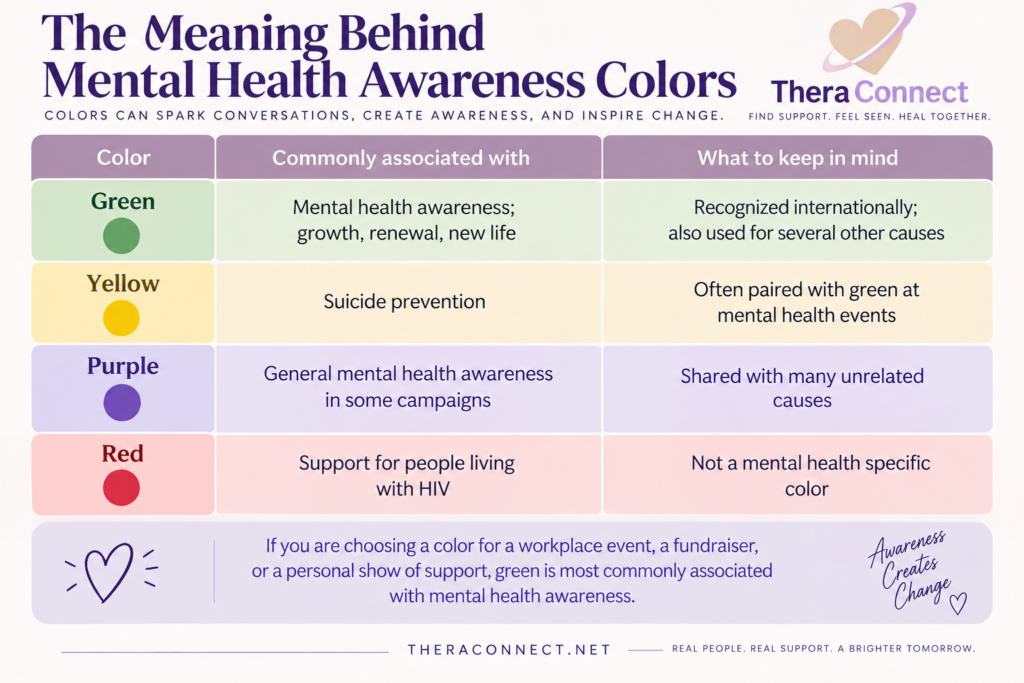
    Green is the designated color for mental health awareness. The green ribbon is recognized internationally as the symbol for mental health awareness, and it is the most common color you will see at mental health events, awareness month campaigns, and community fundraisers.

    Why green? The choice comes down to symbolism. Green represents new life, renewal, and growth, themes that are easy to find in nature and easy to apply to recovery. Someone moving through grief, burnout, or anxiety is often described as growing toward something steadier. Green captures that process better than a color associated with danger or alarm. It suggests that mental health is not a static state but something that keeps developing, and that people can move forward even after hard seasons.

    That symbolism is also practical. Green is calm and non-threatening, which matters when the goal is to get people talking rather than to shock them. A color tied to growth invites the person on the other side of the ribbon to ask a real question instead of changing the subject.

    What the Green Ribbon Means Beyond Mental Health

    Green is a crowded color in the awareness world. Green ribbons carry more than 30 different meanings, and mental health is only the most commonly championed one. Depending on the organization and the list you consult, green ribbons have also been used for bipolar disorder, cerebral palsy, and a range of other causes.

    This overlap is not a flaw in the system so much as a side effect of it. Dozens of causes share a small number of ribbon colors, and groups choose shades based on symbolism, tradition, or what is still available. The practical takeaway is simple: a green ribbon most often signals mental health awareness, but if you need to be certain about a specific campaign, ask the person or organization behind it. Context does the rest of the work.

    Yellow and Suicide Prevention

    Yellow is widely used for suicide prevention awareness. The color tends to read as warm and hopeful, which fits a message built around reaching out before a crisis and keeping people connected to support. You will see yellow in prevention campaigns, school programs, and memorial walks.

    Because suicide prevention sits inside the broader mental health conversation, yellow and green often appear together at the same events. That pairing is useful. Green speaks to mental health as a whole, while yellow points directly at prevention and the importance of checking in on someone who is struggling. If you are planning an event and want to cover both, using green as the base color with yellow accents keeps the message clear without confusing anyone.

    Purple, Red, and Other Colors You May See

    Purple has been used for general mental health awareness in some campaigns, though it is one of the most contested colors in the ribbon world because so many causes claim it. Red is a sign of support for people living with HIV, and it also appears in other advocacy spaces, so a red ribbon alone rarely tells you what someone is championing. Blue, teal, and silver show up in various campaigns as well, and their meanings shift depending on the organization.

    untitled design 2026 09 19t132357.818
    colors and their meanings

    If you are choosing a color for a workplace event, a fundraiser, or a personal show of support, green is the safest and most recognizable choice for mental health. Adding yellow is a reasonable next step if prevention is part of your message.

    How to Wear or Display an Awareness Color Respectfully

    Wearing a color is easy. Wearing it well takes a little thought, especially if you are not personally affected by a mental health condition.

    At events and in public

    Keep it simple. A green ribbon, a green shirt, or a green lanyard communicates the message without turning anyone into a walking billboard. If someone asks what it stands for, answer honestly and briefly, then leave room for them to share or to change the subject. The most helpful response to a disclosure is usually a version of thank you for telling me, not a list of advice.

    Online and at work

    Profile frames, banner images, and small desk items are gentle reminders that cost nothing and pressure no one. In a workplace, a green ribbon on a badge or a shared resource list in a break room can lower the threshold for someone to ask about support. Avoid using awareness colors as decoration unrelated to the cause. If green shows up on a party invitation in the same month as a mental health campaign, the signal gets muddled and people stop reading it.

    Color Is a Starting Point, Not a Substitute for Care

    A ribbon does not treat anything, and it is not meant to. What it can do is normalize the subject enough that someone feels less alone in bringing it up. That matters, because the gap between needing help and asking for it is often less about resources and more about stigma.

    If a color prompts you to finally say something out loud, the next step is finding the right support. Therapy is not one-size-fits-all. Some people want a provider who specializes in anxiety, some are navigating grief or relationship trauma, and some need evening telehealth sessions because of a work schedule. A directory that lets you filter by location, specialty, and session format keeps that search from turning into another source of stress. Take the first step at your own pace, and let the green ribbon be the nudge rather than the whole plan.

    Frequently Asked Questions

    What is the official color for mental health awareness?

    Green is the designated color for mental health awareness, and the green ribbon is recognized internationally as its symbol. The color was chosen for its association with new life, renewal, and growth, themes that fit recovery and long-term mental wellness. You will see green most often at awareness month campaigns, community walks, and fundraising events that support mental health organizations.

    What does the green awareness ribbon mean?

    The green ribbon is most commonly used to champion mental health awareness. It is not exclusive to that cause, though. Green ribbons carry more than 30 different meanings across the awareness world, and some lists also connect green to bipolar disorder and cerebral palsy. If you need to know what a specific green ribbon stands for, ask the organization distributing it.

    What color ribbon represents suicide prevention?

    Yellow is used for suicide prevention awareness. Because prevention falls within the broader mental health conversation, yellow and green frequently appear together at the same events and campaigns, with green representing mental health overall and yellow pointing specifically toward prevention, outreach, and checking in on people who may be struggling.

    Does wearing an awareness color actually make a difference?

    It can start conversations that would not otherwise happen. A visible color signals that you are open to the topic, which makes it easier for someone to ask a question or share something difficult. The color itself does not treat anything, but it lowers stigma, and lower stigma is what moves more people toward professional support when they need it.

  • How Much Does Therapy Cost? What to Ask About Fees and Insurance Before You Book

    How Much Does Therapy Cost? What to Ask About Fees and Insurance Before You Book

    f you’ve searched for a therapist and stopped at the price, you’re not alone. Cost is the number one reason people delay getting mental health support. The good news is that therapy fees are more flexible than most people expect, and a few direct questions can save you weeks of guessing.

    Here’s how pricing and insurance actually work, and exactly what to ask before you book.

    First, understand how TheraConnect works

    TheraConnect is a matching site. We connect you with mental health and wellness professionals across the country, but we are not the provider, and we don’t handle billing or set rates.

    Every professional listed on TheraConnect decides two things on their own:

    1. Their fee per session
    2. Whether they accept insurance, offer reduced rates, or both

    That means two providers with the same specialty can have very different prices. There’s no standard rate, and no “TheraConnect price.” Cost is always a conversation between you and the provider.

    How much does therapy cost per session?

    Across the U.S., private-pay therapy commonly runs anywhere from around $75 to $250 per session, with wide variation by location, credentials, and specialty. Providers in large metro areas and those with advanced specializations tend to charge more. Newer clinicians, group practices, and community-based providers often charge less.

    Many providers also offer sliding-scale fees, which means the rate adjusts based on what you can afford. Sliding-scale spots are limited, so it’s worth asking early.

    Who can take insurance, and who can’t

    This is the part most people don’t know, and it matters.

    Only licensed clinicians can bill insurance. That includes licensed therapists (LMFT, LCSW, LPC, LMHC), psychologists (PhD, PsyD), and psychiatrists. If a provider holds a state license, they may accept insurance, but it’s still their choice. Many licensed therapists don’t take insurance because of low reimbursement rates and paperwork demands.

    Coaches and wellness practitioners are private-pay. Life coaches, wellness coaches, and other non-licensed professionals can’t bill insurance. That doesn’t make them less valuable for the right goals, but it does mean you’ll pay out of pocket.

    If using insurance is important to you, filter for licensed therapists and psychologists, then confirm directly that they’re in-network with your plan. “Accepts insurance” and “in-network with your specific insurer” are not the same thing.

    The two questions to ask every provider

    Before you book a first session, ask these two questions. Ask them by email, phone, or during a free consultation call, whatever the provider offers.

    1. “What is your fee per session?”

    Get the number. Ask whether the first session (often called an intake) costs more, and whether they charge for missed or late-canceled appointments.

    2. “Do you take insurance or offer reduced rates?”

    If they take insurance, ask which plans and whether they’re in-network. If they don’t, ask about sliding-scale availability or a reduced rate for a set number of sessions. You can also ask for a superbill, a receipt you submit to your insurer for possible out-of-network reimbursement.

    If affordability is a concern, say so directly

    People often feel embarrassed to bring up money with a therapist. Don’t be. Providers hear this every day, and a good one would rather know your budget up front than have you disappear after two sessions.

    Try something simple: “I want to be upfront that cost is a concern for me. Is there a rate that could work?”

    The provider might offer a lower rate, suggest biweekly sessions instead of weekly, or refer you to a colleague or community clinic that fits your budget. Any of those answers moves you forward.

    Therapy should feel accessible, not out of reach.

    Other ways to lower the cost of therapy

    • Check your Employee Assistance Program (EAP). Many employers cover several free sessions per year.
    • Ask about telehealth. Some providers charge less for virtual sessions.
    • Look for training clinics. University counseling programs offer supervised therapy at reduced rates.
    • Use your HSA or FSA. Therapy with a licensed provider is typically an eligible expense.
    • Ask about session frequency. Every other week can be effective and cuts cost in half.

    How to find a provider on TheraConnect

    Search by specialty, location, and the type of support you’re looking for. Each listing shows the provider’s credentials so you can tell at a glance whether they’re licensed (and eligible to take insurance) or a coach or wellness practitioner (private-pay). Then reach out, ask the two questions above, and decide from there.

    Browsing is free and no account is needed. When you’re ready to be matched with a provider, you’ll create a free client account so we can connect you.

    untitled design 2026 09 15t120204.969

    FAQ

    Does therapy take insurance? Only licensed clinicians (therapists, psychologists, psychiatrists) can bill insurance, and each one decides whether to accept it. Always confirm your specific plan is in-network.

    How much is therapy without insurance? Private-pay sessions commonly range from about $75 to $250 depending on location and credentials. Sliding-scale rates can be lower.

    What is a sliding-scale fee? A reduced rate based on your income or ability to pay. Ask each provider whether they offer one.

    Can I use a life coach through insurance? No. Coaches aren’t licensed clinicians, so their services are private-pay.

    What should I ask a therapist about cost? Two questions: “What is your fee per session?” and “Do you take insurance or offer reduced rates?”

  • Complex PTSD (C-PTSD): Symptoms, Causes & How Trauma Can Affect You

    Complex PTSD (C-PTSD): Symptoms, Causes & How Trauma Can Affect You

    Complex PTSD can develop after prolonged or repeated traumatic experiences. Learn about C-PTSD symptoms, possible causes, how it differs from PTSD, and why trauma-informed mental care matters.

    Trauma doesn’t always happen once.

    For some people, trauma is a single devastating event. For others, it is repeated or prolonged—sometimes lasting months or years.

    It can happen during childhood or adulthood.

    Living through ongoing abuse, domestic violence, war, captivity, sexual violence, torture, trafficking, or other repeated traumatic experiences can have lasting effects on a person’s emotional health, relationships, sense of safety, and view of themselves. (Oxford Health NHS Foundation Trust)

    One condition associated with prolonged or repeated trauma is Complex Post-Traumatic Stress Disorder, commonly called C-PTSD.

    What Is Complex PTSD?

    Complex PTSD is related to PTSD, but it is a distinct condition.

    The World Health Organization recognizes Complex Post-Traumatic Stress Disorder as a separate diagnosis in ICD-11, the international classification system used for health conditions. (World Health Organization)

    C-PTSD can develop following particularly severe, prolonged, or multiple traumatic experiences in childhood or adulthood. Oxford Health gives examples including repeated abuse, torture, severe domestic violence, slavery, and genocide. (Oxford Health NHS Foundation Trust)

    That distinction is important.

    C-PTSD is not simply “childhood trauma.”

    A person can experience trauma at 8, 18, 38, 58, or any other age.

    What Can Cause C-PTSD?

    No single experience automatically causes C-PTSD.

    Possible sources of prolonged or repeated trauma include:

    • Childhood abuse or neglect
    • Domestic violence
    • Repeated physical or sexual assault
    • War or armed conflict
    • Torture
    • Captivity
    • Human trafficking
    • Slavery
    • Repeated exposure to violence
    • Severe and prolonged interpersonal abuse

    The NHS specifically identifies childhood abuse or neglect, ongoing domestic violence or abuse, and repeatedly witnessing violence or abuse among experiences that can be associated with C-PTSD. (nhs.uk)

    However, experiencing trauma does not automatically mean someone will develop C-PTSD or PTSD.

    People respond to traumatic experiences differently. The World Health Organization notes that most people exposed to potentially traumatic events do not develop PTSD. (World Health Organization)

    C-PTSD vs. PTSD: What’s the Difference?

    PTSD can occur after experiencing or witnessing a traumatic event or events.

    Common PTSD symptoms can include:

    • Flashbacks
    • Intrusive memories
    • Nightmares
    • Avoiding reminders of trauma
    • Feeling constantly on guard
    • Being easily startled
    • Difficulty sleeping
    • Anxiety
    • Feeling disconnected from yourself or the world

    These symptoms can sometimes appear immediately or months or even years after the traumatic experience. (nhs.uk)

    C-PTSD can include PTSD symptoms plus additional difficulties involving emotional regulation, self-worth, and relationships. (Oxford Health NHS Foundation Trust)

    This is one of the major differences between the two conditions.

    Common Symptoms of Complex PTSD

    C-PTSD can affect people differently, but some common difficulties include:

    Difficulty regulating emotions

    You may become overwhelmed by anger, fear, sadness, or anxiety and have difficulty calming yourself afterward.

    Some people experience the opposite and feel emotionally numb or disconnected.

    A negative view of yourself

    C-PTSD can involve persistent feelings of shame, guilt, worthlessness, defeat, or feeling fundamentally different from other people. (Oxford Health NHS Foundation Trust)

    Relationship difficulties

    You may want close relationships but struggle to trust other people.

    You might fear abandonment, have difficulty feeling emotionally close to someone, or expect relationships to eventually become unsafe.

    Hypervigilance

    You may constantly scan your surroundings for danger.

    A change in someone’s voice or behavior may immediately put you on alert.

    Avoidance

    You may avoid people, places, conversations, memories, or situations that remind you of the trauma.

    Dissociation or feeling disconnected

    Some people experience periods of feeling detached from themselves, their emotions, memories, or surroundings. Dissociation can occur in connection with traumatic experiences. (nhs.uk)

    C-PTSD Can Affect Relationships

    Trauma doesn’t stay neatly contained in one part of your life.

    It can affect how you relate to other people.

    Someone experiencing trauma-related difficulties may:

    • Have trouble trusting people
    • Fear abandonment
    • Struggle to establish boundaries
    • People-please to avoid conflict
    • Pull away when someone gets close
    • Become highly sensitive to rejection
    • Have difficulty communicating emotions
    • Feel unsafe even when a relationship is healthy

    These behaviors do not automatically mean someone has C-PTSD.

    There can be many explanations for these experiences, which is why professional assessment matters.

    Why Talking About Trauma Matters

    Trauma is more common than many people realize.

    The The Conversation article you provided, “More than half of Australians will experience trauma, most before they turn 17. We need to talk about it,” discusses the high prevalence of traumatic experiences and the importance of increasing awareness and conversation around trauma.

    The article is particularly useful for highlighting how frequently trauma can occur during childhood and adolescence—but it’s important to remember that trauma isn’t limited to childhood.

    People can experience traumatic events throughout their lives.

    And some people experience multiple traumatic experiences at different stages of life.

    Read the original article at The Conversation

    Can C-PTSD Be Treated?

    Yes.

    Having C-PTSD does not mean you are permanently damaged.

    Treatment can help people understand trauma responses, develop coping strategies, improve emotional regulation, strengthen relationships, and work through traumatic experiences.

    Oxford Health notes that treatment may need to be adapted to address difficulties such as emotional instability, dissociation, relationship problems, shame, guilt, and anger. (Oxford Health NHS Foundation Trust)

    The NHS also lists trauma-focused therapies, including trauma-focused CBT and EMDR, among treatments used for PTSD. A qualified clinician can determine what approach is appropriate for an individual’s situation. (nhs.uk)

    You Are Not Your Trauma

    Trauma can change how you see yourself.

    It can make you believe you’re broken, difficult, weak, or somehow responsible for what happened.

    But experiencing trauma isn’t a character flaw.

    And the ways you learned to survive difficult circumstances don’t make you a bad person.

    Sometimes behaviors that helped someone survive an unsafe situation can continue even after the danger is gone.

    Understanding those patterns can be an important step toward changing them.

    Your trauma may be part of your story. It does not have to become your entire identity.

    And you don’t have to figure it out alone.

    Mental-Care Disclaimer

    This article is for educational and informational purposes only and is not a substitute for professional mental-health care, diagnosis, or treatment. C-PTSD can only be properly assessed and diagnosed by a qualified professional. Experiencing trauma does not automatically mean someone has PTSD or C-PTSD.

    If trauma-related symptoms are affecting your relationships, work, daily life, or sense of safety, consider speaking with a qualified mental-health professional with experience in trauma-informed care.

    Sources

    SEO title: Complex PTSD (C-PTSD): Symptoms, Causes & Trauma Effects

    Meta description: What is Complex PTSD? Learn about C-PTSD symptoms, causes, prolonged trauma, PTSD differences, relationships, and trauma-informed mental care.

    Primary keyword: complex PTSD

    Suggested slug: /complex-ptsd-symptoms-causes-trauma/

  • Creative arts therapy programs can help health care workers dance, write and draw their way through burnout and on‑the‑job stress

    Creative arts therapy programs can help health care workers dance, write and draw their way through burnout and on‑the‑job stress

    Doctors and nurses seldom learn in school how to tell a family that their loved one is not going to survive. Yet health care professionals face the immense burden of tragedy, illness and dying in an intensely stressful setting as a routine, ongoing part of their jobs.

    Long before the COVID-19 pandemic, research was documenting rampant stress and burnout among health care professionals.

    The effects of this crisis are widespread in the U.S. In 2022, Surgeon General Dr. Vivek Murthy raised concerns about the alarming levels of burnout in the health care community in the midst of the COVID-19 pandemic.

    Studies show that if current trends continue, the U.S. will see a shortage of 1.1 million registered nurses, 3 million other health care workers and over 140,000 physicians by 2033. A 2022 Mayo Clinic study reported that only 58% of physicians would choose to become a doctor again if offered a chance to revisit their career choice, dropping from 72% from just one year before.

    An expressive note handwritten in black ink on white paper.
    Contribution of a study participant who chose to remain anonymous. CORAL

    For nearly two decades, our research group – a team of physicians, researchers, creative arts therapists and writers – has focused on understanding the impact of work-related stress on health care workers. In our experience, almost every health care worker has a story about navigating the times when the weight of the profession is just too much to bear.

    To help address this issue, in 2019, with funding from the National Endowment for the Arts, our team established the Colorado Resiliency Arts Lab, or CORAL. Our aim is to use creative arts therapy as an intervention to improve the well-being of health care professionals and to restore their sense of purpose in these demanding work environments.

    Read news based on evidence, not tweets or TikToks

    As physicians who have worked in critical care and emergency medicine for many years, we think that this incorporation of creativity in health care is vital. The nation’s health depends on the well-being of the health care workforce. We believe that incorporating creativity and the arts as a tool for building resiliency in health care workers could help shift the culture of emotional isolation that health care workers live in.

    Artistic rendering of three health care workers in different positions with words underneath expressing sorrow and exhaustion.
    ‘Dancing on a Tightrope’ − work from study participant about balancing a sick child and having to put on a brave face for family and work; feeling ashamed for being tired. CORAL

    A challenge long in coming

    We as health care workers push ourselves to the limits to learn new ways to enhance human health. The irony is that this often comes at the expense of our own physical, emotional and mental health. We learn to mask emotions and internalize all the negative events we see in health care. But that is unsustainable.

    In the 2000s, up to 80% of critical care nurses reported experiencing burnout or other forms of psychological distress. This was contributing to a high turnover rate, with 67% of nurses planning to leave their positions within three years. That was leading to a rise in health care costs, compassion fatigue among workers and diminished quality of care for patients.

    Then came the COVID-19 pandemic, which intensified the stress on health care workers: 3 in 5 physicians reported burnout during the height of the omicron variant in 2022.

    A combination of higher job demands, workload, job complexity, job pressure and intensive working time during the COVID‐19 pandemic increased stress among health care professionals and led to emotional exhaustion.

    Satisfaction with work-life balance dropped from 46.1% in 2020 to 30.2% in 2021.

    In the post-COVID-19 era, health care workers like us are at higher risk for anxiety, depression and post-traumatic stress disorder. Burned-out health care professionals are unlikely to seek professional treatment and, as a result, tend to experience heightened levels of substance use, depression and suicidal thoughts.

    A hand-drawn image with a person in the middle, colorful floral pattern on the left and black and white words on the right.
    A researcher’s view on impostor syndrome and the culture of not showing your feelings. CORAL

    Art as a way forward

    In ancient Greece and Rome, participation in the arts was “prescribed” for people with depression or anxiety. Likewise, for centuries, tribal communities have used dance, music and art to facilitate physical and mental healing in individuals.

    Our focus at CORAL has been on teaching health care workers how to use art-making to effectively process trauma and develop coping mechanisms through expression and community. We invite our participants, who include doctors, nurses, social workers, therapists and researchers, to tap into their authentic vulnerabilities and share stories they would not normally tell by using pen and paper, paintbrushes, guitars, songwriting and movement.

    From 2020 to 2023, we carried out six cohorts of our 12-week clinical trial of creative arts therapy interventions involving health care professionals working at least half-time. Participants were randomly assigned to one of four creative arts therapy groups: art, music, dance/movement and writing, with 12 weekly sessions lasting 90 minutes each.

    We measured participants’ levels of anxiety, depression, burnout, PTSD and job satisfaction through validated questionnaires and asked the same questions again after the conclusion of the intervention. We also measured those scores in a control group that did not take part in the intervention.

    https://www.youtube.com/embed/ihbd3NLLTcI?wmode=transparent&start=0CORAL has been providing arts therapy services for years, but the team’s recent study allows it to measure the healing power of art.

    The results were eye-opening. Study participants experienced less burnout and expressed a lower desire to leave their jobs. Burnout scores for anxiety, depression, PTSD and emotional exhaustion decreased by 28%, 36%, 26% and 12%, respectively, in the participants receiving the creative arts therapy intervention. These improvements remained up to one year after the conclusion of the program.

    Our findings add to the growing body of evidence that creative arts therapy can be an effective tool for dealing with health care worker burnout across the globe.

    We believe that creative art therapy is effective because it allows these health care professionals to be imperfect – freedoms that can be healing in and of themselves. They can use these opportunities to speak the unspeakable through an art form, which becomes a vehicle to help explore and recover from trauma.

    This in turn can increase their tolerance for imperfection as well as helping them to feel grace and compassion for themselves and each other. It expands their emotional vocabularies and, in so doing, builds their resilience.

    A handwritten expressive, poetic description of life as a nurse.
    A nurse’s reflection on constantly living in the extremes. CORAL

    Remembering what it means to be human

    Though the roles of doctors, nurses and other health care professionals are often glorified through terms such as “superheroes” and “guardian angels,” in reality they are human beings who make mistakes and get exhausted too.

    The creative process invites them to remember what it means to be human, to be vulnerable. A health care professional picking up a paintbrush for the first time since kindergarten can explore feelings that have been suppressed, memories that have been buried – and even forgiveness for mistakes they may have held onto for years.

    Artistic rendering of a circle with red paint dripping from the top.
    ‘Rawness Contained,’ by a physician participant of the creative arts intervention study. CORAL

    One participant in the CORAL program wrote in their feedback: “When I am given space to unmask and show all sides of who I am, I am creative and engaged. I think more deeply and clearly. I am more willing to take the risks necessary to have breakthroughs. I am a better colleague, mentor, friend, partner, and scientist. When I feel safe and supported, I can be whole.”

    A square box with the words 'Art & Science Collide' and a drawing of a lightbulb with its wire filament in the shape of a brain, surrounded by a circle.
    Art & Science Collide series.

    This article is part of Art & Science Collide, a series examining the intersections between art and science.

    You may be interested in: Literature inspired my medical career: Why the humanities are needed in health care

    I wrote a play for children about integrating the arts into STEM fields – here’s what I learned about interdisciplinary thinking

    Art and science entwined: This course explores the long, interrelated history of two ways of seeing the world

  • The rise of modern loneliness: 4 essential reads By Nick Lehr

    The rise of modern loneliness: 4 essential reads By Nick Lehr

    In early December, The Wall Street Journal published a feature titled “The Loneliest Generation.”

    “Baby boomers,” the article notes, “are aging alone more than any generation in U.S. history, and the resulting loneliness is a looming public health threat.”

    The irony is that – in the midst of this loneliness crisis – we’re closer and more connected than ever before. Americans are moving to cities in record numbers, while internet use and smartphone ownership continue to grow.

    What’s going on? Shouldn’t trends that ostensibly connect people and bring them closer together mitigate, not exacerbate, loneliness?

    The way the meaning of loneliness has shifted – from physical solitude, to psychological isolation – could offer some clues.

    Don’t let yourself be misled. Understand issues with help from experts

    This site is protected by reCAPTCHA and the Google Privacy Policy and Terms of Service apply.

    1. To stray ‘far from neighbours’

    When researching the Romantic poets, Amherst College English professor Amelia Worsley discovered that the concept of loneliness didn’t emerge until the late-16th century. It was first used to describe the dangers of straying too far from society – to surrender the protections of town and city and enter the unknown.

    To be lonely, according to one 17th-century glossary, was to be “far from neighbours.”

    2. New World loneliness

    As the first European explorers left their neighbors and ventured across the Atlantic, they didn’t know what they’d find. What awaited them in the New World, University of Southern California historian Peter Mancall writes, was left to the imagination: creatures with heads in their chests, brutes with a single, massive leg and cyclops.

    The Pilgrims didn’t encounter any of these monsters. But according to William Bradford, the first governor of Plymouth Colony, they nonetheless needed to contend with “a hideous and desolate wilderness, full of wild beasts and wild men.”

    While they had God and they had each other, there wasn’t much else. A Native American raid could wipe out the entire settlement; a single strain of disease could kill off the whole group.

    They were – in the earliest sense of the word – unbearably lonely.

    3. The wilderness of the web

    The Pilgrims, due to a combination of luck and skill, survived. Others soon joined them. Land was cleared, streets were laid and a country was built.

    Over the centuries, as people grew closer and more connected, the old definition of loneliness slipped away.

    “Modern loneliness,” Worsley writes, “isn’t just about being physically removed from other people. Instead, it’s an emotional state of feeling apart from others – without necessarily being so.”

    Much of this new form of loneliness seems connected to another world – cyberspace – that opened up at the end of the 20th century.

    Like the vast, untouched forests of the New World, the wilderness of the web can be imposing, unsparing and lawless. While there might not be literal monsters, trolls pounce, hackers lurk, governments spy and corporations glean data from your messages, searches and purchases.

    What – and who – can be trusted?

    4. A sea of information

    Yes, all of human knowledge is at our fingertips. But this has created another problem unique to the internet age: information overload.

    University of Nevada, Las Vegas sociologist Simon Gottschalk spent a decade studying the social and psychological effects of new information and communication technologies.

    “Our devices constantly expose us to a barrage of colliding and clamoring messages,” he writes. The unending stream of alerts and pings “deteriorates how we approach our everyday activities, deforms how we relate to each other and erodes a stable sense of self. It leads to burnout at one end of the continuum and to depression at the other.”

    The overwhelming sea of information creates a sense of being unmoored – tugged in one direction by tweets and advertisements, spun in another by breaking news alerts and email notifications.

    At the mercy of these forces, exposed to exploitation, unsure of whom to trust, it’s difficult not to feel small, to feel helpless – to feel alone.

  • Affordable Online Therapy Without Insurance

    Affordable Online Therapy Without Insurance

    A therapy copay may look manageable until it becomes a monthly bill, and for many people without insurance, the listed self-pay rate can make getting support feel out of reach. Affordable online therapy without insurance is possible, but it usually takes more than choosing the lowest number on a website. The goal is care you can continue, with a qualified therapist who is equipped to help with what you are carrying.

    Online therapy can remove practical barriers such as commuting, time away from work, and limited local options. It does not make therapy automatically inexpensive, though. Knowing where costs come from, what questions to ask, and when a lower-cost option is a good fit can help you make a confident decision.

    What affordable online therapy without insurance really means

    “Affordable” is personal. A graduate student working part-time, a parent managing household expenses, and a retiree on a fixed income may each have very different budgets. A session price that works for one person may be impossible for another. Rather than focusing only on the advertised rate, consider what you can reliably spend on mental health care each month without skipping essentials.

    It also helps to think beyond the cost of a single appointment. Therapy works best when there is enough consistency to build trust, identify patterns, and practice new skills between sessions. A lower session fee is valuable, but so is finding a schedule you can maintain. For some people, that means weekly appointments. For others, biweekly sessions, shorter check-ins, or a blended plan with a support group may be more realistic.

    The right fit depends on your needs. Someone looking for help with a recent life change may need something different than a person managing trauma symptoms, severe depression, or a long-standing relationship pattern. Be honest about both your budget and the kind of support you are seeking. Those details lead to better matches.

    Where lower-cost online care can come from

    Many licensed therapists offer sliding-scale rates, meaning the fee is adjusted based on income, financial circumstances, or available appointment times. Sliding scale is not a favor you have to earn. It is a common way providers make room for clients who are paying out of pocket. Availability varies, so it is worth asking directly whether a provider has reduced-fee openings or a waitlist for them.

    Some clinicians offer lower rates for sessions held at less popular times, such as weekday mornings or early afternoons. Others provide brief consultations that let you learn about their approach before committing to a first full session. A consultation is not therapy, but it can prevent you from paying for several appointments with someone who is not the right fit.

    Group therapy can also lower the cost per meeting while offering meaningful professional support. A well-run group is not a substitute for individual therapy in every situation, but it can be especially helpful for concerns such as anxiety, grief, life transitions, parenting stress, or building coping skills. Ask who facilitates the group, what its purpose is, and whether it is appropriate for your goals.

    Training clinics and community mental health programs may offer reduced-cost telehealth sessions with supervised clinicians. These options can be a good choice when cost is the primary barrier. Before enrolling, ask how supervision works, what happens if your needs change, and whether the program can provide referrals for more specialized care.

    Finally, a therapist-matching platform can save time by helping you identify providers who offer virtual care and work within your budget. TheraConnect connects clients with vetted mental health professionals, and signing up is free. Sharing your preferences early, including your budget range, helps make the search more focused and less exhausting.

    Look for value, not just the lowest session rate

    A low price is only helpful if the care is safe, appropriate, and usable. Before booking, confirm that the therapist is licensed or practicing under qualified supervision and can provide telehealth to clients in your state. Licensure rules matter because mental health providers are generally required to be authorized where the client is physically located during the session.

    You should also understand the provider’s experience with your concerns. You do not need to diagnose yourself before reaching out. Still, it is reasonable to ask whether they commonly work with anxiety, burnout, relationship challenges, grief, trauma, identity concerns, or whatever brings you to therapy. A therapist should be able to explain their approach in plain language and tell you if another level of care would be more appropriate.

    Privacy deserves the same attention. Ask whether sessions use a secure video platform, how records are handled, and what you should do if you lose connection during an appointment. Online therapy can be deeply personal, but it works best when you have a private place to talk and a plan for minimizing interruptions.

    Questions to ask before your first appointment

    Cost conversations can feel awkward, especially when you are already asking for help. They do not need to be. Clear financial information is part of informed care. Before you schedule, ask what a session costs, how long it lasts, and whether the fee changes after the first appointment.

    It is also wise to ask about cancellation policies, payment timing, and whether there are charges for forms, letters, messaging, or missed appointments. A provider may have a reasonable rate but a policy that does not work with an unpredictable work schedule or caregiving responsibilities. Knowing this upfront protects your budget and reduces stress later.

    You can keep the conversation simple: “I’m paying out of pocket and need to stay within a set monthly budget. Do you have any sliding-scale availability, lower-fee appointment times, or options that might fit?” The answer may be no, and that is okay. A transparent provider can still point you toward a more suitable option.

    Make online therapy sustainable at home

    The practical setup matters more than people expect. If possible, choose a regular appointment time and a private location where you can speak freely. Headphones, a charged device, and a backup plan for spotty internet can make sessions feel more secure. If privacy at home is difficult, consider whether a parked car, a private office, or another safe confidential space is available to you.

    Between sessions, use the support you are paying for. Keep a short note on recurring thoughts, stressful moments, sleep changes, or questions you want to raise. You do not need to complete homework perfectly for therapy to work. A few honest observations can help your therapist understand what is happening in your daily life and make each appointment more useful.

    If the first therapist is not a fit, do not assume therapy itself has failed. Fit can involve communication style, cultural understanding, scheduling, therapeutic approach, and financial reality. It is appropriate to say that you need a different style of support or to request another match. Finding the right person can take time, but it should not require settling for care that feels dismissive or unaffordable.

    When lower-cost therapy may not be enough

    Affordable care should never mean ignoring urgent needs. If you are in immediate danger, thinking about harming yourself or someone else, or unable to stay safe, call or text 988 in the United States for the Suicide & Crisis Lifeline, call 911, or go to the nearest emergency room. Online outpatient therapy is valuable, but it is not designed for every crisis.

    For ongoing concerns that feel intense or complicated, a therapist may recommend more frequent sessions, medication evaluation, specialized trauma treatment, or a higher level of care. That recommendation is not a failure on your part. It is a sign that your needs deserve the right kind of support.

    You do not have to prove that you are struggling “enough” before looking for help. Start with the budget you have, ask direct questions, and prioritize a qualified provider who treats your time and circumstances with respect. Check your options, get started with a focused match, and take one practical step toward care that can stay with you.

  • Why AI therapists could further isolate vulnerable patients instead of easing suffering By

    Why AI therapists could further isolate vulnerable patients instead of easing suffering By

    Nigel Mulligan

    Imagine a therapist could live in your pocket. They’d be on hand for every wobble, every meltdown, every crisis – no matter where or when. They’d be cheap and accessible, so no more worries about finding the money for expensive therapy or lingering on a waiting list for months for NHS treatment. Sounds too good to be true?

    Maybe, but few can deny the appeal of AI therapy, which uses artificial intelligence, like chatbots and digital platforms, to provide mental health support, guidance, coping strategies and structured exercises, often mimicking talk therapy.

    The growing popularity of AI therapy may be troubling some experts but it’s understandable why so many people are turning to this convenient and cost-effective resource for mental health support.

    In the UK, an NHS mental health referral can take 18 weeks or longer. According to 2025 data from the British Medical Association: “Services are not currently resourced to meet the increased demand, resulting in long waits and high thresholds for treatment; latest estimates put the mental health waiting list at one million people.

    It’s perhaps no wonder then that a growing number of young people, in particular, are turning to AI chatbots to help them cope with mental health issues. But, while AI can prove beneficial for some – often as a supplement to human therapy – it isn’t an effective substitute for a human therapist. And it could even prove dangerous.

    https://youtube.com/watch?v=d_gUVptaXyw%3Fwmode%3Dtransparent%26start%3D0

    Psychotherapy, known as the “talking cure”, uses dialogue to explore thoughts and feelings to help clients understand and address mental health challenges. Psychotherapists are now using AI tools to improve their work in mental health treatment. For example, software such as ChatGPT is being used by therapists to carry out client assessments. They enter details of the client, such as their sex, age, and psychological issues. In response, the chatbot collates the information to create a treatment plan for the therapist to follow.

    But, although AI is proving helpful for some therapists, people turning to chatbots for help with mental health crises might find the lack of human supervision and input far less useful.

    Lack of Humanity

    Chatbots can simulate empathy, but don’t understand or feel emotions. Human therapists can provide emotional nuance, intuition and a personal connection, which chatbots currently cannot replicate in a meaningful way. Chatbots also have a limited ability to understand complex emotions and can struggle with understanding the complexity of human emotions, particularly when the situation involves deep trauma, cultural context or complex mental health issues.

    Chatbots, then, are unsuitable for those with severe mental health issues. The software may provide some support for less severe cases, but they aren’t equipped to deal with severe mental health crises, such as suicidal thoughts or self-harm. Human therapists, however, are trained to recognise and respond to these situations with appropriate interventions.

    While chatbots can be programmed to provide some personalised advice, they may not be able to adapt as effectively as a human therapist can. Human therapists tailor their approach to the unique needs and experiences of each person. Chatbots rely on algorithms to interpret user input, but miscommunication can happen due to nuances in language or context. For example, chatbots may struggle to recognise or appropriately respond to cultural differences, which are an important aspect of therapy. A lack of cultural competence in a chatbot could alienate and even harm users from different backgrounds.

    So while chatbot therapists can be a helpful supplement to traditional therapy, they are not a complete replacement, especially when it comes to more serious mental health needs. Human psychotherapy provides a supportive, safe space for clients to slow down, reflect, and explore their thoughts and feelings with expert guidance. Human therapists are held accountable through ethical guidelines and professional standards.

    Chatbots, however, don’t have accountability structures in place, which may lead to inconsistent or inappropriate advice. Research has also raised concerns about the potential for privacy violations and security risks of sharing sensitive information with chatbot therapists.

    https://youtube.com/watch?v=NHCCRrlcJQc%3Fwmode%3Dtransparent%26start%3D0

    Some people might become overly dependent on chatbot therapists, potentially avoiding traditional therapy with human professionals. This could lead to a delay in receiving more comprehensive care when needed, making vulnerable people more isolated rather than easing their suffering.

    The talking cure in psychotherapy is a process of fostering human potential for greater self-awareness and personal growth. These apps will never be able to replace the therapeutic relationship developed as part of human psychotherapy. Rather, there’s a risk that these apps could limit users’ connections with other humans, potentially exacerbating the suffering of those with mental health issues – the opposite of what psychotherapy intends to achieve.

  • 7 Therapy Financial Assistance Options to Try

    7 Therapy Financial Assistance Options to Try

    The cost of therapy can feel like one more problem to solve when you are already carrying anxiety, grief, relationship stress, or burnout. Therapy financial assistance is not a single program or a one-size-fits-all solution. It is a group of options that can make care more manageable, depending on your income, insurance, location, and the type of support you need.

    You do not have to wait until your budget is perfect to start looking. Many therapists and mental health organizations expect cost to be part of the conversation. Asking about price is not awkward or selfish. It is a practical step toward finding care you can continue using.

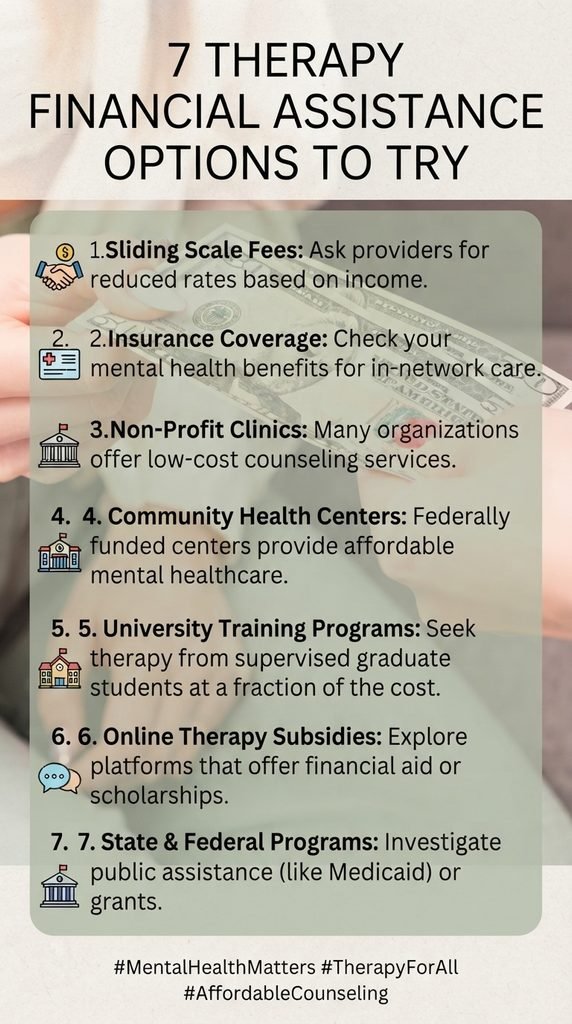
    1. Start with your health insurance benefits

    If you have health insurance, begin by reviewing your behavioral health or mental health benefits. Some plans cover therapy through a separate network or require you to use a specific virtual care provider. Others cover out-of-network therapy after you meet a deductible.

    Call the number on the back of your insurance card and ask direct questions: What is my copay for outpatient psychotherapy? Do I have a deductible to meet first? Do I need a referral or prior authorization? Is telehealth covered? Can I submit receipts for an out-of-network provider?

    The answers can make a meaningful difference. A plan with a low copay may be the most affordable route, but an in-network list is only helpful if providers are accepting new clients and are a good fit. If your preferred therapist is out of network, ask whether they can provide a superbill, which is an itemized receipt you may submit to your insurer for possible reimbursement.

    2. Ask therapists about sliding-scale fees

    A sliding scale means a therapist adjusts their session fee based on financial circumstances, often income, household size, employment status, or significant expenses. Not every provider offers one, and available spots may be limited, but it is always reasonable to ask.

    Be clear about what you can realistically afford per session. You do not need to share every detail of your finances. A simple statement such as, “My budget is closer to $60 per session. Do you have a sliding-scale opening or a lower-fee referral?” gives the therapist useful information.

    There can be trade-offs. A reduced rate may involve a waitlist, less flexible appointment times, or a limited number of sessions at that price. Still, a transparent conversation can help you avoid starting with a fee that becomes unsustainable after a few weeks.

    3. Check employee assistance programs

    Many employers offer an Employee Assistance Program, often called an EAP. These programs may include a set number of free short-term counseling sessions for employees, and sometimes for household members. They can also help with referrals for ongoing therapy, financial stress, caregiving concerns, or substance use support.

    EAP counseling is typically designed for immediate, short-term support. That can be especially helpful if you need someone to talk to now or want help clarifying what kind of therapist to seek. If you need long-term therapy, use those initial sessions to discuss a care plan and affordable next steps.

    Privacy concerns are common. In most cases, your employer receives general usage information, not the details of what you discuss in counseling. Ask the EAP directly how confidentiality works before you enroll so you understand the boundaries.

    4. Look into community mental health resources

    Community mental health centers, nonprofit counseling organizations, university training clinics, and local support agencies can provide lower-cost care. Some offer services based on income, while others receive public funding that helps reduce client fees.

    University clinics can be a strong option when they are supervised well. Graduate interns or doctoral trainees may provide therapy under the guidance of licensed clinicians. This often makes sessions more affordable, though availability and the length of care may vary with the academic calendar.

    You may also find specialized programs for veterans, survivors of violence, caregivers, LGBTQ+ clients, college students, or people managing specific health conditions. Specialized programs can be valuable because they understand the practical realities around a particular life experience. They may also have eligibility requirements, so check those before relying on a program for ongoing care.

    5. Consider federally supported and public coverage options

    Medicaid provides mental health coverage for eligible individuals and families, though eligibility rules and available providers differ by state. If you think you may qualify, it is worth applying even if you are unsure. A change in employment, income, family status, or disability status can affect eligibility.

    Medicare may also cover outpatient mental health services for eligible adults, including therapy from certain qualified providers. If you receive Medicare, confirm that a therapist accepts your specific plan and ask about any coinsurance or deductible responsibilities.

    For people without insurance, state and county behavioral health departments may offer assessments, referrals, crisis services, or reduced-cost treatment. These systems can sometimes involve paperwork and wait times, but they remain an essential source of therapy financial assistance when private care is outside your budget.

    6. Use a flexible spending account or health savings account

    If your employer offers a Flexible Spending Account, or FSA, you may be able to use pre-tax funds for eligible therapy expenses. A Health Savings Account, or HSA, can serve a similar purpose for people enrolled in qualifying high-deductible health plans.

    This does not lower the therapist’s stated fee, but it can lower the effective cost by allowing you to pay with money set aside before taxes. Confirm with your plan administrator that your therapy expense is eligible and keep any documentation you need for reimbursement.

    These accounts work best when you plan ahead. FSA funds may have annual rules about carryovers or deadlines, while HSA funds generally remain in the account. If therapy is something you expect to continue, including it in benefits planning can make monthly costs less surprising.

    7. Find care that fits both your needs and your budget

    The lowest session price is not always the best value if the therapist is unavailable, lacks experience with your concerns, or does not feel like a safe fit. At the same time, the most expensive option is not automatically better. Consistency, trust, clinical qualifications, and a sustainable payment plan matter more than a price tag alone.

    Online therapy can expand your choices by helping you connect with qualified providers beyond your immediate neighborhood, as long as they are licensed to work with clients in your state. It may also make scheduling easier when transportation, caregiving, disability, or work hours create barriers to in-person appointments.

    A matching platform such as TheraConnect can help you begin with factors that matter to you, including your preferences, concerns, availability, and budget. Before booking, ask about the full session rate, insurance participation, sliding-scale availability, cancellation policies, and whether the provider offers a brief consultation. Clear information upfront makes it easier to choose confidently.

    How to talk about cost without losing momentum

    Money can feel personal, especially when you are seeking support during a difficult season. But therapists routinely discuss fees, insurance, and payment arrangements. You can send a short message before a consultation or bring it up during the first call.

    Try asking: “What would I pay per session after insurance?” “Do you have any reduced-fee appointments available?” “If your rate is outside my budget, can you recommend another provider or program?” These questions protect your time and help prevent a stressful surprise after care has begun.

    If a therapist cannot lower their fee, that does not mean the conversation was a failure. They may know of colleagues with openings, group therapy programs, training clinics, or local funds that are not easy to find on your own. A good provider will treat affordability as a real part of access to care.

    A note on lower-cost alternatives

    Group therapy is often less expensive than individual sessions and can be highly effective for concerns such as anxiety, grief, relationship patterns, trauma recovery, or substance use. The group format is not right for everyone, particularly if privacy or individual attention is your main need, but it is worth considering.

    Support groups and peer-led communities can also reduce isolation. They are not a replacement for clinical therapy when you need diagnosis, treatment planning, or help with serious symptoms, but they can complement professional care. Ask about the group’s facilitator, confidentiality expectations, and whether it is intended as support, education, or treatment.

    If you are in immediate danger, thinking about harming yourself, or unable to stay safe, contact 988 in the United States for the Suicide & Crisis Lifeline, call 911, or go to the nearest emergency room. Financial concerns should never keep you from seeking urgent help.

    Finding affordable therapy may take a few calls, a benefits check, or time on a waitlist. That effort is not a reflection of how deserving you are of support. Start with the option that is available to you now, ask honest questions about cost, and give yourself permission to keep looking until care feels both helpful and possible to maintain.

    quick how to find money tor therapy
  • When Virtual Counseling Is Right for You

    When Virtual Counseling Is Right for You

    The moment you decide you want support can be the hardest part. Then come the practical questions: Can you get there after work? Will you feel comfortable in an office? Can you afford it? Virtual counseling can remove some of those barriers by bringing a qualified mental health professional into a private space that works for your life.

    For many people, meeting with a therapist online is not a lesser version of care. It is simply a different setting for the same purposeful work: talking honestly, building skills, understanding patterns, and making room for change. Still, it is not the right fit for every person or every situation. Knowing what to expect can help you choose care with confidence.

    What virtual counseling actually looks like

    Virtual counseling is therapy or mental health support provided remotely, most often through secure video sessions. Depending on the provider and the needs of the client, sessions may also involve phone calls or secure messaging. The therapist is still a trained professional who listens, asks thoughtful questions, offers evidence-based approaches, and works with you toward goals that matter to you.

    A typical session may look familiar if you have attended therapy before. You schedule a time, join from a private location, and speak with your provider one-on-one. You might discuss anxiety that has been building at work, grief after a loss, conflict in a relationship, or the exhaustion of trying to hold everything together. Your therapist may help you identify unhelpful thoughts, practice coping strategies, communicate more clearly, or notice progress that is easy to overlook.

    The screen changes the setting, not the need for trust. A strong therapeutic relationship still depends on feeling heard, respected, and understood. That is why the right match matters as much online as it does in person.

    Why online therapy can make care easier to start

    Accessibility is often the most immediate benefit. A virtual appointment can save the time and expense of commuting, which may make regular care more realistic for people with demanding jobs, caregiving responsibilities, limited transportation, or mobility concerns. It can also expand options for people who live in areas with fewer local providers.

    Convenience should not be mistaken for a lack of depth. Some clients find it easier to open up from a familiar room, especially in the first few sessions. Others appreciate being able to meet during a lunch break or after the kids are asleep rather than losing additional hours to travel.

    Affordability can also be part of the equation. Therapy costs vary based on a provider’s credentials, specialty, location, insurance participation, and session length. A good matching process helps you identify providers whose fees, availability, and approach align with your budget before you commit to an appointment.

    There are trade-offs, too. Virtual sessions require a reasonably reliable internet connection and a place where you can speak privately. If your home is busy or you worry someone may overhear you, that can make honest conversation difficult. Some people also prefer the ritual of leaving home and entering a dedicated therapy office. Neither preference is wrong.

    Who may benefit from virtual counseling

    Online therapy can support people working through a wide range of concerns. It is often a practical option for anxiety, depression, stress, life transitions, relationship challenges, grief, self-esteem concerns, and burnout. It may also work well for people who already know they want therapy but have delayed it because the logistics felt overwhelming.

    It can be especially helpful when consistency is the goal. Therapy tends to be more useful when you can attend regularly enough to build momentum. If traffic, travel, weather, or an unpredictable schedule have made in-person appointments hard to maintain, a virtual format may make it easier to keep showing up for yourself.

    That said, the best format depends on your circumstances, clinical needs, and preferences. Some clients benefit more from in-person care, particularly when privacy at home is limited or when a provider recommends a higher level of support. If you are experiencing immediate danger, thinking about harming yourself or someone else, or facing a mental health emergency, call 911 or 988 in the United States, or go to the nearest emergency room. Routine virtual therapy is not a substitute for emergency care.

    How to find a therapist you can trust

    Credentials matter, but they are only part of a good fit. Look for a provider who is licensed to practice in the state where you are located at the time of your session. Depending on their training, a therapist may be a psychologist, clinical social worker, licensed professional counselor, marriage and family therapist, or another qualified mental health professional.

    You should also consider whether the provider has experience with the issue that brought you to therapy. A therapist who works frequently with trauma may be a strong choice for someone processing difficult past experiences, while another provider may specialize in couples counseling, parenting, substance use, or anxiety disorders. Specialization is helpful, but you do not need to diagnose yourself perfectly before asking for support.

    A thoughtful matching platform can reduce the guesswork. TheraConnect connects clients with rigorously vetted mental health providers based on factors such as care needs, preferences, availability, and budget. Signing up is free for clients, which gives you room to explore options without adding another financial hurdle at the beginning.

    Before scheduling, ask practical questions. Is the provider accepting new clients? What is the session fee? Do they accept your insurance or offer a sliding scale? What platform do they use for video visits? How do they handle cancellations, communication between sessions, and privacy? Clear answers are a sign that the provider respects your time and your right to make an informed choice.

    Making your first online session feel more comfortable

    You do not need a perfectly styled home office or a polished explanation of everything you feel. You only need a private-enough space and a willingness to begin. If possible, use headphones, silence notifications, charge your device, and choose a spot where you can sit comfortably without interruption. A parked car, a private room, or another secure location may work when home is not an option.

    It can help to write down a few thoughts before the session. What has been hardest lately? What would feel different if therapy were helping? Is there anything you are nervous to bring up? You do not have to follow your notes closely, but they can give you a starting point if your mind goes blank.

    It is also okay if the first session feels a little awkward. You are meeting someone new and talking about personal parts of your life through a screen. Give yourself permission to name that discomfort. A good therapist will not expect instant trust. They will work with you to create it.

    What to do if the first match does not feel right

    Therapy is personal, and a qualified provider may still not be the provider for you. Perhaps their communication style feels too structured, their availability no longer works, or you do not feel understood after giving the relationship a fair chance. Changing therapists is not a failure, and it does not mean therapy cannot help.

    If you feel safe doing so, tell the provider what is not working. Sometimes a direct conversation leads to a useful adjustment in pace, goals, or approach. Other times, the clearest next step is to seek a different match. The goal is not to force a connection. It is to find support that helps you feel more capable, more grounded, and less alone.

    You deserve care that fits into your real life, not care that asks you to overcome every obstacle before you can receive it. Get started when you are ready, ask the questions that matter to you, and let the first appointment be one small, meaningful step forward.