
Blog

  • Psychology Today Alternatives for Therapists (2026)

    Psychology Today Alternatives for Therapists (2026)

    The good news: you don’t have to rely on one directory. This guide compares 9 Psychology Today alternatives for therapists and coaches in 2026, including what they cost, who they’re best for, and how to get more clients from whichever you choose.

    Quick answer

    The best Psychology Today alternatives for therapists in 2026 are:

    1. TheraConnect: best value for licensed therapists and experienced coaches, with a flat yearly price and SEO done for you
    2. GoodTherapy: best for therapists who want a verified listing plus CE courses
    3. TherapyDen: best for detailed filters and inclusive search
    4. Zencare: best for therapists who want vetting, professional photos and video
    5. Therapist.com: best low-cost add-on listing
    6. Headway: best for getting credentialed with insurance, no upfront fee
    7. Alma: best for insurance support plus a clinician community
    8. BetterHelp and Talkspace: best if you want clients handed to you and don’t mind lower control
    9. Google Business Profile: the best free listing every therapist should have

    Psychology Today alternatives compared

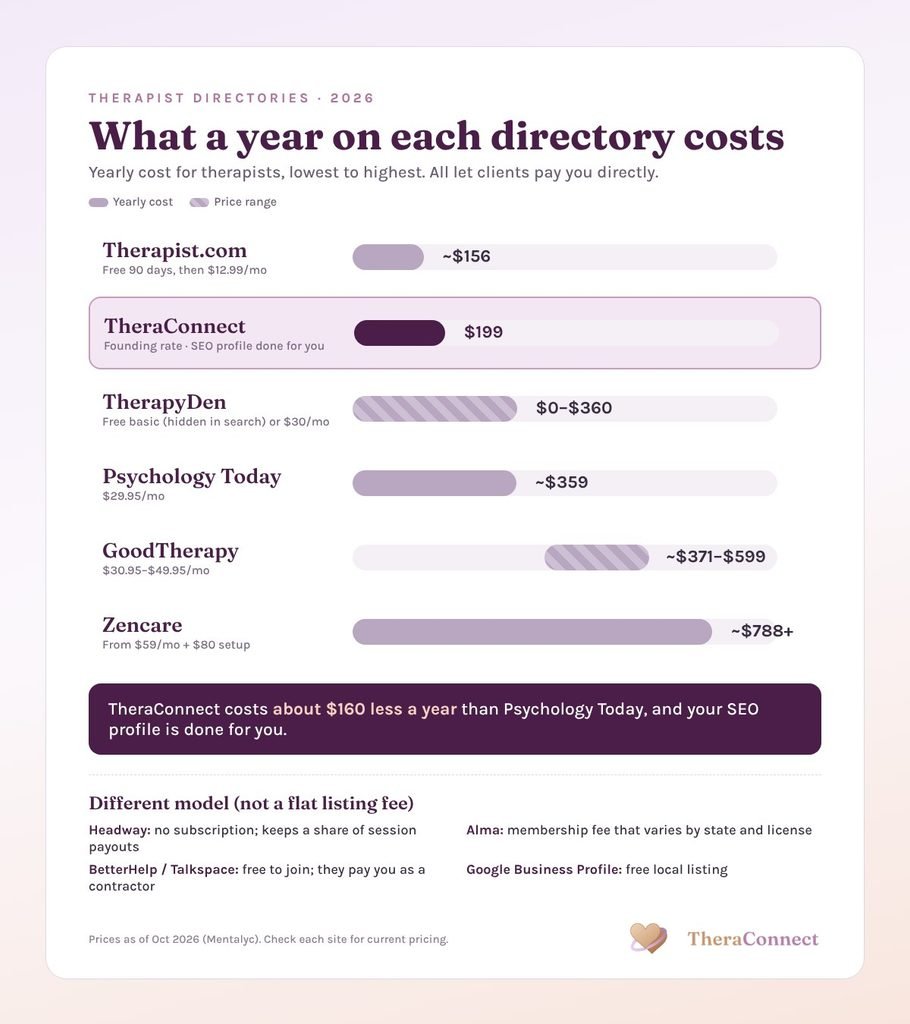
    Prices for therapists as of October 2026. Directories change prices often, so confirm on each site before you sign up.

    PlatformCost for therapistsAbout per yearHow you’re paidBest for
    Psychology Today$29.95/month~$359Clients pay you directlyName recognition
    TheraConnect$199/year (Founding rate)$199Clients pay you directly, 0% commissionTherapists and coaches who want SEO done for them
    GoodTherapy$30.95–$49.95/month~$371–$599Clients pay you directlyVerified listing + CE courses
    TherapyDenFree basic (not shown in search); $30/month premium$0–$360Clients pay you directlyDetailed, inclusive filters
    ZencareFrom $59/month ($69 in NY and CA) + $80 setup~$788+Clients pay you directlyVetting, photos and video
    Therapist.comFree for 90 days, then $12.99/month~$156Clients pay you directlyLow-cost extra listing
    HeadwayNo subscription; a share of session payoutsVariesInsurance, through HeadwayGetting in-network with insurance
    AlmaMonthly or yearly membership (varies)VariesInsurance and private payInsurance support + community
    BetterHelp / TalkspaceFree to join$0Paid by the platform as a contractorSteady caseload, less control
    Google Business ProfileFree$0Clients pay you directlyLocal search and Google Maps

    Why therapists look for sites like Psychology Today

    • Crowded results. In big cities, hundreds of profiles compete for the same searches.
    • Monthly cost with no guarantee. You pay every month whether or not anyone contacts you.
    • Little help standing out. You write your own profile and handle your own marketing.
    • No room for coaches. Many directories are built only for licensed clinicians.

    1. TheraConnect

    Best for: licensed therapists and experienced coaches who want more visibility without monthly fees.

    TheraConnect is a nationwide mental health and wellness directory built by the team behind FitnessHacksForLife.org, a 501(c)(3) wellness nonprofit. Instead of a monthly subscription, providers pay one flat yearly price.

    • Price: $199/year at the Founding Provider rate
    • Your own profile page, with SEO and meta tags set up by the TheraConnect team
    • 0% commission: clients contact and pay you directly, and you keep 100% of your fees
    • Shared with a 52K+ wellness community through FitnessHacksForLife
    • Lists experienced coaches alongside licensed therapists, psychologists and counselors

    Keep in mind: TheraConnect is newer than Psychology Today, so it has fewer providers. That also means less competition for your profile.

    2. GoodTherapy

    Best for: therapists who want a verified listing plus continuing education.

    • Price: $30.95–$49.95/month (Basic to Pro)
    • Pros: verified listings, CE courses, chances to publish articles; the Pro plan adds practice management tools
    • Cons: costs about the same as Psychology Today or more

    3. TherapyDen

    Best for: therapists who want clients to find them through detailed filters.

    • Price: free basic profile; $30/month for premium
    • Pros: filters such as ethnicity, faith familiarity and ADA accessibility
    • Cons: the free profile doesn’t show up in search results, and there are no client messaging or practice tools

    4. Zencare

    Best for: therapists who want a polished, vetted profile.

    • Price: from $59/month ($69 in New York and California), plus an $80 setup fee
    • Pros: vetting, marketing and SEO help, professional photos and video
    • Cons: the most expensive directory on this list

    5. Therapist.com

    Best for: a low-cost extra listing.

    • Price: free for 90 days, then $12.99/month
    • Pros: cheap, created by PESI, includes free CE trainings
    • Cons: smaller audience than the big directories

    6. Headway

    Best for: therapists who want to take insurance without doing the paperwork.

    Headway isn’t a directory in the usual sense. It credentials you with insurance companies and handles billing. There’s no subscription; instead, Headway keeps a share of session payouts, and insurance rates are set by its payer contracts.

    7. Alma

    Best for: insurance support plus a clinician community.

    Alma charges a monthly or yearly membership that varies by state and license type. Like Headway, it helps you get in-network with insurance, and it also supports private-pay clients.

    8. BetterHelp and Talkspace

    Best for: therapists who want clients sent to them and are fine working on someone else’s platform.

    Both are free to join. You work as an independent contractor and the platform pays you, but you have less control over your rates, schedule and client relationships than in your own practice.

    9. Google Business Profile

    Best for: every therapist, as a free extra.

    A free Google Business Profile puts your practice on Google Search and Maps. It won’t replace a directory, but it helps local clients find you, and reviews build trust.

    How to choose the right directory

    • You’re private pay and want more visibility: pick a flat-fee directory like TheraConnect, plus a free Google Business Profile.
    • You want to take insurance: look at Headway or Alma.
    • You serve a specific community: TherapyDen’s filters help clients find a good cultural fit.
    • You’re a coach: choose a directory that lists coaches, like TheraConnect. Many therapist directories don’t.
    • You’re on a tight budget: start with the free options (Google, a basic TherapyDen profile) and add one paid listing.

    Most therapists get the best results from two or three listings, not one.

    How to get more clients from any listing

    1. Use a warm, clear photo. A friendly headshot helps clients feel at ease before they reach out.
    2. Write to your ideal client, not your peers. Say “I help new moms who feel overwhelmed,” not a list of modalities.
    3. Name your specialties in the first two lines. That’s what clients see first.
    4. Say how to start. For example: “Book a free 15-minute call.”
    5. Reply within 24 hours. Clients often contact several therapists at once, so a fast reply stands out.
    6. Keep it current. Update availability and fees so clients don’t hit dead ends.

    Frequently asked questions

    What is the best alternative to Psychology Today for therapists? It depends on your practice. For private-pay therapists and coaches who want visibility at a flat price, TheraConnect costs $199/year at the Founding rate. For insurance-based practices, Headway and Alma are popular choices.

    How much does Psychology Today cost for therapists? As of October 2026, a Psychology Today listing costs $29.95 a month, about $359 a year.

    Are there free sites like Psychology Today? Yes. A Google Business Profile is free, TherapyDen has a free basic profile (though it doesn’t appear in search results), and Therapist.com is free for the first 90 days.

    Is it worth being on more than one therapist directory? Usually, yes. Different clients search in different places, so two or three listings plus a Google Business Profile reach more people than one directory alone.

    Can coaches list on therapist directories? Some can. Many directories are only for licensed clinicians, but TheraConnect lists experienced coaches alongside licensed therapists.

    How do therapists get clients online? Most combine directory listings, a Google Business Profile, a simple website and referrals. A clear profile that names your specialties and a fast reply to inquiries make the biggest difference.

    The bottom line

    Psychology Today isn’t your only option. If you want more visibility for less, a flat-fee directory like TheraConnect, a free Google Business Profile and one or two specialty listings can reach more clients than a single crowded profile.

    Ready to be found? Join TheraConnect for $199 a year at the Founding rate. Get your own profile page with SEO done for you, and keep 100% of your fees.

    Join TheraConnect →

    Sources Were Validated for Theraconnect. Check the others for their details.
    therapist directory cost comparison 2026
  • Is It Best to Ignore a Narcissist? What Happens & How to Do It

    Is It Best to Ignore a Narcissist? What Happens & How to Do It

    Ignoring a narcissist is one of the most powerful and effective strategies for protecting your mental health and breaking free from their control. Narcissists crave attention, drama, and emotional reactions — often referred to as “narcissistic supply.” When you stop providing that reaction, you significantly reduce their power over you.

    Many people are surprised to discover that ignoring a narcissist can be far more effective than arguing, explaining, or trying to reason with them. This approach is commonly known as the Grey Rock Method or strategic emotional detachment.

    In this guide, we’ll explain why ignoring a narcissist works, when to use it, how to do it correctly, the potential challenges, and how it fits into long-term healing from narcissistic abuse.

    For a deeper understanding of subtle manipulation, see our guide on Covert Narcissist Traits.

    Why Ignoring a Narcissist Works

    Narcissists need constant validation, admiration, or emotional energy to maintain their fragile self-esteem. They deliberately provoke strong reactions — anger, guilt, sadness, or even love — because any intense emotion feeds them.

    ZGInv 687x1024

    When you consistently ignore them:

    • You starve them of the narcissistic supply they desperately need.
    • Their manipulative tactics lose effectiveness.
    • They often lose interest and move on to an easier source of attention.
    • You regain control over your own emotions and energy.

    Ignoring is particularly powerful during the devaluation, discard, and hoovering phases.

    When You Should Ignore a Narcissist

    Ignoring works best in these situations:

    • After the relationship has officially ended (no-contact phase)
    • When they attempt to hoover you back in
    • During arguments or provocations
    • When they use silent treatment as punishment
    • In unavoidable situations like co-parenting or work (using a low-contact version)

    However, if you are still in a physically dangerous or abusive situation, prioritize safety first and seek professional help immediately.

    How to Effectively Ignore a Narcissist

    5 1024x559

    Here’s how to apply this strategy successfully:

    1. Go No-Contact When Possible Block them on all platforms — phone, social media, email. This is the cleanest and most effective form of ignoring.
    2. Use the Grey Rock Method Become emotionally boring and unresponsive. Give short, neutral, factual replies such as “Okay,” “Noted,” or “I’ll think about it.” Avoid emotions, explanations, or arguments. Learn the full technique in our guide: The Grey Rock Method.
    3. Don’t Engage with Bait Ignore insults, guilt trips, dramatic messages, or attempts to pull you into conflict.
    4. Maintain Strict Boundaries If complete no-contact isn’t possible (e.g., co-parenting), limit communication to facts only and document everything.
    5. Stay Consistent Narcissists will test boundaries repeatedly. Consistency is what makes ignoring effective over time.

    For additional tools on handling manipulation, explore Stop Manipulators: Simple Strategies to Regain Control.

    Challenges When Ignoring a Narcissist

    T 1024x559

    While powerful, ignoring a narcissist can come with challenges:

    • They may escalate with rage, smear campaigns, or intensified hoovering attempts.
    • You might experience guilt, anxiety, or trauma responses initially.
    • In shared custody or workplace situations, complete ignoring may not be realistic.

    In such cases, switch to low-contact and document all interactions. For family-specific strategies, see Dealing with a Narcissist in the Family.

    Healing After Ignoring a Narcissist

    Once you successfully start ignoring them:

    • Focus on rebuilding your self-worth and confidence.
    • Process the grief and trauma from the relationship.
    • Reconnect with supportive friends and family.
    • Consider working with a specialist through Therapist for Narcissistic Abuse.

    Understanding the broader patterns can help reduce self-blame. Read our guides on Narcissistic Discard Phase and Gaslighting in Relationships for more insight.

    Final Thoughts

    Ignoring a narcissist is not about being petty — it’s a strategic act of self-protection. By refusing to feed their need for drama and attention, you reclaim your power and create space for true healing.

    It may feel uncomfortable at first, but consistency brings freedom and peace. You deserve relationships built on respect, not manipulation.

    Frequently Asked Questions

    Is it best to ignore a narcissist?

    Often, yes. Narcissists feed on attention, both positive and negative. Ignoring them, or keeping contact minimal, takes away the reaction they want and protects your peace. If you can’t fully cut contact, as with a co-parent, coworker or family member, keep conversations short, calm and focused only on what’s necessary.

    What happens when you ignore a narcissist?

    At first, they may push harder. Expect guilt trips, flattery, anger or attempts to involve other people, sometimes called “hoovering.” When those don’t get a reaction, most narcissists lose interest and move on to someone else. Stay consistent, because giving in even once teaches them that pressure works.

    What if a narcissist ignores you first?

    Silence is often a control tactic, known as the silent treatment, meant to make you anxious and chase after them. You don’t have to fix it or apologize for something you didn’t do. Use the space to rest, reconnect with supportive people and decide which boundaries you want going forward.

    What is the grey rock method?

    The grey rock method means becoming as dull and unreactive as a grey rock. You give short, neutral answers, share no personal details and show little emotion. It’s useful when you can’t avoid a narcissist completely, because it gives them nothing to work with. If the relationship feels unsafe or overwhelming, a licensed therapist can help you build a plan. Find one on TheraConnect.

  • PhD vs PsyD vs LCSW: What Your Therapist’s Letters Mean

    PhD vs PsyD vs LCSW: What Your Therapist’s Letters Mean

    PhD, PsyD, LP, LCSW, LPC, LMFT. The letters after a therapist’s name can look like alphabet soup. But they tell you two important things: what training the provider has, and what the state allows them to do.

    This guide explains each credential in plain English, so you can choose the right provider with confidence. If you’re a mental health professional, it also shows how to list your own credentials correctly.

    Quick answer

    • Degree vs. license: A degree (PhD, PsyD, MSW) shows education. A license (LP, LCSW, LPC, LMFT) is what legally allows someone to provide therapy.
    • PhD: a research-focused doctorate in psychology.
    • PsyD: a practice-focused doctorate in psychology.
    • LP: Licensed Psychologist, the state license a PhD or PsyD needs to treat clients.
    • LCSW, LPC, LMFT: master’s-level licensed therapists who provide talk therapy.
    • MD: a psychiatrist, a medical doctor who can prescribe medication.

    The credential that matters most when choosing a therapist is the license, not the degree.

    PhD vs LP: What’s the Difference?

    A PhD is the degree a psychologist earns. An LP is the license that lets them practice. That’s why you’ll often see both together, as in “Jane Smith, PhD, LP.”

    PhD (Doctor of Philosophy) in psychology is a research-focused doctorate. It usually takes 5 to 7 years and includes coursework, clinical training, a dissertation and a supervised internship. Many PhD holders teach or do research. A PhD alone does not legally allow someone to treat clients.

    LP (Licensed Psychologist) is a license granted by a state board. In most states it requires a doctoral degree (PhD or PsyD), supervised clinical hours and a passing score on the national licensing exam, the EPPP. The LP is what allows a psychologist to diagnose, provide therapy and practice independently.

    What does “PhD, LP” mean? The person has a doctorate in psychology and is licensed by the state to treat clients.

    Good to know: In New York, “LP” stands for Licensed Psychoanalyst, a separate license. In Minnesota, some longtime LPs were licensed with a master’s degree under older rules. If you’re unsure, check the provider on your state licensing board’s website.

    PhD vs PsyD vs EdD: The Doctoral Degrees in Psychology

    Psychologists can earn one of three doctoral degrees. The PhD and PsyD are the standard routes to a psychology license, and they differ mainly in focus.

    • PhD (Doctor of Philosophy): combines research with clinical training. Common for psychologists who teach, do research or want a mix of research and practice.
    • PsyD (Doctor of Psychology): focuses on clinical practice rather than research. Most PsyD graduates become therapists or do psychological testing.
    • EdD (Doctor of Education) with a psychology focus: combines psychology with education and leadership. Common in school psychology and counseling roles. In some states it can lead to licensure.

    PhD or PsyD: which is better for clients? Neither. Both are licensed the same way and can provide the same therapy. What matters more is the provider’s experience with your concern and how comfortable you feel with them.

    Psychology Licenses: LP, LCP and LLP

    A doctorate doesn’t automatically make someone a psychologist who can see clients. The state license does. These are the license titles you’ll see most often:

    • LP – Licensed Psychologist: full license to provide psychological services independently.
    • LCP – Licensed Clinical Psychologist: the same idea; some states use this title to stress a clinical focus.
    • LLP – Limited Licensed Psychologist: used in Michigan. A limited license for master’s-level psychologists who practice under supervision, or for doctoral graduates still finishing their supervised hours.
    • LPA – Licensed Psychological Associate: used in states such as North Carolina and Texas for master’s-level providers who work under a licensed psychologist.

    Titles vary by state. If a credential is unfamiliar, look the provider up on your state licensing board’s website.

    For professionals: list your degree first, then your license, as in “Alex Johnson, PsyD, LP.” If you’re licensed in more than one state, keep each listing current. Listing credentials incorrectly, even by mistake, can raise ethical concerns with your licensing board.

    LCSW vs LPC vs LMFT vs MD: Other Letters You’ll See

    Most therapists in the US aren’t psychologists. They’re master’s-level licensed providers, and they’re fully qualified to provide therapy.

    • MD (or DO) – Psychiatrist: a medical doctor who specializes in mental health. Psychiatrists can prescribe medication, and many focus on medication management rather than talk therapy.
    • LCSW – Licensed Clinical Social Worker: a master’s in social work (MSW) plus supervised clinical hours. LCSWs provide therapy and often help clients connect with community resources.
    • LPC or LMHC – Licensed Professional Counselor / Licensed Mental Health Counselor: a master’s in counseling. The title depends on the state.
    • LMFT – Licensed Marriage and Family Therapist: a master’s focused on couples, families and relationships. LMFTs also see individuals.

    Therapist Credentials at a Glance

    CredentialWhat it isTypical educationProvides therapyPrescribes medication
    PhD / PsyD + LPLicensed psychologistDoctorate (5–7 years)YesNo (except in a few states with extra training)
    MD / DOPsychiatristMedical school + residencySometimesYes
    LCSWClinical social workerMaster’s (MSW)YesNo
    LPC / LMHCLicensed counselorMaster’s in counselingYesNo
    LMFTMarriage and family therapistMaster’s in MFTYesNo
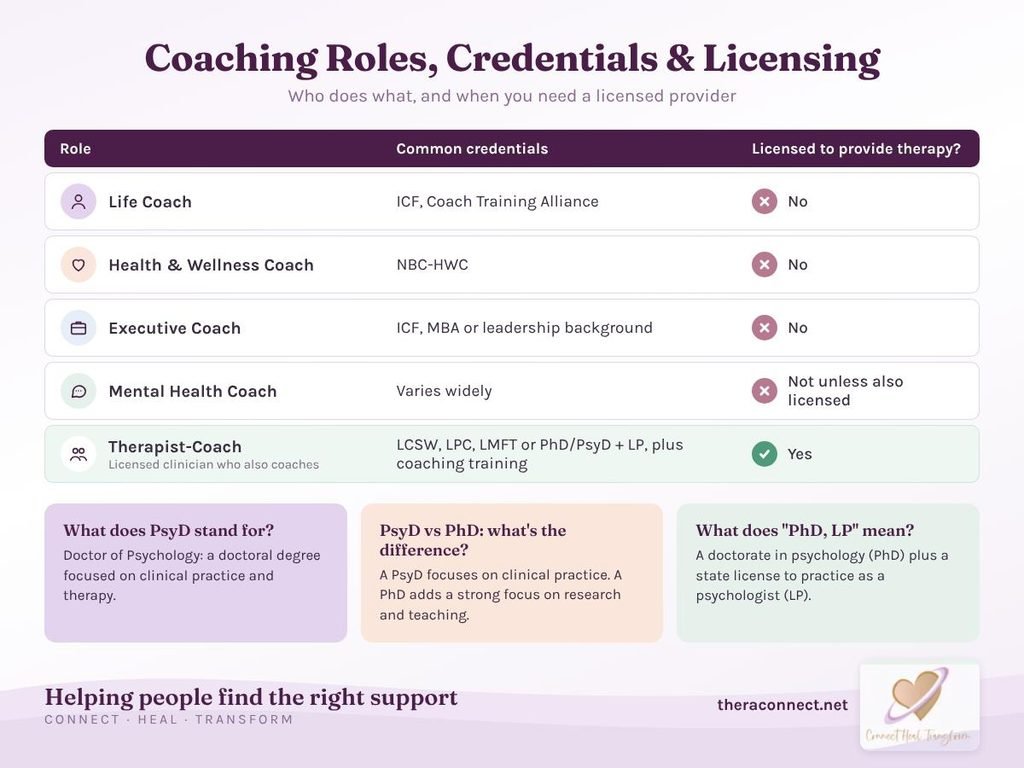
    Coach (ICF, NBC-HWC)Coach, not a clinicianCertification programNo (coaching, not therapy)No

    Key point: you don’t need a provider with a doctorate to get great care. A licensed LCSW, LPC or LMFT is fully qualified to treat anxiety, depression, trauma and relationship concerns.

    Coaches: What Their Credentials Mean

    Coaches help with goals, motivation and life changes. Coaching isn’t therapy, and no license is required. But experienced coaches often hold respected certifications.

    Type of coachCommon credentialsFocus
    Life or mindset coachICF certification (ACC, PCC, MCC), Coach Training AllianceGoals, confidence, accountability
    Health and wellness coachNBC-HWC (National Board for Health & Wellness Coaching); training from programs like Duke Health & Well-BeingStress, sleep, nutrition, exercise habits
    Executive or business coachICF certification, MBA or leadership backgroundLeadership, performance, career growth
    Mental health or wellness coachCoach certification; sometimes a psychology or social work backgroundSupport and skill-building, not treatment
    Mindfulness or spiritual coachMeditation or yoga teacher trainingMindfulness, meaning, inner calm

    ICF credential levels: ACC (Associate Certified Coach), PCC (Professional Certified Coach) and MCC (Master Certified Coach). CPCC (Certified Professional Co-Active Coach) comes from the Co-Active Training Institute.

    What coaches can’t do (unless they’re also licensed clinicians):

    • Diagnose or treat conditions like depression, anxiety or PTSD
    • Bill health insurance
    • Provide therapy

    How to Check a Therapist’s License

    1. Find your state’s licensing board for that profession (psychology, social work, counseling or marriage and family therapy).
    2. Search the board’s online license lookup by the provider’s name.
    3. Check that the license is active and see whether any disciplinary actions are listed.

    How to Choose the Right Provider

    • Want help with goals, habits or motivation? An experienced coach may be a good fit.
    • Dealing with anxiety, depression, trauma or relationship problems? Look for a licensed therapist: LCSW, LPC, LMFT or LP.
    • Need psychological testing, such as for ADHD or learning differences? Look for a licensed psychologist (PhD or PsyD + LP).
    • Think you may need medication? See a psychiatrist (MD or DO) or a psychiatric nurse practitioner.

    Frequently Asked Questions

    What does PhD, LP mean after a name? The person has a doctorate in psychology (PhD) and a state license to practice as a psychologist (LP).

    Is a PsyD a real doctor? Yes. A PsyD is a doctoral degree, so the holder is “Dr.” But a PsyD is not a medical doctor and usually can’t prescribe medication.

    Is an LCSW the same as a psychologist? No. An LCSW has a master’s degree in social work and is licensed to provide therapy. A psychologist has a doctorate and can also do psychological testing.

    What’s the difference between an LPC and an LCSW? Both are master’s-level licensed therapists. LPCs train in counseling; LCSWs train in social work, which adds a focus on community resources and social support.

    Can a therapist prescribe medication? Most can’t. Psychiatrists (MD or DO) and psychiatric nurse practitioners can. A few states let specially trained psychologists prescribe.

    Is a life coach the same as a therapist? No. Coaches help with goals and growth. Only licensed providers can diagnose or treat mental health conditions.

    The Bottom Line

    The degree tells you how a provider was trained. The license tells you what they’re allowed to do. For anxiety, depression, trauma or relationship struggles, look for a licensed provider (LP, LCSW, LPC, LMFT or MD). For goals and personal growth, an experienced coach can be a great fit.

    On TheraConnect, you can find both licensed therapists and experienced coaches nationwide, with every provider’s credentials listed on their profile.

    [Find a provider on TheraConnect →] (link to the Find a Provider page)

    Sources


    coaching roles credentials licensing
  • Therapy Intake Forms: What to Expect

    Therapy Intake Forms: What to Expect

    Starting therapy can feel hopeful, awkward, and a little intimidating all at once. If you’re wondering about therapy intake forms what to expect, you’re not alone. For many people, the paperwork before the first session feels like the most unfamiliar part – and sometimes the part that raises the most questions.

    The good news is that intake forms are not a test, and there are no perfect answers. They are simply a starting point. Therapists use them to understand who you are, what brought you in, and how to support you safely and effectively from the very beginning.

    Therapy intake forms: what to expect before your first session

    Most therapy intake forms cover a mix of practical details, mental health history, and current concerns. Some are short and straightforward. Others are more detailed, especially if a provider wants a fuller picture before meeting with you. In online therapy, these forms are usually completed through a secure portal before your appointment.

    You can expect questions about your contact information, emergency contact, insurance or payment details if relevant, and basic health history. Then the form usually moves into more personal topics, such as your symptoms, stress levels, past therapy experience, medications, relationships, work life, and goals for treatment.

    This can feel like a lot on paper. That does not mean your therapist expects you to explain your whole life story before you even say hello. In many cases, the form helps them avoid spending the first session on logistics alone, so they can focus more quickly on what matters to you.

    Why therapists ask for so much information

    A therapy intake form is partly administrative, but it is also clinical. Therapists are responsible for providing appropriate care, and that starts with context. If you mention panic attacks, a recent breakup, trouble sleeping, and a history of depression, your therapist begins to see patterns that may shape the first few conversations.

    They also need to understand any immediate safety concerns. Questions about self-harm, suicidal thoughts, substance use, trauma history, or major life instability can feel personal very quickly. Still, these questions are there for a reason. They help a therapist know whether your needs fit their scope of practice and whether any urgent support should be addressed right away.

    There is also a practical side. Intake forms often include consent to treatment, privacy policies, cancellation rules, telehealth information, and communication preferences. It may not be the emotional heart of therapy, but it helps set clear expectations. That clarity can make the process feel safer.

    What is usually included in therapy intake forms

    Every practice is a little different, but most intake forms ask for the same core categories. Personal details usually come first, including your name, date of birth, address, and the best ways to contact you. If you’re using insurance, there may be additional billing questions.

    Next comes background information. A therapist may ask about your physical health, current medications, previous diagnoses, past counseling or psychiatric care, and whether mental health conditions run in your family. Some forms also ask about sleep, appetite, energy, and concentration because those details can reveal quite a bit about your current state.

    You will probably also see questions about your daily life. This may include work, school, relationships, living situation, cultural background, and major stressors. These questions are not filler. Therapy does not happen in a vacuum, and your environment matters.

    Finally, many forms ask what brings you to therapy now. Sometimes this is a short written response. Sometimes it is a checklist of concerns like anxiety, depression, grief, trauma, burnout, relationship problems, or life transitions. If your reason feels hard to define, that is okay. You do not need perfect wording to begin.

    How honest do you need to be?

    As honest as you can be, with room for your own pace.

    That answer may sound simple, but real life is not. Some people are ready to be direct on day one. Others freeze when a form asks about trauma, substance use, or suicidal thoughts. If a question feels hard to answer, it is still better to respond as accurately as you can than to leave out something important out of fear of being judged.

    That said, intake forms are not the only chance to clarify your experience. If you write something brief and plan to explain it in session, that is completely normal. You might put, “I have anxiety and a lot of stress at home,” and then talk through the details later. Therapy is a process, not a one-time disclosure event.

    If you truly do not know how to answer, say that. Writing “not sure” or “hard to explain” is more helpful than forcing an answer that does not fit. A good therapist will understand the difference between reluctance, uncertainty, and avoidance, and will meet you with curiosity rather than pressure.

    What if the questions feel too personal?

    That reaction is common, especially if this is your first experience with mental health care. A form may ask about abuse, hospitalizations, sexual history, substance use, or thoughts of self-harm. Seeing those questions in writing can feel abrupt.

    It helps to remember that therapists ask these questions routinely, not because they assume the worst, but because they do not want to miss something important. Mental health care works better when the provider has a realistic picture of what is going on.

    You are still allowed to have boundaries. If a form requests details you are not ready to write out, you can often give a brief answer and note that you would prefer to discuss it in session. The trade-off is that less information upfront may mean your therapist needs more time in the first appointment to assess your needs. That is not a problem – it just shapes the pace.

    How to make filling them out less stressful

    Try not to complete intake forms in a rush, especially five minutes before your session. Give yourself a little quiet time if possible. Even ten or fifteen focused minutes can make the experience feel less overwhelming.

    Read each question once before answering. Some people get anxious and assume every response has to be polished or detailed. It does not. Most therapists are looking for useful, clear information, not perfect grammar or a dramatic personal narrative.

    If memory is a problem, estimate when needed. You may not remember the exact year you started having anxiety or the full list of medications you tried in college. Approximate answers are often enough to start. You can always update details later.

    It may also help to think in terms of your current top concerns. If you are unsure what to write in the goals section, start there. Maybe you want to sleep better, stop feeling on edge, manage grief, set boundaries, or feel less stuck. Clear goals can emerge over time, but even a rough starting point is helpful.

    What happens after you submit the forms

    Usually, your therapist reviews the intake before meeting you. That allows them to notice immediate concerns, prepare follow-up questions, and use your first session more thoughtfully. They may begin by checking something specific you wrote, such as recent panic attacks or a family conflict that feels urgent.

    Do not be surprised if they ask about information that was already on the form. That does not mean they did not read it. Written answers often need context, and therapy is about understanding your experience, not just collecting data.

    Sometimes the form also helps determine fit. If your needs require a level of care or specialty outside that therapist’s expertise, that may come up early. While disappointing in the moment, it is usually a sign of ethical care. The right match matters.

    For people using online platforms to find care, this part can feel more efficient when the process is built around thoughtful matching. At TheraConnect, the goal is to make that first step feel clearer and less intimidating by helping clients connect with vetted professionals who fit their needs and budget.

    A few things people worry about that usually are not a problem

    Many clients worry they will say too much, say too little, sound dramatic, or forget something important. All of that is normal. Intake forms are not there to measure whether you are “bad enough” for therapy or “good enough” at self-reflection.

    People also worry that a messy answer means they are starting therapy the wrong way. There is no wrong way to begin if you are showing up honestly. You can be uncertain, emotional, skeptical, hopeful, or all four at once.

    If you have been putting off therapy because the paperwork feels intimidating, that hesitation makes sense. But the form is not the hard part of healing – it is just the doorway. Once you are through it, the real work becomes a conversation, one step at a time.

  • Find a Therapist Near Me: How to Choose the Right Mental Health Professional

    Find a Therapist Near Me: How to Choose the Right Mental Health Professional

    Finding the right therapist can be one of the most important steps you take toward improving your emotional well-being. Whether you are struggling with anxiety, depression, relationship difficulties, trauma, grief, burnout, or simply feeling overwhelmed, professional mental health support can help you explore what you are experiencing and identify ways to move forward.

    But where do you start?

    With so many therapists, counselors, psychologists, and mental health professionals available, choosing the right person can feel confusing. You may be wondering whether you need a therapist, what credentials to look for, whether online therapy is right for you, or how to find someone who understands your particular concerns.

    The good news is that finding professional mental health support does not have to be complicated.

    TheraConnect is a mental care discovery directory designed to help individuals explore mental health professionals, review their specialties, and discover support options that fit their needs.

    Whether you are searching for a therapist near you or exploring online therapy, understanding your options can help you take the next step with greater confidence.

    Ready to start looking? Explore TheraConnect’s mental care directory to discover mental health professionals.

    Why Finding the Right Therapist Matters

    Mental health is an important part of overall well-being. Stress, anxiety, difficult relationships, grief, trauma, and major life changes can affect how you feel, think, work, and interact with others.

    Sometimes talking with friends or family provides comfort. Other times, professional support may be helpful.

    According to the National Institute of Mental Health (NIMH), psychotherapy can help people identify and change troubling emotions, thoughts, and behaviors. Different approaches are available depending on a person’s needs and circumstances.

    Source: NIMH – Psychotherapies

    Finding the right professional is about more than selecting the first name that appears in a search result. You want someone whose qualifications, experience, specialties, and approach are appropriate for your situation.

    A good starting point is to identify what kind of support you are looking for.

    What Type of Mental Health Professional Should You Look For?

    Not all mental health professionals have the same education, credentials, or scope of practice. Understanding the differences can help you narrow your search.

    1. Licensed Professional Counselors

    Licensed professional counselors provide counseling and mental health services within their state-authorized scope of practice.

    They may work with individuals experiencing:

    • Anxiety and chronic stress
    • Depression
    • Relationship difficulties
    • Life transitions
    • Emotional challenges
    • Self-esteem concerns

    2. Licensed Clinical Social Workers

    Licensed clinical social workers (LCSWs) have specialized training in social work and, when clinically licensed, can provide mental health services within their scope of practice.

    They may help individuals navigate:

    • Family challenges
    • Trauma and difficult experiences
    • Depression and anxiety
    • Relationship concerns
    • Major life transitions
    • Emotional and social difficulties

    3. Psychologists

    Psychologists have specialized education and training in human behavior, psychological assessment, and evidence-based psychological treatment.

    Depending on their training and licensing, psychologists may provide:

    • Psychological evaluations
    • Individual psychotherapy
    • Behavioral interventions
    • Support for anxiety and depression
    • Trauma-related treatment
    • Relationship and family support

    4. Psychiatrists

    Psychiatrists are medical doctors specializing in mental health.

    Depending on their qualifications and practice, they can evaluate mental health conditions, provide treatment, and prescribe medication.

    Someone who may need medication evaluation or management may wish to explore psychiatric services.

    5. Mental Health Coaches and Wellness Professionals

    Mental health coaches and wellness professionals may offer nonclinical support with personal development, stress management, goal setting, and emotional wellness.

    Coaching is not a substitute for licensed mental health treatment, diagnosis, or psychiatric care.

    Always understand a professional’s credentials, qualifications, and scope of practice before beginning services.

    The American Psychological Association provides additional information about psychotherapy and the qualifications of psychologists.

    How to Find a Therapist Near You

    Searching for a therapist near you can produce hundreds of results. Instead of contacting everyone, narrow your search by considering the following factors.

    Step 1: Identify What You Need Help With

    Start by identifying the concerns you would like to discuss.

    Some common reasons people seek mental health support include:

    • Anxiety and excessive worrying
    • Depression and persistent sadness
    • Narcissistic abuse and unhealthy relationships
    • Relationship and family conflicts
    • Trauma and difficult experiences
    • Grief and loss
    • Work-related stress and burnout
    • Low self-esteem
    • Life transitions
    • Emotional exhaustion

    You do not need to have a diagnosis to begin exploring professional support.

    Identifying your concerns can help you locate professionals whose experience aligns with what you are looking for.

    untitled design 2026 11 04t180447.864

    Step 2: Look for Relevant Specialties

    Therapists often have different areas of focus.

    For example, someone recovering from an emotionally abusive relationship may want to explore professionals experienced in trauma and relationship difficulties.

    Someone experiencing persistent anxiety may prefer a professional with experience in anxiety-related concerns.

    When reviewing profiles, look for information about:

    • Areas of specialization
    • Professional qualifications
    • Treatment approaches
    • Experience
    • Types of clients served
    • Online or in-person appointments

    The NIMH recommends considering a therapist’s experience, credentials, and treatment approach when evaluating potential providers.

    Source: NIMH – Psychotherapies

    Step 3: Verify Professional Credentials

    One of the most important parts of finding a therapist is confirming their qualifications.

    Licensing requirements vary depending on the profession and state.

    Before scheduling an appointment, consider checking:

    • Their professional license
    • Their licensing state
    • Their professional experience
    • Their areas of specialization
    • Whether they are authorized to provide services where you live

    You can use your state’s professional licensing board to verify credentials.

    The U.S. Department of Health and Human Services explains that behavioral health professionals providing telehealth must comply with applicable state licensing requirements.

    Source: HHS – Licensure for Behavioral Health

    Step 4: Decide Between Online Therapy and In-Person Counseling

    Another important decision is whether you prefer meeting with someone in person or online.

    Both options may be appropriate depending on your circumstances, the services offered, and the professional’s clinical judgment.

    Online therapy

    Online therapy may be convenient if you:

    • Have a busy work schedule.
    • Live far from mental health offices.
    • Have transportation difficulties.
    • Prefer receiving support from home.
    • Want to explore professionals outside your immediate neighborhood
  • Navigating Jealousy in Family Relationships:

    Navigating Jealousy in Family Relationships:

    Navigating Jealousy in Family Relationships:

    Jealousy within a family, a complex and often sensitive issue, can significantly impact the dynamics of family relationships. While it’s a typical emotional response, understanding its signs and learning practical strategies to manage it can help maintain harmony and strengthen familial bonds.

    Identifying Signs of Jealousy

    Jealousy often manifests subtly and can be overlooked until it escalates. One of the most apparent signs is a lack of enthusiasm for your achievements. When family members downplay or show indifference to your successes, it can be a sign of underlying jealousy. Another telltale sign is competitive behavior, where relatives attempt to outshine or belittle your accomplishments. This rivalry often stems from a place of insecurity and a desire to seek validation.

    Adverse reactions to advice or guidance can also indicate jealousy. In such instances, family members may perceive your suggestions as criticisms, responding with anger or defensiveness. Additionally, if interactions with certain family members consistently leave you feeling bad about yourself, it could be due to their jealous attitudes manifesting as excessive criticism or negative comments.

    Dealing with Jealous Relatives

    Addressing jealousy in family members requires a delicate balance of empathy and assertiveness. One practical approach is to limit the information you share, especially if it pertains to topics that trigger jealous reactions. While it might seem counterintuitive, sometimes not sharing every success or life update can prevent unnecessary tension.

    It’s also crucial to let go of any guilt associated with their jealousy. Remember, their emotional responses are not your responsibility, and you shouldn’t have to downplay your achievements to appease others. In cases where jealousy leads to toxic behavior, reducing your interactions with those family members might be necessary. This doesn’t mean cutting ties entirely, but instead setting boundaries to protect your emotional well-being. In severe cases, focus on managing emotions and stress, and consider distancing toxic family members.

    When Distance is Necessary

    In more severe cases, distancing yourself from family members who exhibit toxic jealousy might be the best course of action. Avoiding confrontations can prevent situations from escalating and causing further strain. Prioritizing your mental and emotional health is essential, and sometimes that means stepping back from relationships that are more harmful than beneficial.

    Understanding the Causes

    Jealousy often stems from deep-seated insecurities and a sense of inadequacy. In family settings, these feelings can be exacerbated by parental favoritism, perceived inequalities, or different life trajectories among siblings. Understanding these root causes is crucial in addressing and resolving jealous behaviors.

    Sibling Rivalry and Parental Influence

    Sibling rivalry is a common manifestation of jealousy within families. It can be fueled by parental influence, where perceived or actual favoritism creates competition and resentment among siblings. Additionally, siblings reaching life milestones at different times can spark feelings of jealousy, as comparisons become inevitable.

    Self-Reflection in the Face of Jealousy

    If you find yourself experiencing jealousy, it’s essential to acknowledge and address these feelings. Self-reflection can help you understand the reasons behind your jealousy and how to overcome it. Developing a sense of self-worth independent of others’ achievements and focusing on your personal growth can be effective strategies in combating jealousy.

    Conclusion

    Navigating jealousy in family relationships requires a nuanced understanding of its signs and causes. By adopting strategies to manage and address these feelings, either in ourselves or in relatives, we can foster healthier and more supportive family dynamics. Remember, while jealousy is a natural emotion, it doesn’t have to dictate the quality of our familial relationships.

  • Mental Health Awareness Colors and Their Meanings

    Mental Health Awareness Colors and Their Meanings


    Colors carry messages before anyone says a word. A green ribbon pinned to a jacket, a purple wristband on a teacher, a yellow shirt at a community walk: each one starts a conversation that many people find hard to begin out loud. For mental health advocacy, color gives supporters a shared, low-pressure signal that says I care about this, and I am safe to talk to.

    The tricky part is that awareness colors overlap. A single ribbon can stand for several causes, and the same shade can mean different things depending on who is wearing it. Here is a clear look at the colors most often tied to mental health, what they mean, and where the meanings blur.

    Why Color Works as an Awareness Tool

    Awareness ribbons became a simple, portable way for advocacy groups to signal support for a cause. A ribbon costs almost nothing, fits in a pocket, and can be worn by anyone from a teenager to a hospital administrator. That accessibility is the point. Someone who is not ready to give a speech about depression or anxiety can still wear a color and let others decide whether to ask about it.

    Color also works because it is visual and memorable. Campaigns lean on it for the same reason sports teams do: repetition builds recognition. Green ribbons, green logos, and green profile frames all reinforce one message over time. The color does not diagnose anyone or explain a condition. It signals openness, and that is enough to shift how a conversation starts.

    Green: The Primary Mental Health Awareness Color

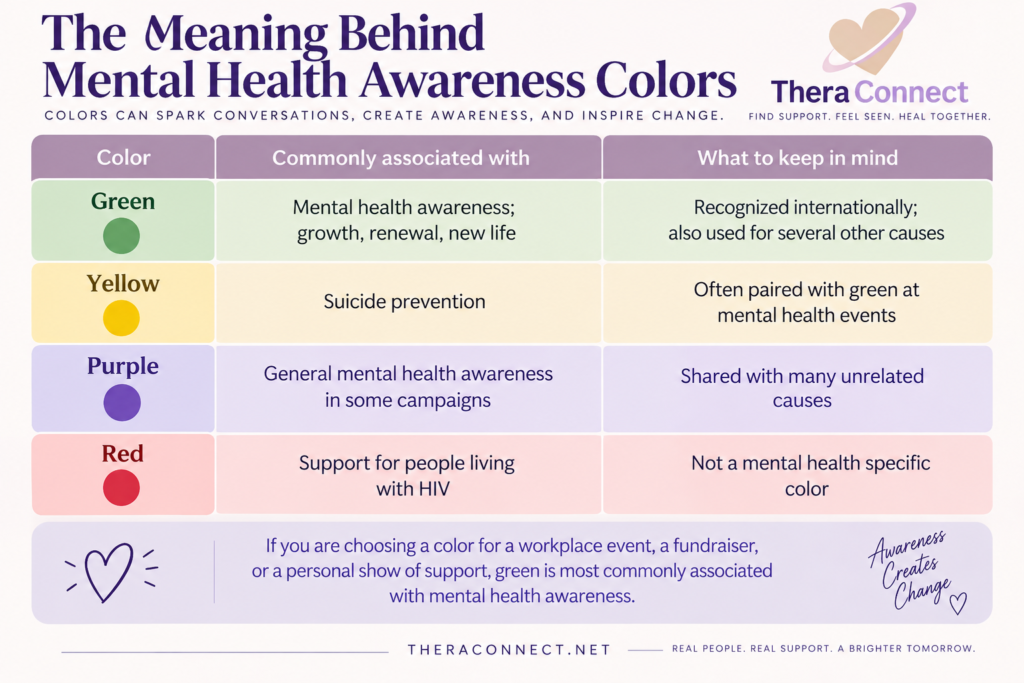
    Green is the designated color for mental health awareness. The green ribbon is recognized internationally as the symbol for mental health awareness, and it is the most common color you will see at mental health events, awareness month campaigns, and community fundraisers.

    Why green? The choice comes down to symbolism. Green represents new life, renewal, and growth, themes that are easy to find in nature and easy to apply to recovery. Someone moving through grief, burnout, or anxiety is often described as growing toward something steadier. Green captures that process better than a color associated with danger or alarm. It suggests that mental health is not a static state but something that keeps developing, and that people can move forward even after hard seasons.

    That symbolism is also practical. Green is calm and non-threatening, which matters when the goal is to get people talking rather than to shock them. A color tied to growth invites the person on the other side of the ribbon to ask a real question instead of changing the subject.

    What the Green Ribbon Means Beyond Mental Health

    Green is a crowded color in the awareness world. Green ribbons carry more than 30 different meanings, and mental health is only the most commonly championed one. Depending on the organization and the list you consult, green ribbons have also been used for bipolar disorder, cerebral palsy, and a range of other causes.

    This overlap is not a flaw in the system so much as a side effect of it. Dozens of causes share a small number of ribbon colors, and groups choose shades based on symbolism, tradition, or what is still available. The practical takeaway is simple: a green ribbon most often signals mental health awareness, but if you need to be certain about a specific campaign, ask the person or organization behind it. Context does the rest of the work.

    Yellow and Suicide Prevention

    Yellow is widely used for suicide prevention awareness. The color tends to read as warm and hopeful, which fits a message built around reaching out before a crisis and keeping people connected to support. You will see yellow in prevention campaigns, school programs, and memorial walks.

    Because suicide prevention sits inside the broader mental health conversation, yellow and green often appear together at the same events. That pairing is useful. Green speaks to mental health as a whole, while yellow points directly at prevention and the importance of checking in on someone who is struggling. If you are planning an event and want to cover both, using green as the base color with yellow accents keeps the message clear without confusing anyone.

    Purple, Red, and Other Colors You May See

    Purple has been used for general mental health awareness in some campaigns, though it is one of the most contested colors in the ribbon world because so many causes claim it. Red is a sign of support for people living with HIV, and it also appears in other advocacy spaces, so a red ribbon alone rarely tells you what someone is championing. Blue, teal, and silver show up in various campaigns as well, and their meanings shift depending on the organization.

    untitled design 2026 09 19t132357.818
    colors and their meanings

    If you are choosing a color for a workplace event, a fundraiser, or a personal show of support, green is the safest and most recognizable choice for mental health. Adding yellow is a reasonable next step if prevention is part of your message.

    How to Wear or Display an Awareness Color Respectfully

    Wearing a color is easy. Wearing it well takes a little thought, especially if you are not personally affected by a mental health condition.

    At events and in public

    Keep it simple. A green ribbon, a green shirt, or a green lanyard communicates the message without turning anyone into a walking billboard. If someone asks what it stands for, answer honestly and briefly, then leave room for them to share or to change the subject. The most helpful response to a disclosure is usually a version of thank you for telling me, not a list of advice.

    Online and at work

    Profile frames, banner images, and small desk items are gentle reminders that cost nothing and pressure no one. In a workplace, a green ribbon on a badge or a shared resource list in a break room can lower the threshold for someone to ask about support. Avoid using awareness colors as decoration unrelated to the cause. If green shows up on a party invitation in the same month as a mental health campaign, the signal gets muddled and people stop reading it.

    Color Is a Starting Point, Not a Substitute for Care

    A ribbon does not treat anything, and it is not meant to. What it can do is normalize the subject enough that someone feels less alone in bringing it up. That matters, because the gap between needing help and asking for it is often less about resources and more about stigma.

    If a color prompts you to finally say something out loud, the next step is finding the right support. Therapy is not one-size-fits-all. Some people want a provider who specializes in anxiety, some are navigating grief or relationship trauma, and some need evening telehealth sessions because of a work schedule. A directory that lets you filter by location, specialty, and session format keeps that search from turning into another source of stress. Take the first step at your own pace, and let the green ribbon be the nudge rather than the whole plan.

    Frequently Asked Questions

    What is the official color for mental health awareness?

    Green is the designated color for mental health awareness, and the green ribbon is recognized internationally as its symbol. The color was chosen for its association with new life, renewal, and growth, themes that fit recovery and long-term mental wellness. You will see green most often at awareness month campaigns, community walks, and fundraising events that support mental health organizations.

    What does the green awareness ribbon mean?

    The green ribbon is most commonly used to champion mental health awareness. It is not exclusive to that cause, though. Green ribbons carry more than 30 different meanings across the awareness world, and some lists also connect green to bipolar disorder and cerebral palsy. If you need to know what a specific green ribbon stands for, ask the organization distributing it.

    What color ribbon represents suicide prevention?

    Yellow is used for suicide prevention awareness. Because prevention falls within the broader mental health conversation, yellow and green frequently appear together at the same events and campaigns, with green representing mental health overall and yellow pointing specifically toward prevention, outreach, and checking in on people who may be struggling.

    Does wearing an awareness color actually make a difference?

    It can start conversations that would not otherwise happen. A visible color signals that you are open to the topic, which makes it easier for someone to ask a question or share something difficult. The color itself does not treat anything, but it lowers stigma, and lower stigma is what moves more people toward professional support when they need it.

  • Therapist Credentialing Guide for Online Care

    Therapist Credentialing Guide for Online Care

    A therapist’s profile may tell you what they specialize in, how they approach treatment, and when they are available. But before any of that can become a useful therapeutic relationship, there is a less visible foundation: credentialing. This therapist credentialing guide explains what that process means, why it affects both providers and clients, and how to approach it without letting paperwork overshadow the human side of care.

    For clients, credentialing is part of the reason a platform can confidently present a provider as qualified. For therapists, it is the work that supports ethical practice, accurate representation, and, when applicable, insurance reimbursement. It is detailed by design, because mental health care deserves safeguards that are more than a quick profile review.

    What therapist credentialing actually means

    Therapist credentialing is the process of confirming that a mental health professional has the education, license, training, and professional standing needed to provide care. Depending on the provider’s credentials and the services they offer, the review can include graduate education, supervised clinical hours, state licensure, identity verification, liability coverage, and disciplinary history.

    Credentialing is sometimes confused with licensing, but they are not the same thing. A state licensing board grants a professional license after someone meets its requirements. Credentialing verifies that license and other qualifications for a particular purpose, such as joining a care platform, working with a healthcare organization, or participating in an insurance network.

    The exact requirements vary. A licensed clinical social worker, licensed professional counselor, marriage and family therapist, psychologist, and psychiatrist all follow different educational and licensing paths. Requirements also differ by state. That variation is normal, but it makes careful verification essential, especially in virtual care where a therapist and client may be in different places.

    Why credentialing matters in online therapy

    Virtual therapy can make care more practical for people managing busy schedules, transportation barriers, limited local options, or the need for privacy at home. It does not, however, remove the professional standards that apply to mental health treatment. In many cases, a therapist must be authorized to practice in the state where the client is physically located during the session, not simply where the therapist lives.

    Credentialing helps confirm that a provider can legally and ethically serve a client in the relevant location. It also helps platforms and organizations identify expired licenses, restrictions, or gaps in required documentation before they create risk for clients or providers.

    For clients, this process offers a meaningful layer of trust. It cannot promise that every therapist will be the right personal fit. Therapy still depends on comfort, communication, clinical needs, and shared expectations. What credentialing can do is establish that the person offering care has met baseline professional requirements and has been reviewed appropriately.

    For providers, a thorough process protects the integrity of a practice. It creates a clear record of qualifications, reduces administrative surprises, and signals to prospective clients that professional standards are taken seriously. That matters when people are deciding whether it feels safe to discuss anxiety, grief, trauma, relationship concerns, or another deeply personal issue through a screen.

    A therapist credentialing guide for providers

    For clinicians, credentialing often becomes easier when it is treated as an ongoing practice task rather than a one-time application. The most common delays are not necessarily complicated. They usually come from incomplete forms, an old liability policy, a license that is nearing expiration, name inconsistencies across documents, or requests for records that take time to arrive.

    Start with a current credential file

    Keep one secure, organized file with your core professional documents. This typically includes your government-issued identification, current state license, degree verification, résumé or curriculum vitae, professional liability insurance, National Provider Identifier if applicable, and any certifications relevant to your scope of practice.

    Also keep a simple renewal calendar. State licenses, malpractice coverage, continuing education requirements, and certifications may follow different schedules. Updating information before a deadline is far less stressful than discovering a problem when a client needs an appointment or an insurance panel requests proof of eligibility.

    Be precise about your scope and locations

    Credentialing forms often ask what services you provide, which populations you treat, and where you are authorized to practice. Answer these questions carefully. A specialty listed on a profile should reflect real education, experience, or training, not simply an area of interest.

    Location is especially important for telehealth. Before accepting a client, confirm the state in which they will be located during sessions and whether your license or an interstate practice pathway permits you to work there. Rules can change, and temporary allowances that once applied may no longer be active. When in doubt, check directly with the relevant licensing board or seek qualified legal or compliance guidance.

    Understand insurance credentialing as a separate track

    Joining an insurance network generally requires payer credentialing, which can take longer than a platform review. The payer may verify your education, license, work history, malpractice history, and practice information. Some also require enrollment steps that are separate from credentialing.

    There is a trade-off. Insurance participation may help clients use their benefits and reduce out-of-pocket costs, but it can involve longer timelines, documentation obligations, reimbursement rules, and less control over certain administrative processes. Private-pay practice can offer more flexibility, yet affordability may become a barrier for some clients. Neither model is automatically better. The right choice depends on your practice goals and the communities you hope to serve.

    What clients can look for before scheduling

    You do not need to become an expert in licensing law before starting therapy. Still, a few practical questions can help you choose with confidence. Look for a clear professional title and license type, such as LCSW, LPC, LMFT, psychologist, or psychiatrist. Confirm that the provider works with your concerns and is authorized to see clients in your state.

    It is also reasonable to ask how fees work, whether insurance is accepted, and what you may owe before your first appointment. A trustworthy care experience should not leave you guessing about basic logistics. If you use insurance, remember that a therapist’s participation status does not always guarantee a specific out-of-pocket cost. Your plan’s deductible, copay, coinsurance, and coverage rules can all affect the final amount.

    Credentials matter, but they are only the starting point. After an initial session or two, ask yourself whether you feel heard, respected, and able to speak openly. Consider whether the therapist explains their approach in a way you understand and collaborates with you on goals. If the fit is not right, changing therapists is not a failure. It can be a thoughtful step toward finding care that better supports you.

    Questions that build clarity early

    A good first conversation can reduce uncertainty without turning therapy into an interview. You might ask about a therapist’s experience with your primary concern, how they typically structure sessions, whether they offer virtual appointments from your location, and what to do if you need support between sessions.

    Providers should welcome reasonable questions about licensure, experience, fees, privacy, and availability. Clear answers are part of informed consent. They help clients decide whether to move forward and help establish expectations before sensitive work begins.

    At TheraConnect, thoughtful provider vetting and meaningful matching are designed to make that first step feel more manageable. The goal is not to reduce therapy to a checklist. It is to give clients a trustworthy place to begin and give qualified providers a way to connect with people seeking the care they offer.

    Credentialing may happen behind the scenes, but its purpose is personal: helping people enter therapy with more clarity, safety, and confidence. When qualifications are verified and expectations are transparent, there is more room for the conversation that matters most – what you need, what you hope will change, and who can help you get there.

    theraconnect website at the office desk
  • How to Access Mental Health Resources Through Your Employer

    How to Access Mental Health Resources Through Your Employer

    Your benefits package may already include mental health support that you have never opened, never activated, or never knew existed. Many people assume therapy has to be paid for entirely out of pocket, so they skip the step of checking what their employer already offers. That assumption can cost both money and months of unnecessary struggle.

    The path to resources on mental health through an employer usually runs through three doors: an employee assistance program, your health insurance plan, and the free national resources that exist outside of work entirely. Knowing which door to knock on first saves time, and knowing what to ask at each one saves a lot of awkward guessing.

    Start With Your Benefits Summary, Not With Google

    Before you search for anything, open the benefits materials you received when you enrolled. Most plans describe mental health or behavioral health coverage somewhere in the documentation, though it is rarely on the first page. Look for words like counseling, behavioral health, outpatient therapy, telehealth, and employee assistance program.

    If you cannot find the documents, check your company intranet or benefits portal. If that fails, email HR and ask for the summary of mental health benefits in writing. A written answer is easier to keep and easier to refer back to when a provider’s office asks you questions about coverage.

    Questions Worth Asking HR or Your Benefits Team

    Vague questions get vague answers. Bring a short list and ask for specifics. You do not have to explain why you are asking, and you do not have to name a diagnosis to get this information.

    QuestionWhy it matters
    Does our plan cover outpatient therapy, and is telehealth included?Telehealth coverage determines whether you can see a provider without commuting.
    What is the difference in cost between in-network and out-of-network providers?Out-of-network rates can be far higher, so this shapes your search from the start.
    Is there an employee assistance program, and how do I contact it?An EAP may offer sessions separately from your insurance plan.
    Are dependent or family members included in the mental health benefit?Coverage for a spouse or child is often handled differently than coverage for you.
    Do I need a referral or prior authorization before seeing a therapist?Some plans require approval first, and skipping that step can affect your claim.

    The Employee Assistance Program Is the Most Overlooked Benefit

    Many employers offer an employee assistance program, usually called an EAP. In practice, these programs typically connect employees with counselors, referrals, or short-term support, and they are often separate from the health insurance plan. That separation is exactly why people miss them: the EAP may not appear anywhere in your insurance documents.

    Because EAP structures differ so much from one employer to the next, ask directly about the number of sessions available, whether there is a cost to you, whether family members can use it, and whether the program is administered by an outside vendor or internally. Get those answers before you book anything. Confirm the current details with your HR team or the program itself rather than relying on a colleague’s memory of how it worked a few years ago.

    therapy session
    Photo by RDNE Stock project on Pexels

    How to Read Your Insurance Coverage Without Getting Lost

    Insurance language is dense, but you only need a handful of terms to make a good decision. Your deductible is the amount you pay before the plan begins sharing costs. Your copay is a fixed amount per visit. Coinsurance is a percentage you pay after the deductible. In-network providers have agreed rates with the plan, while out-of-network providers usually cost more.

    Ask your plan three practical questions: what will a standard therapy session cost me, how many sessions are covered in a year, and does the plan require authorization before ongoing treatment. Then ask the therapist’s office to check your benefits before your first appointment. Billing surprises are one of the most common reasons people stop attending therapy early, and a ten minute phone call prevents most of them.

    Keeping Your Privacy Intact While You Ask

    Wanting to keep your mental health private at work is reasonable. You can ask benefits questions without disclosing a diagnosis or a reason. Phrase it as a general benefits inquiry: “Can you tell me how our plan handles outpatient behavioral health?” That is a normal question and does not require context.

    It also helps to know who handles what. Many EAPs are administered by outside vendors rather than an in-house HR team, which affects who sees any record of your use. Ask the program directly who has access to appointment information and what appears in any internal reporting. Confirm the answer before your first session, not after.

    Finding a Therapist Who Actually Fits

    Coverage only matters if you can find someone to use it with. Start with the practical filters: your location, whether you want in-person or online sessions, and the specialties that match what you are dealing with. If cost is tight, ask about sliding scale options, since many providers reserve a few reduced-rate slots.

    A directory search makes this faster than calling offices one by one. TheraConnect lets you search licensed providers by location, specialty, and session format, and the directory is free for clients to use. Bring your insurance details to the first conversation so the provider’s office can confirm whether they are in-network or what an out-of-pocket session would cost.

    phone call
    Photo by Engin Akyurt on Pexels

    Small Supports You Can Build Into a Workday

    Formal treatment is not the only thing that counts as support. Basic self-care habits are part of caring for your mental health, and they are portable enough to fit around a job. Guidance on self-care commonly includes getting regular exercise, with 30 minutes of walking a day cited as a mood and health booster, eating healthy meals at regular times, and staying hydrated.

    None of that replaces therapy when therapy is what you need. It does, however, give you something to lean on during the weeks you are waiting for a first appointment or waiting on a benefits answer.

    Free Resources on Mental Health That Work Alongside Your Benefits

    National resources exist independently of your employer, which means you can use them whether or not your plan cooperates. Some are crisis routes for immediate help, and some are information or referral lines for ongoing support. Treating those two categories differently matters, because calling an information line when you are in danger wastes time you may not have.

    ResourceHow to reach itWhat it is described as
    988 Suicide & Crisis LifelineCall or text 988, or chat at 988lifeline.orgFree, 24/7/365 help
    Crisis Text LineText HOME to 741741Anonymous, free, 24/7 crisis counseling
    NAMI HelpLine800-950-6264, text NAMI to 62640, or emailSupport and information line (call or text 988 in a crisis)
    National treatment helpline1-800-662-HELP (4357)Free, confidential treatment referral help, available 24/7, 365 days a year

    Beyond phone lines, the National Institute of Mental Health publishes resources on mental health topics, statistics, brochures and fact sheets, clinical trials, and guidance on how to find help for mental illness. Mental Health America offers resources for understanding your own mental health and for helping loved ones. The National Council’s “Find a Provider” tool is described as helping people locate mental health and substance use care in their area, and one resource library covers topics such as anxiety, stress, depression, grief, therapy, and support for parents, LGBTQ+ and BIPOC communities.

    Before you rely on any phone number or service, re-check it on the official site. Contact details change, and the descriptions above are summaries rather than the final word on hours, eligibility, or cost.

    walking outdoors
    Photo by Iren Fedo on Pexels

    If You Need Help Right Now

    Crisis support is free and available around the clock. Call or text 988, or chat at 988lifeline.org. You can also text HOME to 741741 to reach crisis counseling that is described as anonymous, free, and 24/7. If you are in immediate danger, contact emergency services. Do not wait for a benefits question to be answered first. The paperwork can be handled later.

    Frequently Asked Questions

    Is therapy through an employee assistance program confidential?

    Confidentiality arrangements vary by employer and by the vendor running the program, so ask directly who can see appointment information and what appears in internal reporting. You can also ask benefits questions without sharing a diagnosis or a reason for the request, which keeps the conversation at the level you are comfortable with.

    How many therapy sessions does an employee assistance program cover?

    There is no single answer because each employer sets its own arrangement. Ask your HR team or the program itself how many sessions are available, whether there is a cost, and whether family members can use the benefit. Confirm current details rather than relying on what a coworker remembers from a previous year.

    What if my employer does not offer mental health benefits?

    You still have options outside of work. National helplines, provider locator tools, and mental health organization websites offer information and referrals, and directory searches let you filter for providers who offer sliding scale rates or lower-cost online sessions. Ask providers about reduced-rate slots before you assume therapy is out of reach.

    Can I use employer coverage for online therapy?

    Many plans include telehealth, but you should confirm it rather than assume. Ask HR or the plan whether online sessions are covered, whether the same deductible and copay apply, and whether the provider must be in-network. Then ask the therapist’s office to verify your benefits before your first appointment.

    What is the difference between a crisis line and a treatment helpline?

    Crisis lines are for immediate help, such as calling or texting 988 or texting HOME to 741741. A treatment helpline is described in referral terms, helping people find care, and should not be treated as a crisis route. Knowing which number to use before you need it makes a hard moment easier.

  • How much stress is too much? A psychiatrist explains the links between toxic stress and poor health − and how to get help by Prof. Lawson

    How much stress is too much? A psychiatrist explains the links between toxic stress and poor health − and how to get help by Prof. Lawson

    COVID-19 taught most people that the line between tolerable and toxic stress – defined as persistent demands that lead to disease – varies widely. But some people will age faster and die younger from toxic stressors than others.

    So how much stress is too much, and what can you do about it?

    I’m a psychiatrist specializing in psychosomatic medicine, which is the study and treatment of people who have physical and mental illnesses. My research is focused on people who have psychological conditions and medical illnesses as well as those whose stress exacerbates their health issues.

    I’ve spent my career studying mind-body questions and training physicians to treat mental illness in primary care settings. My forthcoming book is titled “Toxic Stress: How Stress is Killing Us and What We Can Do About It.”

    A 2023 study of stress and aging over the life span – one of the first studies to confirm this piece of common wisdom – found that four measures of stress all speed up the pace of biological aging in midlife. It also found that persistent high stress ages people in a comparable way to the effects of smoking and low socioeconomic status, two well-established risk factors for accelerated aging.

    https://www.youtube.com/embed/yiglpsqv5ik?start=0&enablejsapi=1&origin=https%3A%2F%2Ftheconversation.com&widgetid=1&forigin=https%3A%2F%2Ftheconversation.com%2Fhow-much-stress-is-too-much-a-psychiatrist-explains-the-links-between-toxic-stress-and-poor-health-and-how-to-get-help-222245&aoriginsup=1&gporigin=https%3A%2F%2Ftheconversation.com%2Fus%2Fsearch%3Fq%3Dstress&vf=1Children with alcoholic or drug-addicted parents have a greater risk of developing toxic stress.

    The difference between good stress and the toxic kind

    Good stress – a demand or challenge you readily cope with – is good for your health. In fact, the rhythm of these daily challenges, including feeding yourself, cleaning up messes, communicating with one another and carrying out your job, helps to regulate your stress response system and keep you fit.

    Toxic stress, on the other hand, wears down your stress response system in ways that have lasting effects, as psychiatrist and trauma expert Bessel van der Kolk explains in his bestselling book “The Body Keeps the Score.”

    The earliest effects of toxic stress are often persistent symptoms such as headache, fatigue or abdominal pain that interfere with overall functioning. After months of initial symptoms, a full-blown illness with a life of its own – such as migraine headaches, asthma, diabetes or ulcerative colitis – may surface.

    When we are healthy, our stress response systems are like an orchestra of organs that miraculously tune themselves and play in unison without our conscious effort – a process called self-regulation. But when we are sick, some parts of this orchestra struggle to regulate themselves, which causes a cascade of stress-related dysregulation that contributes to other conditions.

    For instance, in the case of diabetes, the hormonal system struggles to regulate sugar. With obesity, the metabolic system has a difficult time regulating energy intake and consumption. With depression, the central nervous system develops an imbalance in its circuits and neurotransmitters that makes it difficult to regulate mood, thoughts and behaviors.

    ‘Treating’ stress

    Though stress neuroscience in recent years has given researchers like me new ways to measure and understand stress, you may have noticed that in your doctor’s office, the management of stress isn’t typically part of your treatment plan.

    Most doctors don’t assess the contribution of stress to a patient’s common chronic diseases such as diabetes, heart disease and obesity, partly because stress is complicated to measure and partly because it is difficult to treat. In general, doctors don’t treat what they can’t measure.

    Stress neuroscience and epidemiology have also taught researchers recently that the chances of developing serious mental and physical illnesses in midlife rise dramatically when people are exposed to trauma or adverse events, especially during vulnerable periods such as childhood.

    Over the past 40 years in the U.S., the alarming rise in rates of diabetes, obesity, depression, PTSD, suicide and addictions points to one contributing factor that these different illnesses share: toxic stress.

    Toxic stress increases the risk for the onset, progression, complications or early death from these illnesses.

    Suffering from toxic stress

    Because the definition of toxic stress varies from one person to another, it’s hard to know how many people struggle with it. One starting point is the fact that about 16% of adults report having been exposed to four or more adverse events in childhood. This is the threshold for higher risk for illnesses in adulthood.

    Research dating back to before the COVID-19 pandemic also shows that about 19% of adults in the U.S. have four or more chronic illnesses. If you have even one chronic illness, you can imagine how stressful four must be.

    And about 12% of the U.S. population lives in poverty, the epitome of a life in which demands exceed resources every day. For instance, if a person doesn’t know how they will get to work each day, or doesn’t have a way to fix a leaking water pipe or resolve a conflict with their partner, their stress response system can never rest. One or any combination of threats may keep them on high alert or shut them down in a way that prevents them from trying to cope at all.

    Add to these overlapping groups all those who struggle with harassing relationships, homelessness, captivity, severe loneliness, living in high-crime neighborhoods or working in or around noise or air pollution. It seems conservative to estimate that about 20% of people in the U.S. live with the effects of toxic stress.

    https://www.youtube.com/embed/WuyPuH9ojCE?start=0&enablejsapi=1&origin=https%3A%2F%2Ftheconversation.com&widgetid=3&forigin=https%3A%2F%2Ftheconversation.com%2Fhow-much-stress-is-too-much-a-psychiatrist-explains-the-links-between-toxic-stress-and-poor-health-and-how-to-get-help-222245&aoriginsup=1&gporigin=https%3A%2F%2Ftheconversation.com%2Fus%2Fsearch%3Fq%3Dstress&vf=1Exercise, meditation and a healthy diet help fight toxic stress.

    Recognizing and managing stress and its associated conditions

    The first step to managing stress is to recognize it and talk to your primary care clinician about it. The clinician may do an assessment involving a self-reported measure of stress.

    The next step is treatment. Research shows that it is possible to retrain a dysregulated stress response system. This approach, called “lifestyle medicine,” focuses on improving health outcomes through changing high-risk health behaviors and adopting daily habits that help the stress response system self-regulate.

    Adopting these lifestyle changes is not quick or easy, but it works.

    The National Diabetes Prevention Program, the Ornish “UnDo” heart disease program and the U.S. Department of Veterans Affairs PTSD program, for example, all achieve a slowing or reversal of stress-related chronic conditions through weekly support groups and guided daily practice over six to nine months. These programs help teach people how to practice personal regimens of stress management, diet and exercise in ways that build and sustain their new habits.

    There is now strong evidence that it is possible to treat toxic stress in ways that improve health outcomes for people with stress-related conditions. The next steps include finding ways to expand the recognition of toxic stress and, for those affected, to expand access to these new and effective approaches to treatment.