
Discover how to navigate the Washington mental health landscape and find a licensed therapist in the Issaquah area who truly aligns with your personal journey.
What is Individual Therapy and Why Start Your Journey in Issaquah?
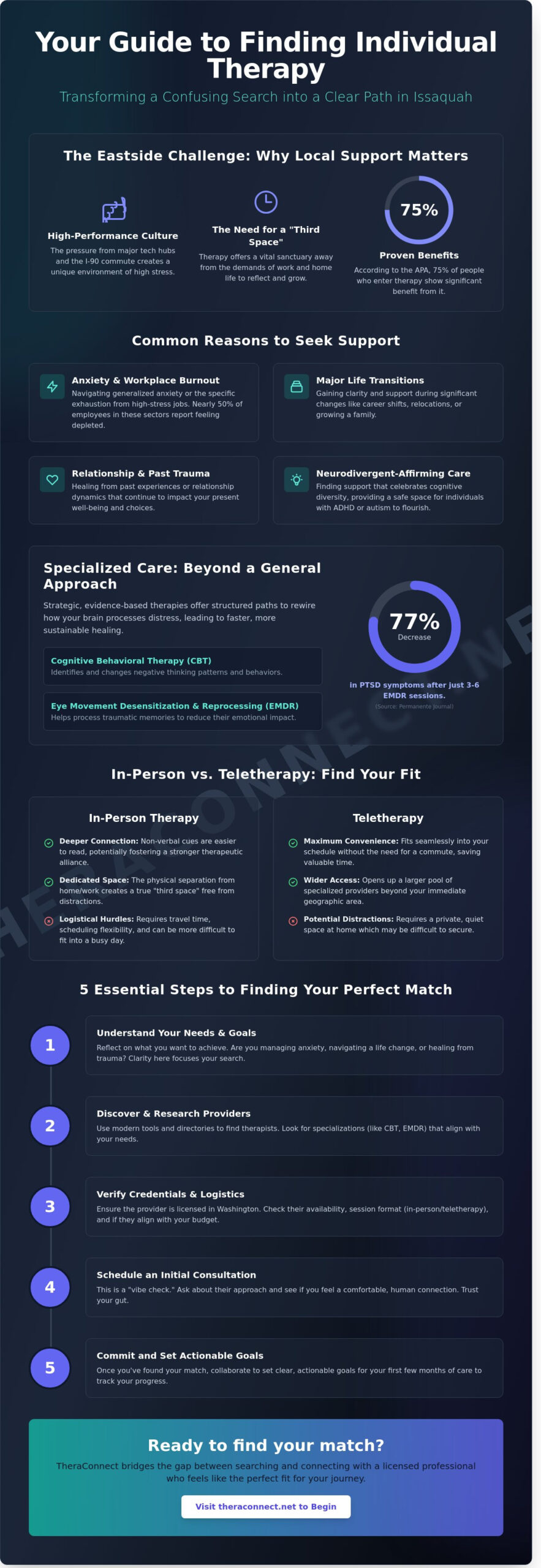
Individual therapy, also known as psychotherapy or counseling, is a collaborative process between you and a trained therapist focused on your emotional and mental growth. It’s a dedicated space to explore your feelings, thoughts, and behaviors in a confidential setting. For those living in dynamic, high-performance areas like Issaquah and the greater Eastside, life can be demanding. The pressures of a fast-paced career culture and daily commutes can leave little room for self-reflection.
Therapy offers a vital "third space"—a place away from work and home where you can process challenges, celebrate wins, and gain new perspectives without judgment. Your therapist acts as a compassionate, professional guide, helping you navigate your inner world and develop practical skills to enhance your well-being.
The Core Benefits of One-on-One Counseling
- Develop emotional resilience and build effective coping strategies for the stressors of modern life.
- Unpack long-standing patterns and beliefs in a safe, confidential environment that encourages self-discovery.
- Improve relationship dynamics with partners, family, and colleagues by fostering a deeper understanding of yourself.
Common Reasons People Seek Support
- Managing symptoms of generalized anxiety, depression, and workplace burnout.
- Navigating significant life transitions, such as career changes, relocation, or family growth.
- Healing from the impact of relationship trauma or difficult childhood experiences.
Specialized Care: From Anxiety Support to Trauma-Informed Therapy
Effective mental health care is never one-size-fits-all. Finding a provider with expertise in your specific area of concern is crucial for making meaningful progress. Whether you’re dealing with chronic anxiety or the echoes of past trauma, specialized therapeutic modalities like Cognitive Behavioral Therapy (CBT) or Eye Movement Desensitization and Reprocessing (EMDR) can provide targeted tools to accelerate healing.
In our professional community, there is also a growing focus on neurodivergent-affirming care, which honors and supports the unique ways different brains experience the world. This specialized approach ensures that therapy is adaptive, respectful, and effective for everyone.
Addressing Anxiety and Depression
- Learn to identify the physical and emotional symptoms of chronic stress and their impact on your daily life.
- Work with a therapist who uses evidence-based tools to help you challenge and quiet your "inner critic."
- Move beyond just surviving and begin thriving with the foundation of consistent, professional support.
Trauma-Informed and Mindfulness-Based Approaches
- Discover what it means for a therapist to be trauma-informed—a commitment to creating an environment of safety, choice, and empowerment.
- Integrate mindfulness techniques to help regulate your nervous system and stay grounded in the present moment.
- Trauma-informed care is a practice that prioritizes the client’s sense of control and safety above all else.
In-Person vs. Teletherapy: Choosing the Right Format for Your Life
Deciding between traditional in-person sessions and the flexibility of online therapy is a key step in your journey. Washington state regulations ensure that telehealth providers adhere to the same high standards of privacy and care as in-office practitioners, so you can choose the format that best fits your lifestyle, personality, and comfort level. Many residents even opt for a hybrid model, combining the benefits of both.
| Feature | In-Person Therapy | Teletherapy (Online Therapy) |
|---|---|---|
| Connection | Allows for direct, face-to-face interaction and non-verbal cues. | Offers access to a wider range of specialists across Washington. |
| Environment | Provides a dedicated, neutral "healing space" away from daily life. | Allows you to connect from the comfort and privacy of your own home. |
| Convenience | Ideal for those who live or work near their therapist’s office. | Eliminates travel time and the stress of a commute. |
| Flexibility | Sessions are at a fixed time and location. | Offers greater scheduling flexibility for busy professionals. |
The Benefits of In-Person Sessions
The value of physical presence can be profound. In-person therapy allows for a nuanced connection where non-verbal communication plays a key role. For many, the act of traveling to a dedicated healing space helps create a mental separation from the stressors of home or work, making it easier to focus on the therapeutic process.
Why Teletherapy is a Game-Changer for Busy Professionals
For those with demanding schedules, teletherapy removes significant barriers to care. It eliminates the stress of commuting, allowing you to use every minute of your session for growth. The comfort of your own environment can foster a greater sense of privacy and ease, and it provides access to specialized providers across Washington state who may not have a physical office nearby.
5 Essential Steps to Finding Your Perfect Therapist Match
Finding the right therapist is about more than credentials; it’s about connection. This step-by-step guide will help you confidently navigate the process and find a professional who truly understands you.
- Identify Your Goals: Before you begin your search, take a moment to reflect. What do you hope to achieve in the next 3-6 months? Are you looking for coping skills for anxiety, support through a life change, or a space to process past events?
- Check Licensing and Credentials: Ensure any potential therapist is a licensed professional in Washington. Common credentials include LMHC (Licensed Mental Health Counselor), LICSW (Licensed Independent Clinical Social Worker), and LMFT (Licensed Marriage and Family Therapist).
- Review Provider Profiles: Look beyond the specialties. Read their bios to get a sense of their therapeutic philosophy and "vibe." Do they sound warm and collaborative? Does their approach resonate with you?
- Utilize Free Consultations: Most therapists offer a free 15-minute consultation call. This is your opportunity to ask questions and see if you feel a "seamless connection." Trust your intuition.
- Evaluate Logistics: Confirm practical details like their policy on insurance, whether they offer a sliding scale for payment, and if their scheduling availability works for you.
Questions to Ask During Your First Consultation
- How do you typically approach working with a client who has my specific concerns?
- What does a typical session with you look like?
- How will we measure progress in our work together?
Understanding the ‘Therapeutic Alliance’
Research consistently shows that the single greatest predictor of success in therapy is the quality of the bond between you and your therapist. This is known as the "therapeutic alliance." If the first person you meet with doesn’t feel like the right fit, it’s okay to keep looking. The therapeutic alliance is the emotional partnership that serves as the foundation for all clinical progress.
How TheraConnect Bridges the Gap to Quality Care
Navigating directories can feel impersonal and overwhelming. TheraConnect was created to be a modern directory designed for human connection. We are committed to verifying every professional on our platform, giving you peace of mind as you search. Our goal is to simplify the process with intuitive filters and detailed profiles that help you find not just any therapist, but the right therapist for you.
The TheraConnect Difference: Connection Over Clicks
- We prioritize the "perfect match" by helping providers tell their stories, so you can find a genuine connection.
- Our focus is on high-quality, Washington-based care, strengthening the local wellness community.
- We support our providers with the tools they need so they can better support you on your journey.
Start Your Journey Today
Taking the first step is often the hardest part, but it’s a powerful act of self-care. You deserve to feel heard, supported, and empowered.
Browse our directory of licensed therapists and find your match
Frequently Asked Questions
How much does individual therapy cost in Issaquah?
The cost of therapy can vary based on the therapist’s experience, location, and specialty. In the greater Seattle and Eastside area, session rates typically range from $125 to $225. Many therapists offer sliding scale fees based on income to make care more accessible.
Is online therapy as effective as in-person counseling?
Yes. Numerous studies have shown that for many conditions, including anxiety and depression, teletherapy is just as effective as traditional in-person therapy. The most important factor for success remains the quality of the therapeutic alliance.
What is the difference between a psychologist and a licensed counselor?
While both are mental health professionals, their training differs. Psychologists (PhD or PsyD) have doctoral-level degrees and extensive training in psychological assessment and research. Licensed counselors (LMHC, LICSW, LMFT) have master’s degrees and are trained specifically in providing psychotherapy and counseling.
How long does a typical individual therapy session last?
A standard therapy session, often called a "therapy hour," is typically 50 minutes long. Some therapists may offer longer sessions for specific modalities like EMDR.
Do therapists in Washington generally accept insurance?
Many therapists do accept insurance, but many also operate on a private-pay basis. If a therapist is "out-of-network," you can often submit a "superbill" to your insurance company for partial reimbursement. It’s always best to check directly with the provider and your insurance plan.
What should I do if I’m in a mental health crisis?
If you are experiencing a mental health crisis and need immediate help, please do not use this site. Call 911, go to the nearest emergency room, or contact the National Suicide Prevention Lifeline at 988.
How many sessions will I need before I start feeling better?
This is highly individual. Some people experience relief and gain valuable tools within a few months, while others benefit from longer-term therapy to work on deeper patterns. You and your therapist will work together to establish goals and track your progress.
Can I switch therapists if I don’t feel a connection after the first visit?
Absolutely. Finding the right fit is essential. It is perfectly normal and acceptable to meet with a few different therapists before you find the one you feel most comfortable with. A good therapist will understand and support your decision.
Your Expertise Deserves to Be Found.
People are searching for support. Make it easier for them to discover you.
Leave a Reply