

gray rock

  • How Sliding Scale Therapy Platforms Work

    How Sliding Scale Therapy Platforms Work

    A therapy fee can look manageable at first glance, then feel impossible once you stack it next to rent, groceries, prescriptions, and everything else competing for your paycheck. That is exactly why so many people start searching for sliding scale online therapy platforms instead of a single fixed-price option.

    The appeal is simple. You still want qualified care, but you need pricing that reflects real life. A sliding scale can make therapy feel less like an all-or-nothing decision and more like something you can actually sustain.

    What sliding scale online therapy platforms actually do

    Sliding scale online therapy platforms connect clients with therapists or counseling providers who offer flexible pricing based on financial circumstances. Instead of charging every client the same rate, a provider may adjust fees using factors like income, household size, employment status, or financial hardship.

    That flexibility matters because affordability is not just about the first session. It is about whether you can keep going long enough for therapy to help. A lower fee that lets you attend regularly is often more useful than a standard rate you can only afford once or twice.

    Online platforms make this process easier because they centralize the search. Rather than contacting dozens of providers one by one, you can often filter by budget, specialty, session type, and availability in one place. For people already feeling stressed or overwhelmed, that time savings is not minor. It can be the difference between getting support now and putting it off again.

    Why pricing varies so much from one platform to another

    If you have looked around, you have probably noticed that “affordable” means different things on different sites. Some platforms offer a true sliding scale through individual therapists. Others use membership models, discounted plans, intern-led care, or limited low-fee spots.

    That difference is worth paying attention to. A therapist offering a personalized reduced rate is not the same as a platform advertising low prices across the board. Both can help, but they work differently.

    In many cases, the final cost depends on who sets the fee. On some platforms, the therapist controls pricing. On others, the platform sets package rates and assigns providers within that structure. Neither model is automatically better. It depends on what matters most to you – more pricing flexibility, more predictable billing, or a wider choice of therapists.

    Geography can also affect rates, even online. Therapists are licensed by state, and session fees may reflect local market conditions, credentials, demand, and specialization. A provider with advanced training in trauma, couples therapy, or severe anxiety may charge more than a generalist, even with a sliding scale.

    What to look for in sliding scale online therapy platforms

    The best platform for you is not always the cheapest one. Price matters, but so do trust, therapist quality, and whether the matching process actually helps you find someone who fits.

    Start with transparency. A good platform should make it reasonably clear how pricing works. If sliding scale rates are available, you should be able to tell whether they are broadly offered, limited to select therapists, or based on an application or conversation. Vague language can lead to frustrating surprises later.

    Next, look at provider vetting. Affordability should not come at the expense of qualifications. You want to know that therapists are licensed, verified, and practicing within their area of expertise. This is especially important online, where trust often starts with a profile and a short intake form.

    Matching also matters more than people expect. Lower-cost care is valuable, but if you end up with a therapist who is not a good fit, you may stop going. Platforms that use thoughtful matching based on your goals, preferences, budget, and needs can save you from that cycle.

    It also helps to check whether you can switch providers without starting over completely. Sometimes the first match is right. Sometimes it is not. A platform that makes adjustments easier can reduce the pressure to get it perfect on day one.

    Questions to ask before you book

    Even on strong platforms, it is smart to ask a few direct questions. You are not being difficult. You are making an informed decision about your care.

    Ask how the sliding scale is determined. Some therapists have a formal range tied to income, while others make case-by-case decisions. Ask whether the fee is temporary or ongoing, and whether it may change after a set number of sessions.

    You can also ask about session length, cancellation policies, and how often clients usually meet. A lower per-session rate can still become expensive if the expected frequency does not fit your budget. Weekly therapy is helpful for many people, but every-other-week scheduling may be more realistic in some cases.

    If you plan to use insurance reimbursement, ask whether the therapist can provide a superbill. Not every online platform supports out-of-network documentation the same way. This does not mean the platform is a bad choice, only that you should know the logistics upfront.

    The trade-offs to keep in mind

    Sliding scale therapy can open doors, but it is not magic pricing with no limits attached. Providers still have bills, caseload limits, and only so many lower-fee openings available.

    That means availability may be tighter for reduced-rate appointments. You might find fewer evening slots, longer wait times, or a smaller pool of therapists at your target price point. This can be frustrating, especially if you need support quickly.

    There is also the question of consistency. Some clients find a long-term reduced rate and stay with the same therapist for months or years. Others start with a lower fee that later increases as their financial situation changes or as the provider updates their schedule. If you need a very specific monthly budget, ask about stability before you commit.

    Another trade-off is platform experience. Some lower-cost services rely on minimal matching, limited messaging support, or fewer customization options. That may be perfectly fine if your main goal is getting affordable care fast. But if you want more personalized guidance, the cheapest route may not feel best.

    How to tell if a platform is trustworthy

    Trust is a big part of online mental health care. You are sharing personal information, relying on professional judgment, and often making decisions while already under stress.

    A trustworthy platform is usually clear about who its providers are, what credentials they hold, how privacy is handled, and what kind of support is available if something goes wrong. It should not feel hard to understand the basics.

    Look for therapist bios that go beyond generic language. Good profiles explain specialties, approaches, licensure, and who the provider works with. That level of detail helps you judge fit and signals that the platform takes quality seriously.

    The intake process should also feel thoughtful, not random. A few meaningful questions about your concerns, goals, preferences, and budget can go a long way. Platforms built around careful matching often create a smoother path to care because they are not just filling open calendar slots.

    For many people, that combination of vetted professionals, transparent pricing, and smarter matching is what makes a platform feel usable rather than overwhelming. That is part of the reason platforms like TheraConnect are designed to connect people with qualified providers in a way that supports both affordability and fit. If you are ready to take the next step, you can Get Started at https://theraconnect.net/.

    When sliding scale online therapy platforms make the most sense

    These platforms can be especially helpful if you do not have strong insurance coverage, if your deductible is too high to make therapy feel affordable, or if you want the privacy and convenience of online sessions from home. They can also be a strong option if you live in an area with limited local providers or long waitlists.

    They are not only for people in crisis or extreme financial hardship. Many clients use sliding-scale care because their budgets are tight right now, they are paying for school, they are supporting family members, or they are between jobs. Needing therapy to fit your finances is normal.


    At the same time, if you need specialized services such as intensive outpatient care, emergency support, or medication management, a standard outpatient therapy platform may not be enough on its own. It depends on your needs. Sliding scale online therapy can be a strong part of care, but not always the full picture.

    Finding care you can actually keep

    The right therapy platform is not just the one with the lowest advertised number. It is the one that helps you find a qualified therapist, understand the cost clearly, and continue care without constant financial strain.

    If you are comparing options, give yourself permission to be practical. Ask about fees. Ask about fit. Ask what happens if your budget changes. Therapy should feel supportive, not financially mysterious.

    Affordable care is not lesser care. Often, it is simply care designed around the reality that people need mental health support and a workable payment option at the same time. That is a reasonable thing to look for, and a good place to begin.

  • What makes somebody a narcissist? Mounting evidence suggests links to insecure attachment styles By

    What makes somebody a narcissist? Mounting evidence suggests links to insecure attachment styles By

    Megan Willis

    Narcissism has become the armchair diagnosis of the decade. Social media is awash with people flinging the label around. Everyone’s ex seems to be a narcissist, some of our parents are under suspicion, and that office villain? They definitely tick the box, too.

    The accuracy of these rampant diagnoses warrants scepticism. But the reality is narcissists do exist. At its extreme, narcissism is a rare mental health diagnosis, known as narcissistic personality disorder. But narcissism also describes a cluster of personality traits, which we all display to varying degrees.

    For those of us who have been in close quarters with someone high in narcissistic traits, we rarely walk away unscathed. And we may be left with lingering questions. For example, what made them this way?

    In a recent meta-analysis, my colleagues and I pulled together studies examining the link between narcissism and adult attachment styles. Our findings offer an important clue – especially when it comes to the potential roots of vulnerable narcissism.

    Types of narcissism

    There are two main types of narcissism.

    Grandiose narcissism is what typically comes to mind. It is characterised by an overtly grandiose, aggressive and dominant interpersonal style. In contrast, vulnerable narcissism is marked by introversion, hypersensitivity to criticism, and a defensive, insecure grandiosity that masks fragile self-esteem.

    One great story in your inbox every afternoon

    Try our Substack

    Antagonistic traits such as entitlement, manipulation, and a lack of empathy lie at the core of both narcissism types. This helps to explain the interpersonal difficulties linked to each.

    Vulnerable narcissism, in particular, has been linked to a range of harmful behaviours in romantic relationships. Individuals high in this trait are more likely to engage in love bombingghosting and breadcrumbing.

    They also tend to report lower relationship satisfaction, hold more permissive attitudes towards infidelity and perpetrate intimate partner violence at higher rates.

    https://www.instagram.com/reel/DIyj175t6iV/embed/captioned/?cr=1&v=14&wp=1196&rd=https%3A%2F%2Ftheconversation.com&rp=%2Fwhat-makes-somebody-a-narcissist-mounting-evidence-suggests-links-to-insecure-attachment-styles-257468#%7B%22ci%22%3A0%2C%22os%22%3A1105.5%7D

    Secure versus insecure attachment

    Researchers have turned to attachment styles to help explain how individuals high in narcissism behave in romantic relationships.

    Attachment theory proposes that early experiences with primary caregivers shape our beliefs about ourselves and others. These beliefs are thought to persist into adulthood and influence how we experience and navigate adult relationships.

    If we felt safe, loved and supported as children, we are more likely to have a positive view of our self and others. This is the hallmark of secure attachment, which lays the foundation for healthy, stable relationships in adulthood.

    But when early relationships are marked by neglect, inconsistency or abuse, they can give rise to insecure attachment styles. Adult attachment models generally identify three types of insecure attachment.

    Preoccupied attachment develops from a negative view of the self and a positive view of others. Individuals with this style often feel unworthy of love and seek constant reassurance in relationships, fearing rejection and abandonment.

    Dismissive attachment is rooted in a positive view of the self but a negative view of others. These individuals tend to prioritise independence over intimacy. As a result, they often struggle to form deep connections.

    Fearful attachment involves negative views of both the self and others. Those with this style typically crave connection while at the same time fearing it, leading to push-pull dynamics in relationships.

    An interesting pattern

    In our meta-analysis, we combined the results of 33 previous studies comprising more than 10,000 participants to examine how narcissism relates to each of the four adult attachment styles. Overall, narcissism was linked to each of the three insecure attachment styles.

    But when we looked at the two types of narcissism separately, an interesting pattern emerged. Vulnerable narcissism was consistently linked to insecure attachment styles – with associations of moderate strength for preoccupied and fearful attachment styles.

    In contrast, grandiose narcissism showed no such link.

    Does this mean insecure attachment causes vulnerable narcissism? Not necessarily. The studies we reviewed were “correlational”, which means they looked at connections, not causes. So we can’t say attachment styles cause vulnerable narcissism. To answer that, we’d need longitudinal research tracking people over time.

    Still, our findings suggest that insecure attachment – particularly preoccupied and fearful attachment styles – may be an important risk factor in the development of vulnerable narcissism.

    Of course, not everyone with an insecure attachment style has high levels of vulnerable narcissism. However, for some, vulnerable narcissism may emerge as a defensive coping strategy that arises when early attachments were marked by inconsistency, neglect or abuse.

    A young father lovingly holding his newborn.
    Supporting parents and caregivers to build secure attachments with the their children could help prevent the development of vulnerable narcissism Halfpoint/Shutterstock

    Healing childhood wounds

    Attachment styles tend to be fairly consistent throughout a person’s life, however change is possible. Attachment-focused therapies, such as schema therapy and emotionally focussed therapy, can help individuals heal attachment wounds and build more secure relationship patterns. These approaches may be especially helpful for those high in vulnerable narcissism.

    At the same time, it is important that families have access to free and timely mental health care, so that children are supported to process and heal from trauma before it shapes their adult relationships, and the way they parent the next generation.

    But prevention is better than cure.

    Supporting parents and caregivers to build secure attachments with the their children and equipping them with the tools to parent effectively is essential. This is especially urgent given disturbingly high rates of child maltreatment in Australia, including emotional abuse, physical abuse and neglect – all of which have been linked to the development of vulnerable narcissism.

    We don’t need to look too far to see the cost of turning a blind eye.

    Megan Willis

  • How to Pick the Right Online Therapist

    How to Pick the Right Online Therapist

    Finding a therapist online can feel strangely high-stakes. You are trying to make a smart, personal decision, often at a time when you already feel stressed, overwhelmed, or worn down. A polished profile and a friendly headshot can help, but they do not tell you everything you need to know.

    If you are wondering how to choose an online therapist, the goal is not to find the “perfect” person on the first try. It is to find someone qualified, affordable, and like a good fit for what you need right now. That takes a little clarity upfront, and it can save you time, money, and frustration later.

    How to choose an online therapist without overthinking it

    Start with your reason for seeking support. You do not need a perfect explanation or a formal diagnosis. But it helps to ask yourself a few simple questions: What has been hardest lately? Are you dealing with anxiety, depression, grief, relationship stress, burnout, trauma, or a major life transition? Do you want short-term support for a specific issue, or are you looking for ongoing therapy?

    Your answer shapes what kind of therapist may be the best match. For example, someone coping with panic attacks may want a clinician experienced in anxiety treatment and structured approaches like CBT. Someone working through childhood trauma may care more about a therapist who understands trauma-informed care and moves at a pace that feels safe.

    This is also where practical needs come in. If you need evening appointments, a therapist who only works weekdays may not be realistic, no matter how impressive their background looks. If budget is tight, affordability is not a secondary detail. It is part of choosing well.

    Know what qualifications actually matter

    One of the biggest concerns people have about online therapy is whether the therapist is truly qualified. That concern is fair. The good news is that legitimate online therapists should have the same professional credentials required for in-person care.

    Look for a licensed mental health professional in your state. That may include psychologists, licensed clinical social workers, licensed professional counselors, marriage and family therapists, or psychiatrists. The letters after their name matter less than whether they are properly licensed and trained to treat your concerns.

    A therapist can be warm and relatable and still not be the right clinical fit. On the other hand, someone can have strong credentials but use an approach that does not feel helpful to you. Both pieces matter. Strong therapy usually comes from a mix of training, experience, and human connection.

    If a platform explains how providers are vetted, that is a good sign. It shows some level of quality control instead of leaving you to sort through everything on your own. At TheraConnect, for example, provider vetting and matching are designed to make that process more trustworthy and less time-consuming.

    Match the therapist to your specific needs

    Not every therapist treats every issue, and that is not a red flag. Specialization is often a good thing.

    If you are searching for help with a specific concern, read profiles carefully for experience in that area. Common specialties include anxiety, depression, trauma, PTSD, couples counseling, family conflict, ADHD, substance use, eating disorders, and LGBTQ+ affirming care. Some therapists also focus on cultural identity, faith-based counseling, postpartum mental health, or support for teens and college students.

    This is where honesty helps. If you want direct tools and homework, a highly reflective, open-ended therapist may not feel satisfying. If you want space to process emotions slowly, someone who pushes techniques too quickly may feel like a mismatch. There is no universally best style. There is only what fits your goals, your personality, and your current capacity.

    Therapy style matters more than people expect

    Many people choose based on specialty alone, then feel disappointed when the actual sessions do not click. That is often a style issue.

    Some therapists are structured and goal-oriented. They may set agendas, teach coping skills, and track progress in a concrete way. Others are more exploratory and relational, helping you notice patterns, emotions, and deeper themes over time. Neither is better. But one may feel more useful to you.

    If the therapist profile mentions approaches like CBT, DBT, EMDR, psychodynamic therapy, or person-centered therapy, that can give you clues. You do not need to become an expert in therapy methods. You just want enough information to ask, “Does this sound like the kind of help I want?”

    Pay attention to cost, insurance, and scheduling

    The best therapist on paper is not the best choice if sessions are priced beyond what you can sustain. Therapy works best when it is consistent, so affordability matters from the start.

    Before booking, check the session fee, whether the provider accepts insurance, whether out-of-network reimbursement is possible, and whether sliding-scale rates are available. Some people assume cheaper means lower quality, but that is not always true. A great therapist with a reasonable rate may simply want to keep care accessible.

    It also helps to think beyond the first appointment. Ask yourself whether you could realistically continue for at least several sessions if it feels helpful. Weekly therapy may be ideal for one person, while biweekly sessions may be the only practical option for another. The right plan is the one you can actually maintain.

    Scheduling is just as important. If you work irregular hours, travel often, or need childcare coverage, flexibility is not a bonus. It is essential. Online therapy can remove commuting time, but it still has to fit your life.

    How to evaluate fit after the first session

    A lot of people expect instant certainty after one appointment. Sometimes that happens, but often it does not. A first session is usually more like a starting point than a final verdict.

    Still, there are useful signs to watch for. Did the therapist listen closely? Did they seem respectful, engaged, and clear about how they work? Did you feel pressured, dismissed, or talked over? Were they able to reflect back what you were saying in a way that felt accurate?

    You do not need to feel totally comfortable right away. Therapy can feel vulnerable, and nerves are normal. But you should feel emotionally safe enough to continue. There is a difference between healthy discomfort and a bad fit.

    Green flags and red flags

    A good online therapist will usually be clear about boundaries, confidentiality, fees, and scheduling. They should explain what therapy with them may look like and welcome your questions. If they are a strong fit, you will likely feel some combination of understood, respected, and gently challenged.

    Be cautious if a therapist makes sweeping promises, acts overly casual about serious concerns, avoids explaining their credentials, or pushes a one-size-fits-all solution. Online therapy should still feel professional, even when the tone is warm and relaxed.

    Technical reliability matters too. If sessions are constantly interrupted by poor communication, missed appointments, or disorganization, that can wear down trust quickly.

    Give yourself permission to switch

    This part matters more than people think. Choosing a therapist is not a lifetime contract.

    If you have attended a few sessions and the fit feels off, you are allowed to move on. That does not mean therapy “isn’t for you.” It may simply mean that this therapist is not the right match. People stay with the wrong therapist longer than they should because they do not want to be rude or start over. But staying in a mismatched relationship can delay the support you actually need.

    If you are unsure, it is okay to bring that up directly. A good therapist will not be offended by honest feedback. In fact, many will appreciate it and may even help you clarify what you are looking for next.

    A practical way to make the decision easier

    If you are comparing several options, keep your decision simple. Look at credentials, specialty, cost, availability, and whether their communication style feels right for you. You are not choosing the most impressive bio. You are choosing the person you are most likely to talk to honestly and keep seeing consistently.

    That is often why matching platforms can be helpful. Instead of spending hours filtering through endless profiles, you can focus on therapists who already align with your needs, budget, and preferences. If you are ready to take the next step, you can Get Started at https://theraconnect.net/ and check your options with more confidence.

    The right online therapist is not just qualified. They are someone you can meet where you are, at a price and pace that make support possible. Sometimes that is enough to turn a stressful search into real momentum.

  • Self‑Esteem Among Aarcissists is ‘Puffed Up, but Shaky’

    Self‑Esteem Among Aarcissists is ‘Puffed Up, but Shaky’

    Like a grotesque mask reflected in a pool, narcissism has two faces, neither of them attractive. Narcissists have an inflated sense of self-worth, seeing themselves as superior beings who are entitled to special treatment.

    However they also tend to be thin skinned, reacting angrily when their unique gifts are challenged or ignored.

    This combination of high but easily undermined self-worth might seem paradoxical. A positively viewed self would be expected to be a happy and secure self. To understand the paradox we need to parse the complexities of self-esteem.

    Self-esteem

    The main thrust of early research on self-esteem – the broad positive or negative evaluation of the self – explored the implications of its level.

    People with higher self-esteem were compared to those with lower, and were generally found to report better life outcomes. High self-esteem people tended to be happier, healthier, more successful in love and work, and more resilient in the face of adversity.

    On the strength of such findings, self-esteem came to be seen in some circles as a panacea of all manner of personal and social ills. If we could only improve people’s self-esteem, we might remedy their suffering and underachievement.

    One great story in your inbox every afternoon

    Try our Substack

    In the 1980s the state of California set up a self-esteem task force to promote that cause.

    Unfortunately, the self-esteem bandwagon was sideswiped by some troubling research evidence, presented in an influential review published in 2003. Studies commonly showed that high self-esteem was a consequence or side-effect of life success rather than a cause.

    Enhancing a person’s self-esteem would therefore no more increase their performance at school or work than applying heat to a light bulb would increase its luminance.

    In addition, high self-esteem appeared to have some negative implications. For example, people with some forms of high self-esteem are sometimes especially prone to forms of aggression and antisocial behaviour.

    Different forms of high self-esteem

    One way to reconcile this ambivalent picture of high self-esteem is to recognise that it is not only the level of self-esteem that matters. We also need to consider the consistency and stability of self-esteem.

    People whose overt self-esteem is high but accompanied by covert self-doubts may be worse off than those whose self-esteem is consistently high. And people whose views of self are dependably positive are likely to be better off than those whose self-views are equally positive on average but oscillate wildly.

    Neither of narcissism’s two faces is very attractive. pixabayCC BY

    These two alternative ways of thinking about high self-esteem have been recognised by psychologists as “defensive” and “fragile” self-esteem, respectively.

    People with defensive self-esteem evaluate themselves positively by questionnaire, but negatively when their automatic or non conscious self-views are examined. Their positive self-views are inferred to be defences against lurking insecurities.

    The self-views of people with fragile self-esteem are prone to fluctuate, dropping sharply when they encounter difficulties because their self-worth lacks a firm anchor.

    Narcissism and self-esteem

    These two forms of self-esteem help to make sense of narcissism. There is evidence narcissists tend to have higher than average levels of self-esteem, but that these levels are to some degree defensive and fragile.

    Below the shiny surface of their arrogance and grandiosity, narcissists often view themselves less positively. Their inflated self-image also tends to deflate rapidly when punctured by evidence that other people do not share it.

    The dynamics of self-esteem among narcissists are well illustrated in a recently published study by a team of German and Dutch psychologists. The researchers examined the facets of narcissism and linked them to the level and stability of self-esteem in a series of laboratory and field studies.

    The studies spring from a model that distinguishes two key components of narcissism. “Narcissistic admiration” refers to assertive self-promotion of a grandiose self-image. People high on this component may be charming, but it is a charm that gradually loses its lustre as the person’s unquenchable appetite for admiration becomes apparent to others.

    In contrast, “narcissistic rivalry” is the tendency to react antagonistically to perceived threats to the narcissist’s egotism. People high on this component are fiercely competitive and prone to denigrate those who challenge their sense of superiority.

    The two components are only moderately related, so narcissistic people may be substantially higher on one than the other.

    The researchers found that admiration and rivalry had quite different associations with self-esteem. People high on admiration tended to report high levels of self-esteem and average degrees of stability. Those high on rivalry, in contrast, reported average levels of self-esteem but high degrees of instability.

    By implication, narcissists scoring high on both admiration and rivalry would show the familiar toxic combination of high but fragile self-esteem.

    In one of the researchers’ three studies, for example, a large sample of students reported their levels of self-esteem on a daily basis over a two-week period. People who reported higher average levels of self-esteem scored high on admiration and low on rivalry. Those whose levels of self-esteem varied widely from day to day scored high on rivaly.

    In addition, when self-esteem dropped from one report to the next, these drops were greater among people high in rivalry. A follow up study showed that these people were especially likely to experience drops in their self-esteem on days when they felt less liked by their peers. A perceived lack of social inclusion is particularly bruising to the self-esteem of people who see others as threats to their sense of superiority.

    This research shows that narcissism is not a unitary phenomenon. In the words of the researchers, it involves a self that is “puffed-up but shaky”. Such a self may be unpleasant to others, but it is fundamentally a vulnerable self.

    Nick HaslamProfessor of Psychology,

    The University of Melbourne

  • Online Therapy vs In-Person Cost

    Online Therapy vs In-Person Cost

    A lot of people start looking for therapy with one very practical question: what is this actually going to cost me each month?

    That question matters more than most therapy websites admit. If care looks affordable for the first session but becomes hard to sustain by month two, it is not really affordable. When people compare online and in-person therapy, the biggest difference is not just the session rate. It is how the full cost fits into real life – transportation, scheduling, insurance, missed work, and whether you can keep going consistently.

    Online therapy vs in person cost: the short answer

    In many cases, online therapy costs less than in-person therapy, but not always. Individual online sessions in the US often fall somewhere around $65 to $150, while in-person sessions commonly range from about $100 to $250 or more, depending on location, specialty, and therapist experience.

    That said, the listed session fee is only part of the picture. Some online providers charge weekly or monthly membership fees instead of a straightforward per-session rate. Some in-person practices accept insurance more readily than online-only services. And for some clients, online therapy saves money mainly because it cuts out commuting, parking, childcare, or time away from work.

    If you are trying to decide based on budget, the better question is not only, “Which costs less per hour?” It is, “Which option can I realistically afford and continue?”

    What affects therapy pricing most?

    The biggest cost drivers are usually the therapist’s credentials, your state and city, the type of therapy you need, and whether insurance is involved.

    A licensed psychologist or specialist with years of experience may charge more than a therapist who is earlier in practice. Therapists in major metro areas often charge more than providers in smaller markets. Couples therapy, trauma treatment, and care for complex conditions may also cost more than standard individual talk therapy.

    Format matters too, but not as much as people think. Online therapy can be cheaper because providers may have lower overhead. They do not always need office rent, waiting room staff, or the same level of in-person operating costs. Still, highly qualified online therapists may charge rates similar to in-person therapists because you are paying for expertise, not just the room.

    The real cost of in-person therapy

    In-person therapy often has the clearest pricing model. You book a 45- or 50-minute session and pay a set fee. That simplicity can be helpful. But the true cost often goes beyond the therapist’s rate.

    If you drive to appointments, transportation adds up. Gas, parking, rideshares, and public transit all count. If you need childcare during sessions, that is another expense. For people with rigid work schedules, a daytime office visit may also mean unpaid time off or a longer lunch break than their job allows.

    There is also a geographic factor. In many areas, the therapists with the best fit for your needs may be across town or fully booked. That can limit options and make the search more expensive in terms of both time and money.

    None of this means in-person therapy is the wrong choice. For some people, it is worth the extra cost. The office setting can feel more private, more focused, and more grounding. If you struggle to talk openly at home or do not have a quiet place for virtual sessions, in-person care may offer better value even at a higher price.

    The real cost of online therapy

    Online therapy often looks cheaper up front, and sometimes it is. But pricing models vary more than people expect.

    Some therapists offer virtual sessions at a standard private-pay rate, just as they would in person. Others charge slightly less for telehealth appointments. Platform-based services may bundle therapy into subscriptions, which can include messaging, one live session per week, or a set number of sessions per month.

    This is where comparison gets tricky. A low monthly price may sound better than paying per session, but you need to check what is included. Does the fee cover weekly video therapy or only text support? Are you matched with a licensed therapist in your state? Can you choose your therapist, switch providers, or book at times that work for you?

    Online care can also save money in quieter ways. You do not need to commute. You may be able to book around work instead of missing hours. If mobility, chronic illness, parenting demands, or transportation barriers have made therapy harder to access, virtual care may lower the total cost of getting support.

    Online therapy vs in person cost with insurance

    Insurance can change the math completely.

    Some in-person therapists are in-network with major insurance plans, which can bring your out-of-pocket cost down to a copay. If your copay is $20 to $40 per session, in-person therapy may actually be less expensive than paying privately for online therapy.

    At the same time, many online therapists and telehealth platforms also accept insurance, and teletherapy coverage has expanded in recent years. Coverage still depends on your plan, your state, and whether the provider is in-network. Some services do not bill insurance directly but can provide a superbill for possible reimbursement.

    This is why broad statements like “online therapy is always cheaper” are not very useful. If insurance covers one format and not the other, the lower-cost option for you may be the opposite of what someone else experiences.

    It helps to ask a few direct questions before you book: what is the full session fee, do you accept my insurance, what will I owe after benefits, and are there cancellation fees? A little clarity up front can prevent surprise costs later.

    Hidden costs people forget to compare

    When people look at online therapy vs in person cost, they often compare only the advertised rate. A better comparison includes the costs around the appointment.

    The most common hidden costs are missed work, commuting time, parking, childcare, internet or device needs, and late cancellation policies. Online therapy is not free of extras. If your connection is unreliable or you need more privacy than your home allows, you may end up paying for headphones, data, or a separate quiet space.

    Emotional cost matters too. If one format makes you more likely to skip sessions, reschedule often, or stop treatment early, it may be the more expensive choice in the long run. Consistency matters in therapy. Affordable care is care you can keep showing up for.

    When online therapy gives better value

    Online therapy tends to offer stronger value for people who need flexibility, live in areas with fewer provider options, or want to widen their search beyond nearby offices. It can also be a better fit for those balancing caregiving, school, shift work, or transportation barriers.

    Value is not the same as the lowest sticker price. If virtual therapy helps you find a qualified therapist sooner, stick to weekly sessions more consistently, and avoid extra travel costs, it may be the smarter financial choice even if the session rate is similar.

    This is one reason many people start online. They want access, convenience, and a realistic way to continue care. A matching platform like TheraConnect can help reduce the trial-and-error part of the process by helping clients look for therapists who fit both their needs and their budget.

    When in-person therapy may be worth the extra cost

    There are situations where paying more for in-person care makes sense.

    Some clients simply feel more connected face to face. Others need a setting outside the home to focus, especially if home is stressful, crowded, or lacking privacy. Certain treatment needs may also be better served in person, depending on symptoms, safety concerns, and the therapist’s clinical approach.

    If the in-person format helps you engage more fully, open up faster, or feel more supported, the higher price may still be a good investment. Therapy is not a commodity. The right fit can matter as much as the fee.

    How to compare costs without getting overwhelmed

    Start with your monthly budget, not just the price per session. Think about what you can reasonably afford for at least eight to twelve weeks, since therapy often works best when it is consistent.

    Then compare the full picture: session fee, insurance coverage, travel or time costs, cancellation policy, and how easy it will be to keep appointments. If you are choosing between two options with similar pricing, go with the one you are most likely to attend regularly and feel comfortable in.

    If budget is tight, ask about sliding scale spots, reduced-fee options, or less frequent sessions after the initial phase of treatment. A good provider or platform should be transparent about cost. You should not have to guess what care will actually require from your wallet.

    The best therapy option is not always the cheapest one on paper. It is the one that feels financially manageable, clinically appropriate, and possible to sustain when life gets busy. If you are still comparing, start with the format that removes the most barriers. Getting started matters, and so does being able to keep going.

  • How to Choose a Therapist?

    How to Choose a Therapist?

    Choosing a therapist is a personal decision. Many people begin searching for therapy when they want support navigating stress, emotional challenges, relationships, or life transitions.

    Understanding how therapists work and what to look for can make the process easier.

    TheraConnect helps individuals explore licensed professionals and learn about available therapy options.


    Types of Mental Health Professionals

    Different professionals provide therapy and mental health support.

    Examples include:

    Psychologists

    Professionals trained in psychological assessment and therapy.

    Licensed Clinical Social Workers (LCSW)

    Therapists who provide counseling and support for emotional and social challenges.

    Licensed Professional Counselors (LPC)

    Mental health professionals who specialize in therapy and counseling.

    Marriage and Family Therapists (LMFT)

    Therapists who focus on relationship and family dynamics.

    Each professional may use different approaches depending on their training and specialties.


    Therapy Specialties

    Many therapists focus on specific areas.

    Examples include:

    • anxiety and stress
    • depression and mood concerns
    • trauma and PTSD
    • relationship counseling
    • burnout and life transitions
    • grief and loss

    Exploring therapist profiles can help you find someone with experience in the areas you want support with.


    Questions to Ask When Choosing a Therapist

    When considering a therapist, you may want to ask:

    • What areas do you specialize in?
    • What therapy approaches do you use?
    • Do you offer in-person or online sessions?
    • What is your experience working with similar concerns?

    These questions can help determine whether a therapist may be a good fit.


    Therapy Approaches

    Therapists may use different methods depending on their training and the needs of the client.

    Examples include:

    • Cognitive Behavioral Therapy (CBT)
    • Psychodynamic Therapy
    • Solution-Focused Therapy
    • Trauma-informed approaches
    • Mindfulness-based techniques

    Each approach offers different ways to support emotional well-being.


    Exploring Therapy Options

    Many individuals begin their search by reviewing therapist profiles, learning about specialties, and exploring different therapy approaches.

    TheraConnect provides a place to explore licensed professionals and learn about available mental health resources.


    Start Exploring Therapists

    If you are interested in exploring therapy options, you can browse therapist profiles and learn about available services.

    Important Notice

    TheraConnect is not intended for crisis situations. If you are experiencing a mental health emergency, please contact local emergency services or reach out to the 988 Suicide & Crisis Lifeline in the United States.

  • How to Start Therapy Without Feeling Lost

    How to Start Therapy Without Feeling Lost

    Starting therapy can feel strangely high-stakes. You are not just booking an appointment. You are deciding to say personal things to someone you have never met and hoping it helps.

    That mix of hope, doubt, and awkwardness is normal. If you are wondering how to start therapy for first time, the good news is that you do not need to have the perfect reason, the perfect words, or a full plan before you begin. You just need a starting point.

    How to start therapy for first time when you are not sure you “need” it

    A lot of people wait because they think therapy is only for a crisis. Sometimes it is. But therapy can also help when life feels off, heavy, confusing, or harder than it should.

    You do not need to prove that your pain is serious enough. If stress keeps building, if relationships feel strained, if anxiety is running your day, if grief will not let up, or if you just feel unlike yourself, that is enough reason to look for support.

    For some people, the hardest part is admitting they want help. For others, it is not wanting to overreact. Therapy sits in the middle of that tension. It is not a last resort, and it is not a magic fix. It is a structured space to understand what is happening and work on it with someone trained to help.

    Start with what you want help with

    Before you search for a therapist, it helps to put rough words to the reason you are going. Do not worry about getting the language right. This is not a diagnosis exercise.

    You might say you are dealing with anxiety, burnout, panic attacks, relationship stress, low mood, trauma, work pressure, parenting stress, or a general sense that things are not okay. You might also want help with a specific goal, like setting boundaries, handling grief, or improving self-esteem.

    This matters because different therapists have different specialties. A therapist who is great with trauma may not be the best fit for couples issues. Someone who works well with teens may not be who you want for workplace stress in your forties. Good therapy is not only about credentials. Fit matters.

    If your needs feel broad, that is okay too. You can begin with one sentence: “I have not felt like myself lately, and I want help figuring out why.”

    What to look for in a therapist

    The first name you find is not automatically the right one. Therapy is personal, so it helps to look at a few factors at once.

    Credentials come first. You want a qualified mental health professional licensed to practice in your state. Depending on your needs, that could be a psychologist, licensed clinical social worker, licensed professional counselor, marriage and family therapist, or psychiatrist. A psychiatrist can prescribe medication, while many other therapists focus on talk therapy.

    Then look at experience. If you know your main concern is anxiety, trauma, depression, or couples conflict, try to find someone who works with that regularly. Read how they describe their approach. Some therapists are more structured and skills-based. Others are more reflective and open-ended. Neither is automatically better. It depends on what helps you feel supported and challenged in a useful way.

    Practical details matter more than people think. Check whether they offer virtual sessions, what they charge, whether they take insurance, and whether their availability matches your schedule. A great therapist who is always booked or far outside your budget may not be sustainable.

    This is one reason online matching platforms can help. If you want a simpler way to sort through options, TheraConnect helps connect clients with vetted professionals based on needs, preferences, and budget, which can take some pressure off the search.

    Questions to ask before booking

    You are allowed to ask questions before committing. In fact, you should.

    A good first question is whether the therapist has experience with the issue bringing you in. You can also ask how they typically work with clients, what a first session looks like, whether they offer virtual therapy, and how payment or insurance works.

    If you are nervous, keep it simple. You do not need to interview them like you are hiring for a corporate role. You are just trying to learn whether this feels like a reasonable fit.

    Some people also care about identity-based fit. You may prefer someone of a certain gender, cultural background, faith background, or LGBTQ+ affirming experience. That is not being picky. Feeling understood can affect whether you open up at all.

    What happens in the first therapy session

    One reason people put therapy off is that they imagine the first session will be intense or exposing. Usually, it is more grounded than that.

    Most first sessions focus on getting context. The therapist may ask what brought you in, how long things have felt this way, what your life looks like right now, and whether you have been in therapy before. They may ask about your health history, relationships, work, family, or major stressors.

    You do not have to tell your life story in perfect order. You also do not have to reveal your deepest trauma in session one. A good therapist will pace things with you.

    That said, the first session may feel a little awkward. That does not mean therapy is not for you. It often takes a session or two to get comfortable. Think of it less like instant chemistry and more like building trust. Some immediate connection helps, but comfort often grows with time.

    How to know if a therapist is a good fit

    A therapist does not need to feel exactly like a friend. In fact, therapy works differently than friendship. But you should feel respected, heard, and emotionally safe.

    A good fit often feels like this: they listen closely, they do not rush to judge, they ask thoughtful questions, and they help you notice patterns you may have missed. You may leave feeling relieved, challenged, tired, hopeful, or all four.

    A poor fit can look different. Maybe you feel consistently dismissed. Maybe they talk over you, push too fast, stay too vague, or seem unfamiliar with your concerns. Sometimes the issue is not that the therapist is bad. It is that their style does not match what you need.

    It is okay to switch. A lot of first-time clients assume they have to stay once they start. You do not. Therapy is not about forcing a mismatch to work.

    Common worries that stop people from starting

    Money is a real concern. Therapy can be expensive, and affordability matters. If cost is stopping you, look for therapists with sliding-scale fees, insurance options, or lower-cost virtual care. It may take a bit more searching, but more accessible options do exist.

    Time is another barrier. Weekly therapy can sound hard to fit into an already packed schedule. Virtual sessions help many people because they cut out commuting and make it easier to attend consistently. Still, consistency matters more than intensity. A realistic schedule is better than an ideal one you cannot maintain.

    Then there is fear. Fear of crying, fear of being judged, fear that therapy will bring up things you would rather avoid. Those worries make sense. But therapy is not about being forced open. It is about having support while you sort through what is already affecting you.

    Some people also worry that if they start therapy, it means something is deeply wrong with them. Usually, it means the opposite. It means they are paying attention and trying to care for themselves before things get worse.

    How to get more out of therapy early on

    You do not need to perform in therapy, but a little honesty goes a long way. If you are nervous, say that. If you are not sure what you need, say that too. Therapists are used to working with uncertainty.

    It also helps to notice what happens between sessions. Are there moments that spike your anxiety? Are there conflicts that repeat? Do you shut down in certain situations? You do not need a formal journal, but paying attention gives you more to work with.

    Try to keep expectations realistic. Therapy can create real change, but often not in one dramatic breakthrough. Sometimes progress looks like sleeping better, setting one boundary, having fewer panic symptoms, or catching a harsh inner voice a little sooner. Small shifts count.

    A simple way to begin

    If all of this still feels like a lot, narrow it down to one action. Search for providers in your state. Read a few profiles. Send one message. Book one consultation. You do not need to map out your whole healing process this week.

    Starting therapy for the first time is rarely about feeling fully ready. It is usually about deciding that support would help and taking the next manageable step. If you have been waiting for certainty, this is your reminder that you can begin before you feel brave enough. Sometimes bravery shows up after you hit Get Started.

  • Online Trauma Therapy: What to Expect

    Online Trauma Therapy: What to Expect

    If you have ever opened a therapy intake form and paused at the question about trauma, you are not alone. Starting trauma therapy can bring up a mix of hope, fear, relief, and a very practical concern: what will actually happen in the session, and will it make things worse before it gets better?

    Online trauma therapy adds another layer. You might wonder if a video call can really feel safe, how privacy works at home, or what happens if you start to panic and your therapist is not physically in the room. The good news is that trauma therapy is not a single, intense “tell me everything” conversation. In most cases, it is a structured process designed to help you feel steadier first, then help you heal.

    Online trauma therapy: what to expect in the first steps

    Most trauma-informed therapists start by building safety and clarity, not by digging for details. Expect early sessions to focus on what you are dealing with now: sleep, anxiety, irritability, numbness, intrusive memories, relationship strain, or feeling on edge. You may also talk about what is going well, because your strengths matter in trauma recovery.

    You will likely review consent and confidentiality, including the limits. Your therapist may ask for your location at the start of each session for emergency purposes, and they will clarify what they can do if they are concerned about your immediate safety. If you have worried that you will say the “wrong” thing and get forced into a hospital, it helps to know the standard is usually imminent risk, not simply having intense feelings.

    Intake often includes questions about symptoms of PTSD, depression, anxiety, substance use, and dissociation (feeling unreal, spaced out, or disconnected). These questions can feel personal fast. You can ask why something is being asked, and you can slow the pace. A trauma-informed therapist will respect that.

    How the online format changes the experience

    Online sessions are typically held over secure video, sometimes with phone as a backup. The experience can feel more comfortable because you are in your own space. It can also feel more vulnerable because home is not always private.

    Expect to troubleshoot logistics early: where you will sit, how to keep sound from traveling, what to do if someone walks in, and what device works best. Headphones can make a big difference. Some people also find that having a grounding object nearby (a blanket, a mug of tea, a stress ball) helps their nervous system settle during hard moments.

    Choosing a trauma therapist online

    Not every therapist who is “good” is automatically the best fit for trauma work. It is reasonable to ask direct questions before you commit. A therapist does not need to use the same method everyone talks about on social media. They do need to understand trauma responses and know how to keep therapy paced and contained.

    A few useful questions sound like regular conversation: What is your approach to trauma treatment? How do you handle sessions if a client gets flooded or dissociates? Do you typically start with coping skills and stabilization? What does progress look like in your work?

    Licensing matters, too. In the US, therapists must generally be licensed in the state where you are located at the time of the session. If you travel, it is worth bringing that up so you can plan.

    What sessions actually look like week to week

    Many people expect trauma therapy to be nonstop retelling. In reality, trauma treatment often has phases. The pace depends on your history, your current stress level, and what support you have outside therapy.

    Early work commonly includes learning to track your window of tolerance – the zone where you can feel emotions without becoming overwhelmed or shut down. You may practice skills like paced breathing, grounding with the senses, naming emotions, or gently noticing body sensations. This can feel “too basic” at first, especially if you have been powering through for years. But these tools are not fluff. They are how you build control over your nervous system so you can approach painful material without getting pulled under.

    Once there is enough stability, you may do trauma processing. That can mean carefully revisiting memories, working with body-based reactions, shifting beliefs like “it was my fault,” or reducing the intensity of triggers. Some approaches are more structured, some are more relational. Either way, you should feel like there is a plan, not like you are being thrown into the deep end.

    You will also talk about your life right now. Trauma therapy is not only about the past. It is about how the past shows up in boundaries, trust, self-worth, anger, and the ability to rest.

    Common evidence-based approaches you might hear about

    Different therapists use different tools, and it often depends on your goals.

    Cognitive Processing Therapy (CPT) focuses on identifying and shifting trauma-related beliefs that keep you stuck.

    Prolonged Exposure (PE) uses gradual, supported exposure to memories and avoided situations so your brain learns you are safer now.

    EMDR uses bilateral stimulation while you focus on aspects of traumatic memories, aiming to reduce their emotional intensity.

    Somatic approaches pay attention to body sensations and defensive responses like freezing, fawning, or bracing.

    You do not need to pick the “perfect” method on day one. What matters is that your therapist explains why they recommend something, checks your readiness, and collaborates with you.

    Safety planning and what happens if you get overwhelmed

    A big part of online trauma therapy is having a clear plan for tough moments. You and your therapist may set agreements like: if you start feeling panicky, you will pause and do grounding for a few minutes; if video freezes, you will switch to phone; if you feel unsafe after session, you will use a specific support plan.

    This is also where online therapy can be a trade-off. Being at home can make it easier to self-soothe, but it can also mean you are alone right after session. Some people prefer to schedule sessions at a time when they can take a short walk afterward, journal, or transition gently before jumping back into work or family responsibilities.

    If you have a history of self-harm, suicidal thoughts, or severe dissociation, online therapy can still be appropriate, but the screening and planning may be more thorough. In some situations, a higher level of care or a hybrid plan may be recommended. That is not a failure. It is the system trying to match intensity of support to intensity of need.

    Privacy, confidentiality, and practical boundaries

    Confidentiality rules are the same whether therapy is online or in person, but your environment matters more. Expect your therapist to encourage you to find as private a space as possible and to avoid public Wi-Fi if you can.

    If you live with other people, you might talk about simple boundaries like using a white noise machine outside your door, sitting in your car, or scheduling when the house is quieter. If none of that is available, phone sessions with headphones can sometimes be more discreet than video.

    It is also normal to talk about between-session contact. Some therapists offer secure messaging for scheduling only; others may offer limited support messages. Clarity upfront helps you avoid feeling abandoned when you reach out and do not get an immediate response.

    How you will know it is working (and when it is not)

    Progress in trauma therapy is often quiet at first. You might notice you are sleeping a little better, recovering faster after a trigger, or feeling less ashamed about reactions you used to judge. You may still have symptoms, but they take up less space.

    There can also be a temporary increase in emotion when you start paying attention to what you have been pushing away. The difference is whether you feel supported, whether the sessions have structure, and whether you are gaining skills alongside insight.

    It may not be the right fit if you consistently leave sessions feeling raw with no plan, if your therapist pressures you to share details you are not ready to share, or if they minimize your experience. You deserve trauma-informed care that respects your boundaries.

    Cost and accessibility – what to ask upfront

    Affordability is part of what makes online therapy appealing, but pricing can vary widely. Before you start, ask about session fees, sliding scale options, cancellation policies, and whether your therapist provides superbills for out-of-network reimbursement.

    If you are trying to find a therapist who fits both your needs and your budget, a matching platform can save time by narrowing the search to providers whose approach, availability, and pricing align with what you are looking for. TheraConnect (https://theraconnect.net/) is one option designed to make that match more efficient, with clients able to sign up free and connect with vetted providers.

    A realistic timeline for healing

    Trauma therapy is not a quick fix, but it is also not endless. Some people feel meaningful relief in a few months, especially if the trauma is more circumscribed and life is relatively stable. Others need longer, particularly with complex trauma, ongoing stressors, or limited support.

    What matters most is that therapy feels like it is building capacity over time. You are not trying to erase what happened. You are working toward a life where your body does not act like the danger is still happening, where your choices feel freer, and where connection does not feel like a constant threat.

    If you are considering online trauma therapy, you do not have to arrive perfectly ready. You just need a starting point, a therapist who works at a pace your nervous system can handle, and permission to take this one session at a time. Your story can be held carefully – and you can still keep living while you heal.

  • How to Find a Sliding Scale Therapist Fast

    How to Find a Sliding Scale Therapist Fast

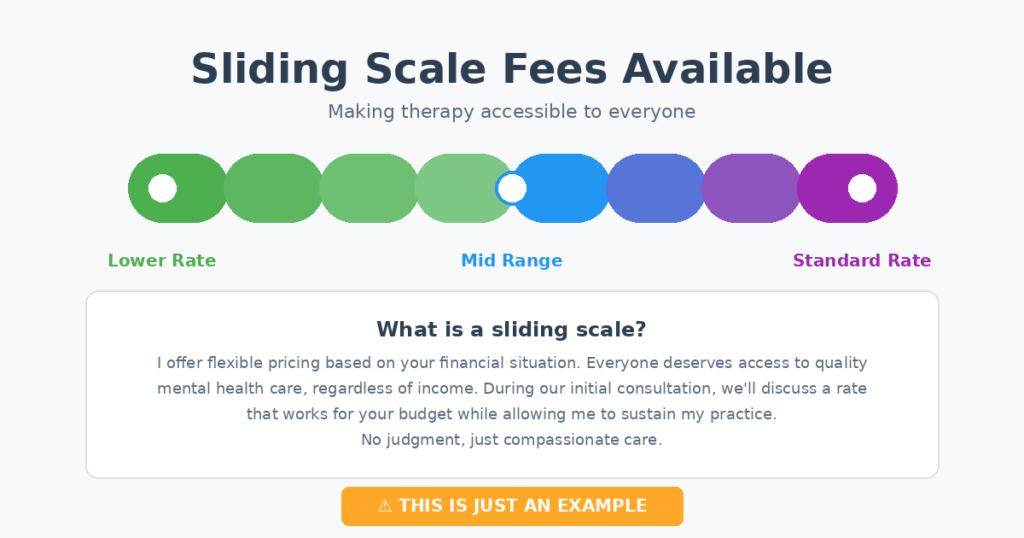
    That moment when you finally decide to look for therapy can feel like a small win – and then you see the price. It is frustrating, and it is common. Sliding scale therapy exists for exactly this reason: many therapists reserve spots at reduced rates so people can get care without having to wait for a crisis.

    Here is how to find sliding scale therapist options in a way that is practical, respectful of your time, and more likely to lead to a good match.

    What “sliding scale” really means (and what it doesn’t)

    A sliding scale fee is a flexible price based on financial circumstances. In practice, it might be a range (for example, $60 to $140 per session) where the therapist sets your rate using factors like income, dependents, local cost of living, and sometimes your current expenses.

    Two things can be true at once: sliding scale can make therapy far more affordable, and it can still be limited. Many clinicians only offer a few reduced-fee slots, and those spots can fill quickly. Some providers apply a sliding scale only to private-pay clients, while others use it alongside insurance or for out-of-network clients.

    You will also see related terms that sound similar but are different. “Low-cost” might mean a clinic setting, an intern, or a short-term program. “Pro bono” is free care and is usually rare and time-limited. “In-network” means your insurance contract sets the cost (often a copay), which can be cheaper than sliding scale for some people – or more expensive if you have a high deductible.

    Start with your budget, not a perfect number

    Before you search, decide what is sustainable for you. If you pick an unrealistic number because you are embarrassed to ask for help, you risk dropping out after two sessions and feeling worse.

    A simple way to choose a starting point is to ask yourself: what amount could I pay weekly for the next two months without borrowing money or skipping essentials? If weekly sessions are too much, consider whether every-other-week therapy could still help. Some people do better with consistent weekly support at a lower fee; others do fine biweekly if they are also using skills between sessions. It depends on your needs, symptom severity, and what you are working on.

    If you have a range (for example, “I can do $70 to $90”), you will have an easier time in the first conversation.

    Where sliding scale therapists are most often found

    Sliding scale options tend to cluster in certain places. Private practices may offer a few reduced-fee openings, but community-oriented settings often have more.

    Community mental health centers and nonprofit counseling agencies frequently price services on a sliding scale, sometimes using a formal formula. These can be excellent for affordability, though there may be waitlists or a more structured intake process.

    Group practices sometimes have a wider range of fees because they have clinicians at different experience levels. You may find a licensed clinician, an associate, or an intern, all working under supervision, each with a different rate.

    Training clinics connected to universities can be another strong option. You might work with a graduate clinician who is closely supervised. The trade-off is that you may have less scheduling flexibility, and there can be semester-based changes.

    Employee Assistance Programs (EAPs) are worth checking if you are employed and your workplace offers one. EAP sessions are often free for a limited number of visits. While this is not a sliding scale, it can bridge the gap while you look for a long-term fit.

    If you prefer online therapy, a matching platform can save time by filtering for affordability and fit in one place. TheraConnect (https://theraconnect.net/) is one option designed to help clients find vetted providers and match based on needs and budget.

    How to search: use the words therapists actually respond to

    When you reach out, clear language helps. Therapists are more likely to respond quickly when you are specific, polite, and direct about finances.

    In your search terms and messages, include phrases like “sliding scale,” “reduced fee,” and “low-fee openings.” Some clinicians do not use the term “sliding scale” in their profile even if they offer it, so “reduced fee” can catch more.

    Also include your logistics upfront: your state (for telehealth licensing), your availability, and whether you want weekly or biweekly sessions. If you have a preference for a therapist’s identity (for example, faith background, cultural experience, LGBTQ+ affirming), it is okay to say so. Fit matters, and you should not have to explain yourself later.

    What to ask in the first message (without oversharing)

    You do not need to disclose your whole story to ask about pricing. A simple note works. For example: “I am looking for weekly telehealth therapy. My budget is $80 per session. Do you have any sliding scale openings?”

    If you can pay more after a few months, you can mention that too. Some therapists are willing to start lower and reassess later. Others have fixed tiers and will tell you what is available.

    It also helps to ask one process question: “Do you offer a brief consult call?” Many therapists do a short call to confirm fit, explain their approach, and answer fee questions. Some skip the consult and go straight to an intake session, so you want to know before you commit.

    Red flags and green flags when discussing fees

    Money conversations can feel uncomfortable, but a good therapist will handle them calmly and professionally.

    A green flag is transparency. They can clearly tell you the full fee, the sliding scale range, how long the reduced rate can last, and what would trigger a change.

    Another green flag is collaboration. They might ask what feels manageable, discuss frequency options, or suggest a referral if they cannot meet your budget.

    A red flag is pressure or guilt. Sliding scale is a business decision and a service decision, not a personal favor you owe someone for. If you feel shamed for asking, that is not a great foundation for therapy.

    Also watch for vague answers like “we’ll figure it out later” without any specifics. You deserve to understand what you are agreeing to.

    Don’t skip the “fit” check just because the price works

    Affordable therapy that does not feel safe or helpful is still expensive. A few minutes of fit-checking can save you weeks of frustration.

    On a consult call or in the first session, ask how they typically work with the issues you are bringing in. If you want skills and structure, ask about approaches like CBT, DBT skills, or solution-focused work. If you want deeper processing, ask how they work with trauma, attachment, or grief.

    You can also ask what progress looks like in their practice. Some therapists track goals formally; others do it through regular check-ins. There is no single right answer, but you should feel like there is a plan, not just an endless conversation.

    If you are seeking therapy for something specific – panic attacks, relationship issues, postpartum anxiety, substance use, OCD, trauma – it is reasonable to ask about their experience and training. “Have you worked with this before?” is a fair question.

    If you have insurance, compare costs honestly

    Sometimes sliding scale is the best option, and sometimes insurance is cheaper. The only way to know is to run the numbers.

    If you have a low copay and your therapist is in-network, insurance may be the clear winner. If you have a high deductible, you might be paying close to the full rate for a while anyway. In that case, a sliding scale private-pay rate could be lower than your deductible-rate sessions.

    One trade-off: some people prefer private pay for privacy or flexibility, while others want the cost stability of insurance. If you are unsure, you can ask a therapist whether they accept insurance, provide superbills for out-of-network reimbursement, or work private pay only.

    What to do if you can’t find openings right away

    If you run into “no availability” messages, it does not mean you did something wrong. Sliding scale slots are often limited.

    Ask to be put on a waitlist, but also ask if they can refer you to two or three colleagues with reduced-fee openings. Therapists tend to know who in their network keeps a few sliding scale spots.

    Consider widening one variable at a time. If you are set on evening appointments, you might wait longer. If you can do midday sessions, you may find openings faster. If you are looking only in your immediate city, expanding statewide for telehealth can increase options (as long as the therapist is licensed where you live).

    If your budget is very low, look at training clinics or nonprofit agencies, and consider starting biweekly while you get on a waitlist for weekly care.

    How to protect your energy during the search

    Looking for affordable therapy can start to feel like a second job. Keep it contained.

    Set a small goal, like reaching out to three therapists at a time, then waiting two business days. Use one reusable message template so you are not rewriting your story. If a therapist is not a fit, let it be a neutral data point, not a verdict on you.

    If you are reaching out while you are in distress, consider asking a trusted friend to help you draft messages or keep track of replies. You still control the decision, but you do not have to carry every step alone.

    The right sliding scale therapist is not just someone who charges less. It is someone who makes it easier to stay in care long enough for it to actually help. Keep asking clear questions, keep your budget in the conversation, and let “affordable and effective” be the standard you are aiming for.

    A Practical Guide to Finding the Right Therapist for Your Needs

    A close-up, ultra-realistic scene of a painter creating perfect “cut-in” lines where a wall meets ceiling and trim, showcasing precision and craftsmanship; smooth wall texture, freshly painted neutral tone, high-quality brush and angled sash brush visible, masking tape cleanly applied, soft natural light, modern home interior background slightly blurred, premium photography style, vertical composition, no text, no watermark, crisp detail that highlights flawless finishing work.

  • Teletherapy vs Phone Therapy: Which Fits You?

    Teletherapy vs Phone Therapy: Which Fits You?

    You finally get a quiet hour on your calendar, you are ready to talk, and then the practical question hits: should you meet by video or just pick up the phone? When you are already carrying stress, anxiety, grief, or burnout, the last thing you need is a confusing decision.

    Both options are real therapy. Both can be effective. The difference is less about which one is “better” and more about which one makes it easier for you to show up consistently and feel safe enough to be honest.

    Teletherapy vs phone therapy: what each one really is

    Teletherapy usually means therapy over secure video, where you and your therapist can see and hear each other. It may also include secure messaging, but most people mean live video sessions when they say “teletherapy.”

    Phone therapy is therapy delivered through an audio-only call. It can happen on a regular phone line or through an app-based call, depending on the provider’s setup.

    In both cases, you are working with a licensed professional using the same clinical skills they use in an office: assessment, goal-setting, evidence-based approaches (like CBT, DBT skills, ACT, trauma-informed care), and the relationship that makes therapy work. The format changes the environment, not the core work.

    What tends to feel different in the room (even when there is no room)

    Video creates more of an “in-person” feel. You can read facial expressions, posture, and small shifts in emotion. For some people, that helps them feel understood faster. For others, being seen can feel intense, especially early on, or when talking about shame, trauma, or relationship conflict.

    Phone therapy often feels lower-pressure. Many clients report they open up more quickly when they are not on camera. If you are someone who worries about how you look when you cry, or you get self-conscious watching yourself on-screen, audio-only can remove a big barrier.

    Neither reaction is unusual. The best format is the one that helps you stay present instead of performing.

    Privacy and confidentiality: where each format shines and where it can get tricky

    Privacy is not just about encryption. It is also about where you physically are during sessions.

    With teletherapy, you may need a private space where you can speak freely and keep your screen away from roommates, partners, kids, or coworkers. Headphones help. So does sitting with your back to a wall. But video can be harder to pull off if you live in a small space or you are often on the go.

    Phone therapy can be easier to make private because you can take a walk, sit in your car, or talk from a quiet corner without worrying about a camera angle. That said, moving around can increase the risk of interruptions. If you choose phone sessions, it helps to decide ahead of time where you will be, how you will keep the conversation from being overheard, and what you will do if someone walks in.

    A practical middle ground many people use: schedule therapy when the home is quiet, use headphones, and tell the people around you that you are unavailable for that time – even if you are “just on a call.”

    Technology and accessibility: the hidden decision-maker

    If your internet drops, your session drops. That reality shapes a lot of people’s experiences with teletherapy.

    Video usually requires a stable connection, a device with a working camera, and comfort with troubleshooting basic tech. If you live in an area with unreliable Wi-Fi, share bandwidth with family, or feel stressed by apps and settings, teletherapy can start to feel like an obstacle course.

    Phone therapy is typically more forgiving. Audio needs less bandwidth, and even a basic phone can work. That makes phone sessions a strong option if you travel often, have limited data, or need something dependable.

    Accessibility also includes disability and neurodiversity needs. Some clients with social anxiety, PTSD hypervigilance, or autism find phone sessions easier because they reduce sensory and social demands. Others find video helpful because they can read cues and feel more grounded.

    Connection and rapport: does seeing your therapist matter?

    Therapy outcomes depend heavily on the therapeutic alliance – your sense that your therapist “gets it,” takes you seriously, and is working with you toward goals you care about.

    Video can strengthen that alliance quickly because nonverbal communication is richer. A therapist can notice your expression change when you mention a parent, or your shoulders tense when you talk about work. Those details can guide the conversation in a way that feels supportive and precise.

    Phone therapy can absolutely create strong rapport too, just through different cues. Tone, pacing, silence, and the words you choose carry more weight. Some people actually feel more attuned on the phone because they are not distracted by facial expressions, eye contact, or the temptation to multitask.

    If you are worried you will not “connect” without video, try reframing: connection is not a camera feature. It is consistency, trust, and the therapist’s skill.

    What works best for different goals and situations

    Your needs may change over time, and that is normal. The “right” choice can shift depending on what you are working on.

    If you are starting therapy for the first time, teletherapy can feel more orienting. It resembles an office visit and can help you build familiarity. If you are highly anxious about being judged, phone therapy can be a gentler entry point.

    If you are doing trauma work, it depends. Some people feel safer with video because they can see a calm, steady therapist and use grounding exercises together. Others do better with phone because eye contact and being observed can trigger shutdown or dissociation. A trauma-informed therapist can help you test what feels stabilizing.

    If your therapy includes skills practice, video sometimes helps. For example, a therapist might guide breathing, progressive muscle relaxation, or mindfulness and notice if you are tensing or holding your breath. But phone therapy can still work well here if you describe what you are experiencing and your therapist gives clear prompts.

    For relationship counseling, video is usually the better fit because communication patterns are easier to observe. Some couples still use phone successfully, but it can be harder for the therapist to track dynamics when voices overlap.

    Cost, scheduling, and consistency: the factors that make therapy actually happen

    Most people do not stop therapy because it is not helpful. They stop because it becomes too hard to fit into life.

    Phone therapy tends to win on convenience. It is easier to do from a car between shifts, during a lunch break, or while traveling. That flexibility can be the difference between weekly support and “I will reschedule next month.”

    Teletherapy can require a more controlled setup: a stable internet connection, a quiet space, and a predictable time. But for clients who need structure, that setup can be a feature, not a drawback. It creates a ritual: sit down, close the door, and focus.

    If budget is part of the equation, ask directly about fees for different formats. Some clinicians charge the same for video and phone because the clinical work is the same. Others price differently. Transparent pricing and scheduling options matter, especially if you are planning for longer-term care.

    Safety and crisis considerations

    Remote therapy can still be safe and effective, but the plan needs to be clear.

    With either video or phone therapy, your therapist should confirm your location at the start of sessions and discuss what to do in an emergency. If you have active suicidal thoughts, severe self-harm urges, or a situation involving immediate danger, audio-only may feel less containing, while video can offer more real-time assessment. But the biggest safety factor is not the format – it is whether you have a solid plan and the right level of care.

    If you are in crisis or think you might be, be upfront when you schedule and at the start of the session. That helps your therapist support you appropriately.

    How to choose between teletherapy and phone therapy (without overthinking it)

    Start with the question that matters most: what is most likely to help you show up and talk honestly each week?

    If privacy is hard where you live, phone therapy may be the easiest. If you want to feel more connected and grounded by seeing your therapist, teletherapy may be better. If you are tech-stressed or have unreliable internet, phone may reduce friction. If you tend to dissociate or feel unreal when you are anxious, video might help you stay anchored.

    You can also choose a flexible approach. Many clients begin with video to build familiarity, then switch to phone when life gets busy, or alternate based on what they are working on that week.

    One practical move: ask for a short trial period. Commit to three sessions in one format, then reassess with your therapist. You do not need to make a forever decision before you have any data.

    If you are still searching for a therapist who offers the format you want at a price you can manage, a matching platform can reduce the back-and-forth. For example, TheraConnect helps clients find vetted providers and filter for fit, including telehealth options, so you can spend less time hunting and more time getting support.

    What to ask a therapist before you decide

    A good therapist will not pressure you. They will help you choose what supports your goals.

    Ask how they handle privacy and secure communication, what platform they use for video, and what happens if the connection drops. Ask whether they can switch between video and phone if your needs change. If you have a specific concern – like social anxiety, panic attacks, or trauma triggers related to being seen – say it plainly. The answer you get will tell you a lot about their flexibility and clinical judgment.

    The most reassuring truth here is simple: you are allowed to optimize for what makes therapy doable. If phone sessions help you start, that is a strong choice. If video helps you feel held and understood, that is a strong choice too. Your job is not to pick the “perfect” format – it is to pick the one that helps you keep coming back to yourself, week after week.