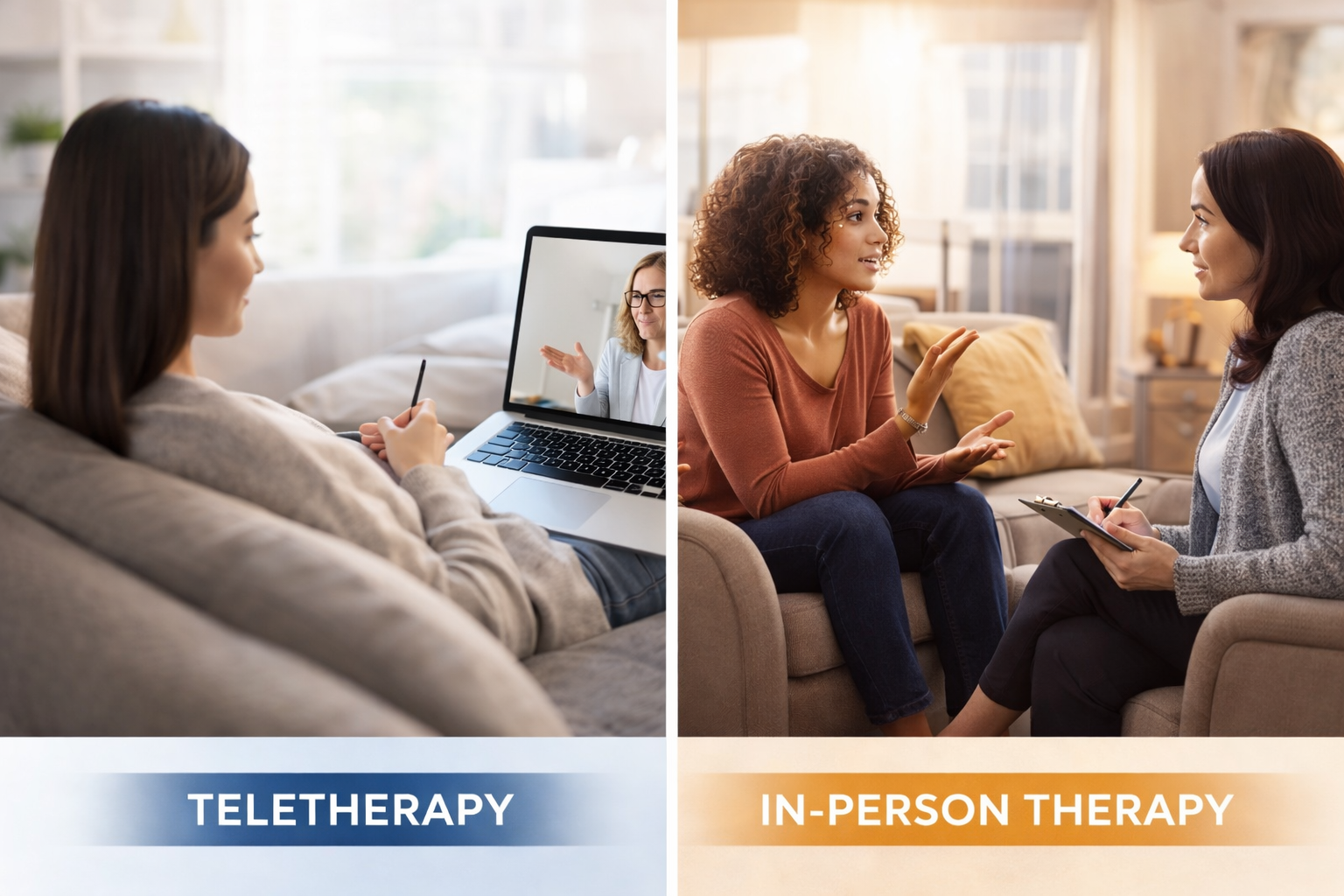
You finally have a window in your week to get help – and the next question hits: do you book a video session from your couch, or do you carve out time to drive across town and sit in an office?
That decision can feel bigger than it “should” because it is tied to real things: how safe you feel opening up, how predictable your schedule is, what you can afford, and how quickly you need support. The good news is that teletherapy vs in person therapy is rarely a right-or-wrong choice. It is usually a “best fit for right now” choice.
Teletherapy vs in person therapy: what’s actually different?
Both formats can offer the same core ingredients: a licensed mental health professional, a structured time to talk, evidence-based approaches, and a relationship built on trust. The difference is the setting and the logistics – and those details affect how therapy feels and how easy it is to keep showing up.
Teletherapy is therapy delivered remotely, most often by secure video, sometimes by phone, and occasionally by secure messaging depending on the provider’s rules and your state. In-person therapy happens in a clinic, office, hospital, or community setting.
For many people, the biggest difference is not clinical at all. It is friction. When therapy requires commuting, parking, time off work, childcare arrangements, or managing mobility challenges, the barrier to “actually going” can outweigh the desire to start.
Does one work better than the other?
For common concerns like anxiety, depression, stress, relationship issues, and grief, research over the past decade has generally found that teletherapy can be as effective as in-person care for many clients when it is delivered by a qualified clinician using solid methods.
But “effective” is personal. If you feel guarded on camera, worry about being overheard at home, or find it hard to connect through a screen, then in-person sessions may help you open up faster. On the other hand, if you are more comfortable in your own space, the same screen can make it easier to start talking about the hard stuff.
A more useful question than “which is better?” is “which makes it most likely I will show up consistently and be honest in session?” Consistency and honesty are huge drivers of progress.
When teletherapy tends to be a strong fit
Teletherapy often shines when your biggest challenge is access. That can mean living far from providers, having limited transportation, traveling frequently, or needing appointment times that local offices do not offer.
It can also be a great fit if your symptoms make leaving the house harder. People dealing with panic attacks, chronic illness, caregiving responsibilities, or postpartum stress sometimes find it easier to begin with teletherapy, build momentum, then decide later if they want any in-person support.
Teletherapy can also widen the pool of therapists you can choose from within your state, which matters if you are looking for a particular specialty or a therapist who shares a cultural background, identity, or lived experience that helps you feel understood.
When in-person therapy may feel better
In-person sessions can be reassuring if you want a clear boundary between “therapy space” and “home space.” Some clients find it grounding to walk into an office, settle into a routine, and leave the session behind when they walk out the door.
In-person care can also reduce certain privacy worries. If you have roommates, thin walls, a nosy household, or limited control over your environment, it may be hard to talk freely on video.
And for some types of work – like certain exposure-based treatments, somatic approaches, or sessions where nonverbal cues feel especially important – being in the same room can feel more natural. Many therapists do excellent work over video, but it is fair to say that some people simply connect better face-to-face.
Practical differences that matter day-to-day
Privacy and comfort
Teletherapy privacy depends on your space. If you can close a door, use headphones, and know you will not be interrupted, it can feel very secure. If you cannot, you may find yourself editing what you say. In-person therapy typically gives you a controlled, confidential environment, though you still may have to manage the discomfort of running into someone you know in a waiting room.
Comfort cuts both ways. Being at home can lower anxiety and help you feel safe. It can also make it easier to dissociate, multitask, or minimize your own feelings. In-person therapy can keep you more present, but it can also feel intense, especially early on.
Scheduling and consistency
If you have a packed schedule, teletherapy can turn “I can’t” into “I can.” A 50-minute session is easier to keep when it does not require a 30-minute drive each way. Over time, that consistency can be the difference between therapy that helps and therapy you keep rescheduling.
In-person therapy can work beautifully if you like routine and can commit to a specific time and place. Some people also find it easier to protect that time when it is a physical appointment.
Cost and affordability
Pricing varies widely by provider, location, and insurance. Teletherapy sometimes costs less because overhead can be lower, but that is not guaranteed. In-person therapy can be more expensive in high-cost areas, but some clinics offer sliding-scale fees or community programs.
A hidden cost to consider is time: unpaid time off, transit, gas, parking, and childcare. Even if the session fee is the same, your total weekly cost may not be.
The relationship with your therapist
Many people build a strong therapeutic relationship online. The screen does not automatically weaken connection. Still, if you are someone who relies heavily on subtle body language or you feel “far away” in video conversations, you might prefer in-person.
A good therapist will also adapt: slowing down, checking in more often, and making space for what feels different about meeting remotely.
Clinical and safety considerations
Teletherapy is not the best fit for every situation. If you are in immediate danger, experiencing a mental health emergency, or need a higher level of care, you may need local in-person crisis services, an intensive outpatient program, or emergency support.
For ongoing therapy, many clinicians can work with clients who have more complex needs, but they will want a clear safety plan, your location at the time of session, and emergency contact information. This is normal and helps keep care responsible.
If you are unsure, it is completely reasonable to ask a therapist during a consultation: “What concerns or symptoms would make you recommend in-person care instead?” A trustworthy clinician will answer clearly.
How to choose the right format for you
Start with the most practical question: what is most likely to help you begin and keep going? If getting to an office feels like a major hurdle, teletherapy may be the most compassionate option. If privacy at home is shaky, in-person may help you feel free to speak.
Next, think about how you connect. Do you feel emotionally present in video calls with friends or coworkers, or do you feel detached? Do you find it easier to talk when you are walking and on the phone, or do you want to sit face-to-face?
Then consider the specifics of what you want help with. If you are looking for skills for anxiety, support through a life transition, help with burnout, or a place to process grief, either format can work well. If you want a more immersive experience, or you find grounding harder at home, in-person might fit better.
You do not have to get it perfect. Many people start one way and switch later.
A flexible option: hybrid care
Some clients use a hybrid approach: mostly video sessions with occasional in-person visits. That can be especially helpful if you want the convenience of teletherapy but also appreciate the connection of meeting face-to-face sometimes.
Hybrid care is also useful when life changes. A new job, a move, a health issue, or a caregiving role can make your old therapy routine unrealistic. Switching formats can keep your support steady.
If you’re choosing teletherapy, set it up for success
A few small choices can make teletherapy feel dramatically better. Try to take sessions in the same private spot each time, use headphones, and let others in your home know you cannot be interrupted. If you can, avoid doing therapy from bed – not because it is “wrong,” but because your brain may associate that space with sleep or scrolling, not focused reflection.
If video feels awkward, tell your therapist. They can slow down, use more check-ins, and help you build comfort. If you worry you will be overheard, consider taking sessions from a parked car, a private office, or another quiet space where you can speak freely.
If you’re choosing in-person, make it easier to keep your appointments
For in-person therapy, your biggest ally is reducing friction. Choose a location that you can realistically get to every week, even when motivation is low. Schedule sessions at a time that does not require heroics – like racing across town in rush hour.
It can also help to plan a gentle buffer before and after sessions. Even 10 minutes to breathe in your car, jot down a thought, or transition back into your day can make therapy feel more supportive and less jarring.
Finding the right therapist matters more than the format
People often debate teletherapy vs in person therapy as if the format is the main ingredient. In reality, the quality of the match can matter more: a therapist who listens well, has experience with your concerns, explains their approach, and makes you feel respected.
That is why matching support can be so helpful. If you want a simple way to connect with vetted providers and narrow options based on your needs and budget, you can Get Started with TheraConnect and see what fits.
You deserve care that works in your real life, not an idealized schedule you can never keep. Pick the option that helps you show up, speak honestly, and stay with the process long enough to feel change.
Your Expertise Deserves to Be Found.
People are searching for support. Make it easier for them to discover you.
Leave a Reply