

PhD, PsyD, LP, LCSW, LPC, LMFT. The letters after a therapist’s name can look like alphabet soup. But they tell you two important things: what training the provider has, and what the state allows them to do.
This guide explains each credential in plain English, so you can choose the right provider with confidence. If you’re a mental health professional, it also shows how to list your own credentials correctly.
Quick answer
- Degree vs. license: A degree (PhD, PsyD, MSW) shows education. A license (LP, LCSW, LPC, LMFT) is what legally allows someone to provide therapy.
- PhD: a research-focused doctorate in psychology.
- PsyD: a practice-focused doctorate in psychology.
- LP: Licensed Psychologist, the state license a PhD or PsyD needs to treat clients.
- LCSW, LPC, LMFT: master’s-level licensed therapists who provide talk therapy.
- MD: a psychiatrist, a medical doctor who can prescribe medication.
The credential that matters most when choosing a therapist is the license, not the degree.
PhD vs LP: What’s the Difference?
A PhD is the degree a psychologist earns. An LP is the license that lets them practice. That’s why you’ll often see both together, as in “Jane Smith, PhD, LP.”
PhD (Doctor of Philosophy) in psychology is a research-focused doctorate. It usually takes 5 to 7 years and includes coursework, clinical training, a dissertation and a supervised internship. Many PhD holders teach or do research. A PhD alone does not legally allow someone to treat clients.
LP (Licensed Psychologist) is a license granted by a state board. In most states it requires a doctoral degree (PhD or PsyD), supervised clinical hours and a passing score on the national licensing exam, the EPPP. The LP is what allows a psychologist to diagnose, provide therapy and practice independently.
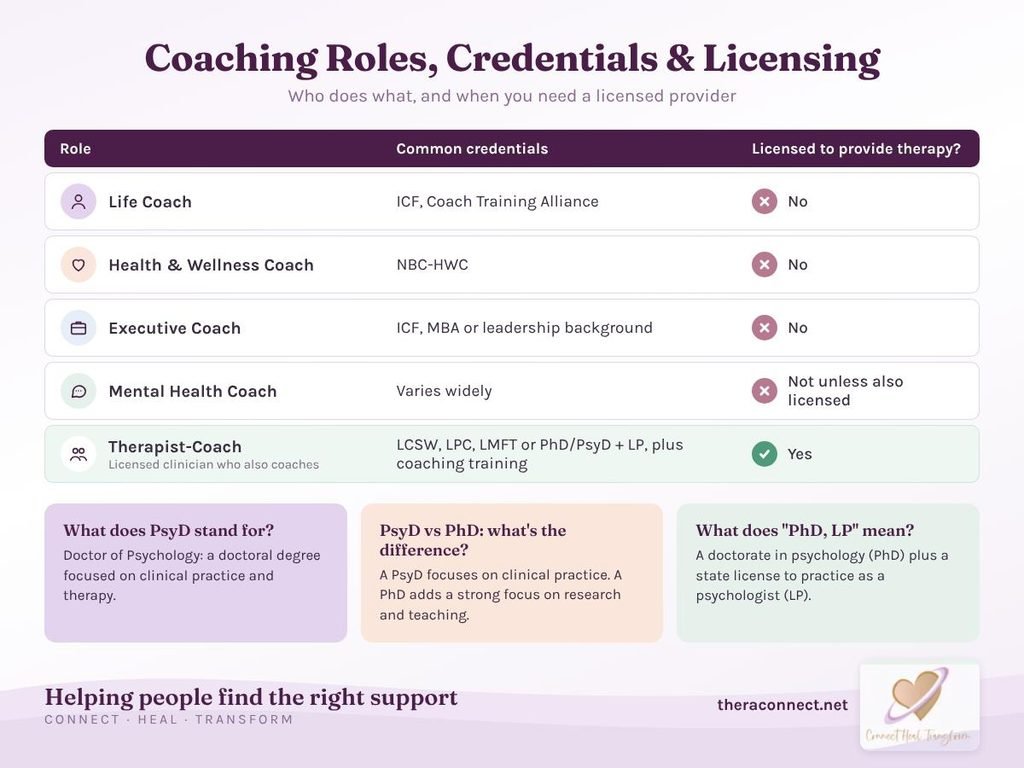
What does “PhD, LP” mean? The person has a doctorate in psychology and is licensed by the state to treat clients.
Good to know: In New York, “LP” stands for Licensed Psychoanalyst, a separate license. In Minnesota, some longtime LPs were licensed with a master’s degree under older rules. If you’re unsure, check the provider on your state licensing board’s website.
PhD vs PsyD vs EdD: The Doctoral Degrees in Psychology
Psychologists can earn one of three doctoral degrees. The PhD and PsyD are the standard routes to a psychology license, and they differ mainly in focus.
- PhD (Doctor of Philosophy): combines research with clinical training. Common for psychologists who teach, do research or want a mix of research and practice.
- PsyD (Doctor of Psychology): focuses on clinical practice rather than research. Most PsyD graduates become therapists or do psychological testing.
- EdD (Doctor of Education) with a psychology focus: combines psychology with education and leadership. Common in school psychology and counseling roles. In some states it can lead to licensure.
PhD or PsyD: which is better for clients? Neither. Both are licensed the same way and can provide the same therapy. What matters more is the provider’s experience with your concern and how comfortable you feel with them.
Psychology Licenses: LP, LCP and LLP
A doctorate doesn’t automatically make someone a psychologist who can see clients. The state license does. These are the license titles you’ll see most often:
- LP – Licensed Psychologist: full license to provide psychological services independently.
- LCP – Licensed Clinical Psychologist: the same idea; some states use this title to stress a clinical focus.
- LLP – Limited Licensed Psychologist: used in Michigan. A limited license for master’s-level psychologists who practice under supervision, or for doctoral graduates still finishing their supervised hours.
- LPA – Licensed Psychological Associate: used in states such as North Carolina and Texas for master’s-level providers who work under a licensed psychologist.
Titles vary by state. If a credential is unfamiliar, look the provider up on your state licensing board’s website.
For professionals: list your degree first, then your license, as in “Alex Johnson, PsyD, LP.” If you’re licensed in more than one state, keep each listing current. Listing credentials incorrectly, even by mistake, can raise ethical concerns with your licensing board.
LCSW vs LPC vs LMFT vs MD: Other Letters You’ll See
Most therapists in the US aren’t psychologists. They’re master’s-level licensed providers, and they’re fully qualified to provide therapy.
- MD (or DO) – Psychiatrist: a medical doctor who specializes in mental health. Psychiatrists can prescribe medication, and many focus on medication management rather than talk therapy.
- LCSW – Licensed Clinical Social Worker: a master’s in social work (MSW) plus supervised clinical hours. LCSWs provide therapy and often help clients connect with community resources.
- LPC or LMHC – Licensed Professional Counselor / Licensed Mental Health Counselor: a master’s in counseling. The title depends on the state.
- LMFT – Licensed Marriage and Family Therapist: a master’s focused on couples, families and relationships. LMFTs also see individuals.
Therapist Credentials at a Glance
| Credential | What it is | Typical education | Provides therapy | Prescribes medication |
|---|---|---|---|---|
| PhD / PsyD + LP | Licensed psychologist | Doctorate (5–7 years) | Yes | No (except in a few states with extra training) |
| MD / DO | Psychiatrist | Medical school + residency | Sometimes | Yes |
| LCSW | Clinical social worker | Master’s (MSW) | Yes | No |
| LPC / LMHC | Licensed counselor | Master’s in counseling | Yes | No |
| LMFT | Marriage and family therapist | Master’s in MFT | Yes | No |
| Coach (ICF, NBC-HWC) | Coach, not a clinician | Certification program | No (coaching, not therapy) | No |
Key point: you don’t need a provider with a doctorate to get great care. A licensed LCSW, LPC or LMFT is fully qualified to treat anxiety, depression, trauma and relationship concerns.
Coaches: What Their Credentials Mean
Coaches help with goals, motivation and life changes. Coaching isn’t therapy, and no license is required. But experienced coaches often hold respected certifications.
| Type of coach | Common credentials | Focus |
|---|---|---|
| Life or mindset coach | ICF certification (ACC, PCC, MCC), Coach Training Alliance | Goals, confidence, accountability |
| Health and wellness coach | NBC-HWC (National Board for Health & Wellness Coaching); training from programs like Duke Health & Well-Being | Stress, sleep, nutrition, exercise habits |
| Executive or business coach | ICF certification, MBA or leadership background | Leadership, performance, career growth |
| Mental health or wellness coach | Coach certification; sometimes a psychology or social work background | Support and skill-building, not treatment |
| Mindfulness or spiritual coach | Meditation or yoga teacher training | Mindfulness, meaning, inner calm |
ICF credential levels: ACC (Associate Certified Coach), PCC (Professional Certified Coach) and MCC (Master Certified Coach). CPCC (Certified Professional Co-Active Coach) comes from the Co-Active Training Institute.
What coaches can’t do (unless they’re also licensed clinicians):
- Diagnose or treat conditions like depression, anxiety or PTSD
- Bill health insurance
- Provide therapy
How to Check a Therapist’s License
- Find your state’s licensing board for that profession (psychology, social work, counseling or marriage and family therapy).
- Search the board’s online license lookup by the provider’s name.
- Check that the license is active and see whether any disciplinary actions are listed.
How to Choose the Right Provider
- Want help with goals, habits or motivation? An experienced coach may be a good fit.
- Dealing with anxiety, depression, trauma or relationship problems? Look for a licensed therapist: LCSW, LPC, LMFT or LP.
- Need psychological testing, such as for ADHD or learning differences? Look for a licensed psychologist (PhD or PsyD + LP).
- Think you may need medication? See a psychiatrist (MD or DO) or a psychiatric nurse practitioner.
Frequently Asked Questions
What does PhD, LP mean after a name? The person has a doctorate in psychology (PhD) and a state license to practice as a psychologist (LP).
Is a PsyD a real doctor? Yes. A PsyD is a doctoral degree, so the holder is “Dr.” But a PsyD is not a medical doctor and usually can’t prescribe medication.
Is an LCSW the same as a psychologist? No. An LCSW has a master’s degree in social work and is licensed to provide therapy. A psychologist has a doctorate and can also do psychological testing.
What’s the difference between an LPC and an LCSW? Both are master’s-level licensed therapists. LPCs train in counseling; LCSWs train in social work, which adds a focus on community resources and social support.
Can a therapist prescribe medication? Most can’t. Psychiatrists (MD or DO) and psychiatric nurse practitioners can. A few states let specially trained psychologists prescribe.
Is a life coach the same as a therapist? No. Coaches help with goals and growth. Only licensed providers can diagnose or treat mental health conditions.
The Bottom Line
The degree tells you how a provider was trained. The license tells you what they’re allowed to do. For anxiety, depression, trauma or relationship struggles, look for a licensed provider (LP, LCSW, LPC, LMFT or MD). For goals and personal growth, an experienced coach can be a great fit.
On TheraConnect, you can find both licensed therapists and experienced coaches nationwide, with every provider’s credentials listed on their profile.
[Find a provider on TheraConnect →] (link to the Find a Provider page)
Sources
- Minnesota Board of Psychology
- Minn. R. 7200.1300 – Educational requirements for licensure
- NYSED – Licensed Psychoanalyst checklist
Your Expertise Deserves to Be Found.
People are searching for support. Make it easier for them to discover you.
Leave a Reply